Set Up an SPV and Open a Bank Account in the United Kingdom
The United Kingdom is a leading jurisdiction for Special Purpose Vehicles (SPVs), particularly for investment holding, corporate acquisitions, financing, joint ventures and cross-border transactions.
Its corporate framework, straightforward incorporation process and financial-services sector make the UK a practical choice for international investors, private equity firms, corporate groups and transaction sponsors looking to establish an SPV.
Registering the company is the quick part, as Companies House usually processes an online application within 24 hours. The SPV will then also need a business account to receive capital, hold funds, make investment or acquisition payments, pay professional advisers and transact with counterparties, and for internationally owned SPVs, opening that account can be more challenging than incorporating the company itself.
This guide explains both sides of the process:
- How to establish an SPV in the United Kingdom
- The principal UK SPV structures
- UK share capital requirements
- Companies House incorporation and identity verification requirements
- Incorporation timelines and costs
- Tax and ongoing reporting requirements
- How to open a business account for a UK SPV
- Foreign ownership and non-resident directors
- What account providers assess during onboarding
- Documents required to open the account
- Multi-currency and international payment requirements
Requirement | United Kingdom |
|---|---|
Common SPV structures | Private limited company (Ltd), Limited Liability Partnership (LLP) and limited partnership (LP) |
Most common corporate structures | Private company limited by shares (Ltd) |
Minimum Ltd share capital | No fixed statutory minimum |
Minimum directors | One individual aged 16 or over. At least one director must be a natural person, not a company |
Minimum shareholders | One |
Registered office | Required in the UK, within the company's jurisdiction of registration. Must be a physical address, not a PO box |
Company secretary | Not required for a private limited company |
Typical formation time | Usually within 24 hours (online) |
Companies House incorporation fee | £100 online |
Beneficial ownership registration | Persons with Significant Control (PSC) information must be filed with Companies House |
Identity verification | Required for all directors and PSCs |
Corporation Tax | 19% small profits rate and 25% main rate, subject to eligibility |
Standard VAT rate | 20% |
Dividend withholding tax | None on dividends paid to overseas shareholders |
Business bank account | Not required before incorporation |
Non-resident ownership | Permitted for foreign shareholders and directors |
Multi-currency requirements | Available through specialist account providers, subject to eligibility |
Why Set Up an SPV in the United Kingdom?
The United Kingdom is one of the world's main centres for international business and investment, offering a globally recognised commercial legal framework, flexible company structures and straightforward incorporation. English commercial law is widely used in international transactions, while the UK's financial-services sector and professional expertise make it particularly attractive for corporate acquisitions, investment holding, financing and cross-border investment structures.
Straightforward Incorporation
A UK private limited company can normally be incorporated online through Companies House for £100, usually within 24 hours. No notary or pre-incorporation share-capital deposit is required.
Separate Legal Personality and Limited Liability
A UK limited company provides a distinct legal entity for holding investments, assets and liabilities, helping separate the financial obligations of an SPV from its shareholders and other group companies. Shareholder liability is generally limited to any unpaid amount on their shares.
Flexible SPV Structures
SPVs can be established using several legal forms, including private limited companies, LLPs and limited partnerships. A private limited company can have one shareholder, its directors do not need to reside in the UK, and there is no fixed minimum share capital, allowing companies to be incorporated with as little as £1 of issued share capital.
Specialist Investment and Securitisation Tax Frameworks
The UK has dedicated tax regimes for qualifying securitisation companies and certain investment-holding structures, including Qualifying Asset Holding Companies (QAHCs). These provide specific tax treatment for eligible investment and financing arrangements.
Extensive Double Tax Treaty Network
The UK has double taxation treaties with more than 100 countries, including major international investment markets such as the US, Germany, France, Singapore, Canada, Australia, India and Japan. These agreements can help reduce double taxation on cross-border investments, subject to the relevant treaty conditions.
Established Financial and Professional Services Ecosystem
The UK, particularly London, has a deep network of financial institutions, investment managers, law firms, accountants and corporate-services providers experienced in international acquisitions, financing and investment structures.
These advantages make the UK particularly relevant for corporate acquisitions, investment holding, private equity, structured finance and internationally owned SPVs.
What Types of SPV Can Be Established in the United Kingdom?
There is no SPV company type in UK law. An SPV is a commercial description for a company or partnership set up for one purpose, so several UK legal structures can be used. The most commonly considered are:
Private Company Limited by Shares — Ltd
A private limited company is one of the most commonly used structures for UK SPVs.
It is frequently used for corporate acquisitions, investment holding, property ownership and financing transactions.
The company has a separate legal personality, with shareholders generally protected from liabilities beyond any unpaid amount on their shares.
A Ltd can be established with one shareholder and one director, with no fixed minimum share capital.
For many straightforward investment, acquisition or holding SPVs, this is often the first structure considered.
Limited Liability Partnership — LLP
An LLP combines the operational flexibility of a partnership with limited liability protection for its members.
It requires at least two members, including two designated members responsible for statutory compliance. Members can be individuals or companies, and an LLP can be registered online for £100.
LLPs are often considered for joint ventures, investment arrangements and structures where participants require flexibility over management and profit sharing.
Unlike a typical limited company, an LLP is generally taxed as a partnership, with profits taxed at member level.
Limited Partnership — LP
A UK limited partnership requires at least one general partner and one limited partner.
The general partner manages the partnership and has unlimited liability for its obligations, while the limited partner's liability is generally restricted to its contribution. The limited partner cannot take part in managing the partnership without putting that protection at risk.
Limited partnerships are particularly relevant for private equity, investment funds and partnership-led investment structures.
The UK also offers a Private Fund Limited Partnership (PFLP) designation for qualifying private investment funds, providing additional flexibility in how these structures operate.
Which structure fits depends on what the SPV will do. Acquisition and holding SPVs are most often set up as a Ltd, while private fund structures are more likely to use a limited partnership with the PFLP designation, and an acquisition SPV, investment holding company, property SPV and private equity fund can each have very different legal, tax and operational requirements. Legal and tax advice should be taken before the entity is chosen.
How to Set Up an SPV in the United Kingdom
The exact formation process depends on the legal structure and intended transaction, but establishing a UK SPV as a private limited company generally involves seven steps.
Step 1 — Determine the purpose of the SPV
Before incorporation, the parties should clearly establish:
- What assets the SPV will own
- What transaction it will undertake
- Who will own the company
- How it will be funded
- Where the funding will originate
- Who its counterparties will be
- Which countries it will transact with
- Whether it will issue debt or securities
- What currencies it will need
- How cash will enter and leave the structure
This information is important for legal structuring and when opening the UK business account and completing KYC.
Step 2 — Select the legal structure
The parties determine whether the SPV should be incorporated as a private limited company, LLP, limited partnership or another appropriate UK structure.
For most straightforward acquisition, investment and holding SPVs, a private limited company is commonly considered.
Step 3 — Establish the ownership structure
The shareholders and Persons with Significant Control (PSCs) must be identified.
In the UK, individuals holding more than 25% of the shares or voting rights, or exercising certain other forms of significant control, must generally be disclosed to Companies House.
For international groups, the ownership structure might look like this:
Individual Investor
↓
International Holding Company
↓
UK SPV
↓
UK Investment or Acquisition
The commercial purpose of each ownership layer should be clearly established, particularly for internationally owned SPVs.
Step 4 — Appoint the directors and verify their identity
A UK private limited company requires at least one director aged 16 or over. Directors do not need to reside in the UK. At least one director must be an individual rather than a company.
Directors must complete Companies House identity verification and obtain a personal code for incorporation.
Persons with Significant Control are also subject to identity verification requirements.
Step 5 — Establish a UK registered office
A registered office must be established in the UK, within the company's jurisdiction of registration. It must be a physical address. A PO box cannot be used.
The address must meet Companies House requirements and can be provided by a corporate-services provider, accountant or solicitor.
A registered email address is also required.
Step 6 — Prepare the incorporation documents
The company must prepare its Memorandum and Articles of Association, establish its share capital and confirm its shareholders.
A UK private limited company does not require a notary or a share-capital blocking certificate before incorporation.
The company name, share structure and relevant business activity codes (SIC codes) must also be established.
Step 7 — Register with Companies House
Once the ownership, directors, identity verification and incorporation documentation are complete, the company can be registered with Companies House.
Online incorporation costs £100 and is usually completed within 24 hours. Paper applications cost £124 and take 8 to 10 days.
Following registration, Companies House issues a Certificate of Incorporation confirming the company's legal existence, registration number and incorporation date.
The company can then complete its HMRC tax arrangements and proceed with opening its operational business account.
The overall timeline will depend on the ownership structure, documentation, identity verification and any additional legal or regulatory requirements.
What Documents Are Usually Required to Establish a UK SPV?
Requirements vary depending on the legal structure and ownership arrangements, but establishing a UK SPV as a private limited company will generally require the following information and documentation:
- UK company name availability confirmation
- UK registered office address and registered email address
- Memorandum of Association
- Articles of Association, either standard model articles or bespoke provisions
- Proposed company activities and relevant Standard Industrial Classification (SIC) codes
- Shareholder identities, addresses and shareholdings
- Statement of Capital and Initial Shareholdings, including share classes and voting rights
- Director details, including residential and service addresses
- Companies House identity verification and personal codes for directors
- Persons with Significant Control (PSC) details and applicable identity verification
- Corporate registration details for overseas corporate shareholders, where required
- Supporting identification and ownership documentation where requested by professional advisers
- Statutory incorporation declarations, including lawful purpose and compliance with registration requirements
For online incorporation, Companies House automatically generates the Memorandum of Association, while the Articles of Association must follow the standard model articles. SPVs needing bespoke articles can incorporate through a formation agent or software, or by post.
Once registered, Companies House issues the Certificate of Incorporation and makes the company's statutory registration information available through its public register. More complex international ownership structures may require additional supporting documentation.
How Much Does It Cost to Establish an SPV in the United Kingdom?
The cost of establishing a UK SPV depends on its legal structure, ownership arrangements and the professional services required.
For a private limited company, Companies House charges the following statutory incorporation fees:
Incorporation method | Cost |
|---|---|
Online incorporation | £100 |
Paper incorporation | £124 |
Same-day incorporation (via software) | £156 |
These are the official Companies House registration fees.
However, establishing an SPV for an investment, acquisition or financing transaction can involve additional costs beyond company registration, including:
- Legal structuring: Preparing bespoke Articles of Association, shareholder agreements and transaction-specific documentation.
- Corporate-services provider: Incorporation support, registered office, company administration and secretarial services.
- Tax structuring: Advice on the SPV's ownership, investment activities, financing arrangements and applicable UK tax treatment.
- Investment and financing documentation: Preparing shareholder loans, funding agreements, investment documents and security arrangements where required.
- Directors and administration: Professional directors, accounting, ongoing administration and governance requirements.
- Banking: Establishing the SPV's business account and any specialist international payment or foreign exchange arrangements.
- Regulatory requirements: Additional legal, compliance or reporting work for regulated investment or securitisation structures.
A straightforward UK SPV can therefore be incorporated for £100 in statutory registration fees, while a sophisticated investment, acquisition or structured-finance vehicle can involve substantially higher legal, tax, financing and administration costs.
The total establishment budget should reflect the underlying transaction and the level of professional support required.
What Are the Tax Considerations for a UK SPV?
UK SPV taxation depends on the legal structure, activities and assets held by the vehicle.
For a UK corporate SPV, the key tax considerations include:
- Corporation Tax: The main rate is 25% on taxable profits above £250,000, while qualifying companies with profits of £50,000 or less pay 19%. For profits between £50,000 and £250,000, marginal relief gradually increases the effective tax rate towards 25%. These thresholds are reduced where associated companies exist. Companies are usually set up for Corporation Tax when they register with Companies House, and must notify HMRC within three months of starting business activity.
- Close investment-holding companies: UK companies controlled by a small group of shareholders and primarily holding passive investments, such as investment portfolios or cash deposits, can be subject to the 25% Corporation Tax rate regardless of profit levels. Holding companies of qualifying trading groups are generally excluded from this classification.
- Dividend income: Dividends received by a UK SPV from shares held in other UK or overseas companies are generally exempt from UK Corporation Tax. For example, an SPV receiving dividends from a trading subsidiary can usually retain those distributions without additional UK Corporation Tax on the dividend income itself.
- Substantial Shareholdings Exemption: A UK SPV selling shares in another trading company can qualify for an exemption from Corporation Tax on the resulting capital gain. Generally, the SPV must have held at least 10% of the company for a continuous 12-month period within the six years before the sale, with the underlying company meeting the relevant trading requirements.
- Dividend withholding tax: Ordinary dividends paid by UK companies to overseas shareholders generally have no UK withholding tax deducted. The overseas shareholder may still owe tax in their country of residence. By contrast, certain UK-source interest payments to overseas lenders and some royalty payments can attract withholding tax.
- Double-tax treaties: The UK has treaties with more than 100 countries that can reduce or eliminate withholding taxes on qualifying cross-border payments, including certain interest and royalties. For example, a treaty can reduce UK tax deducted from interest paid to an overseas lender, helping prevent the same income from being taxed twice.
- Specialist investment structures: The UK's Qualifying Asset Holding Company (QAHC) regime provides exemptions on certain investment gains for eligible fund and institutional investment structures, generally requiring at least 70% qualifying investor ownership. Separately, qualifying securitisation companies can be taxed on the profit retained from their financing arrangements rather than their full accounting profits.
- Property SPVs: An SPV buying residential property in England or Northern Ireland pays Stamp Duty Land Tax (SDLT) at the standard rates plus a 5% surcharge, or a flat 17% on purchases above £500,000 unless a relief applies. A further 2% surcharge applies on top of either where the buyer is non-UK resident, which can include some UK companies controlled by non-UK residents. Companies holding UK residential property worth more than £500,000 also pay the Annual Tax on Enveloped Dwellings (ATED) each year, from £4,600 for 2026 to 2027, unless a relief applies.
- Value Added Tax (VAT): The standard UK VAT rate is 20%, with compulsory registration generally applying above £90,000 in taxable turnover. However, many financial and investment transactions are VAT-exempt, meaning an SPV that simply holds investments or receives investment income may not have the same VAT obligations as a trading company.
Tax treatment should not be assumed from the SPV label. An acquisition SPV, investment-holding company, financing vehicle and securitisation structure can have very different tax outcomes, and for a UK SPV the main questions are whether it will be treated as a close investment-holding company, whether SSE or the QAHC regime applies, and whether it will hold residential property. Independent UK tax advice should be taken before the structure is set.
What Are the Ongoing Reporting Requirements?
UK SPVs have ongoing accounting, tax, corporate and beneficial-ownership reporting obligations.
For a UK private limited company used as an SPV, the key requirements include:
- Annual accounts: UK companies must file annual accounts with Companies House within nine months of their financial year-end. First accounts are generally due within 21 months of incorporation. Even dormant companies must file accounts.
- Confirmation statement: Every company must submit a confirmation statement to Companies House at least once every 12 months, within 14 days of the review period ending. The online filing fee is £50, even if no company details have changed.
- Corporation Tax returns: Companies required to file a Company Tax Return must submit it to HM Revenue & Customs (HMRC) within 12 months of the relevant accounting period ending, including where no tax is payable.
- Corporation Tax payments: Corporation Tax is generally payable nine months and one day after the accounting period ends. Companies with profits over £1.5 million pay in quarterly instalments.
- Beneficial ownership: Changes to Persons with Significant Control (PSCs), including ownership or control arrangements, must be reported to Companies House within 14 days of confirming the change. PSC details are public, including each PSC's name, nationality, country of residence and month and year of birth. Directors and PSCs must also satisfy applicable identity verification requirements.
- Corporate changes: Changes to directors or their details must generally be reported within 14 days. Changes to share capital, registered office addresses and constitutional documents also require Companies House notifications, with deadlines depending on the change.
- Audit requirements: Some UK SPVs qualify for audit exemption if they meet the relevant size and eligibility conditions. For financial years beginning on or after 6 April 2025, the small-company criteria include turnover of no more than £15 million, assets of no more than £7.5 million and no more than 50 employees, with at least two conditions normally required.
- VAT reporting: UK SPVs registered for VAT generally submit quarterly returns to HMRC, usually within one month and seven days after the reporting period. Investment and financial activities may have different VAT obligations.
- FATCA and CRS: UK investment entities classified as reporting financial institutions may need to report qualifying investor and financial-account information to HMRC annually, generally by 31 May.
- Securitisation reporting: UK securitisation vehicles falling within the applicable regulatory framework can have additional disclosure obligations, including reporting information about underlying assets and transactions under the Financial Conduct Authority's securitisation rules.
The exact reporting requirements depend on the SPV's legal structure, assets, ownership, activities and regulatory status.
These obligations should be considered when establishing and operating a UK SPV, particularly where the company forms part of a larger international investment or financing structure.
Opening a Business Account for a UK SPV
Once a UK SPV is registered, its business account becomes the next priority, and for many SPVs it is the slower part of the process.
Although a UK SPV can be incorporated through Companies House relatively quickly, opening its business account requires a separate assessment of the company's ownership, purpose and expected financial activity.
A typical operating company may have employees, customers, suppliers and recurring trading revenue.
A UK SPV might instead:
- Hold a single investment or acquisition
- Receive capital from shareholders or international investors
- Hold shares in another company
- Receive dividends or investment proceeds
- Make occasional large-value acquisition or financing payments
- Hold substantial funds for an extended period
- Receive funding from overseas holding companies
- Operate across several jurisdictions
None of these characteristics automatically makes a UK SPV unsuitable for a business account.
However, account providers must understand who ultimately owns the company, where its funding originates and how the account will be used.
For internationally owned UK SPVs, a clearly documented ownership structure and investment purpose can therefore be especially important during onboarding.
Can a UK SPV Open a Business Account?
Yes. A UK SPV can open a business account. Approval depends on the company's legal structure, ownership, purpose, source of funding and expected account activity.
For a UK SPV, account providers will typically assess:
- Legal structure: Whether the SPV is a private limited company, LLP, limited partnership or another UK structure.
- Corporate purpose: Why the UK SPV has been established and the underlying investment, acquisition or financing activity.
- Ownership and Ultimate Beneficial Owners (UBOs): The complete ownership structure, including foreign holding companies and the individuals who ultimately own or control the SPV.
- Companies House and PSC information: The company's UK registration details, directors and Persons with Significant Control.
- Source of funds: Where the capital entering the SPV originates, including shareholder contributions, investor funding or loans.
- Source of wealth: How the ultimate owners or investors accumulated the wealth supporting the investment.
- Underlying assets: The shares, investments, securities or other assets the SPV will acquire or hold.
- Expected account activity: Anticipated balances, transaction values, payment frequency and counterparties.
- Countries and currencies: The jurisdictions involved and the currencies the SPV needs to receive, hold or transfer.
- Supporting evidence: Investment agreements, acquisition documents, shareholder loans or other records supporting the proposed transactions.
A newly incorporated UK SPV does not need an established trading history simply to apply for a business account. Instead, account providers will focus on the company's ownership, source of funding, commercial purpose and evidence supporting its expected activities.
The clearer and better documented the UK SPV's ownership and intended transactions are, the easier it is for the account provider to assess its eligibility and compliance requirements.
Working with a specialist business-account provider experienced in international SPVs can also help identify suitable account solutions and make the onboarding process more manageable.
Can a Foreign-Owned UK SPV Open an Account?
Yes. A foreign-owned UK SPV can open a business account, subject to the account provider's eligibility and compliance requirements.
UK private limited companies can be owned by overseas individuals, international holding companies or other foreign corporate shareholders.
A financial institution will normally look beyond the UK company itself and assess the complete international ownership structure.
For example:
US Private Equity Investor
↓
US Holding Company
↓
UK SPV
↓
UK Business Acquisition
The account provider will assess:
- Why the UK SPV has been established for the acquisition
- Who ultimately owns and controls the US holding company
- Whether the ownership structure is consistent with Companies House and PSC disclosures
- Where the acquisition funding originates
- How investment capital will be transferred from the US to the UK
- Whether the acquisition is supported by purchase agreements and financing documentation
- What currencies the SPV will receive and hold
- Which parties will receive acquisition payments and future distributions
Foreign ownership does not automatically prevent a UK SPV from opening a business account. A clearly documented ownership structure, legitimate investment purpose and transparent funding arrangements will help the account provider assess the application.
Can an SPV With Non-Resident Directors Open an Account?
Yes. A UK SPV with non-resident directors can open a business account, subject to the account provider's eligibility and compliance requirements.
UK company law does not require directors of a private limited company to live in the United Kingdom. A company can therefore be incorporated and managed by overseas directors, provided it maintains a registered office in the UK and meets Companies House requirements.
Non-resident directors must complete the applicable Companies House identity verification requirements. Account providers will separately assess their identities, countries of residence, the SPV's ownership, source of funds and expected transactions.
For internationally managed UK SPVs, working with a specialist account provider that supports non-resident directors can make the account-opening process simpler and more manageable.
What Will a UK Account Provider Want to Understand?
UK account providers carry out customer due diligence under the Money Laundering Regulations 2017. For an SPV, that review comes down to four questions:
1. Who owns and controls the UK SPV?
The provider will verify the shareholders, Ultimate Beneficial Owners (UBOs) and complete ownership chain, including any overseas holding companies. It will also review Companies House registration details and Persons with Significant Control (PSC) disclosures.
2. Why was the UK SPV established?
The commercial purpose must be clear, whether the SPV is being used to acquire a UK business, hold investments, raise financing or undertake a structured-finance transaction. Relevant investment or acquisition agreements can help demonstrate the purpose.
3. Where will the investment capital come from?
The provider will establish the source of funds and source of wealth, including shareholder contributions, international investor capital, acquisition financing or shareholder loans. Supporting evidence should explain how the funds were generated and their intended use.
4. How will the UK business account operate?
The provider will assess the expected balances, countries, counterparties, currencies, payment frequency and flow of funds, including where money will be received from and where it will ultimately be transferred. For example, a UK acquisition SPV receiving USD investment capital and making a large GBP acquisition payment has different requirements from an SPV receiving regular investment distributions.
A well-prepared UK SPV application explains these four areas clearly, supported by Companies House records, ownership information and relevant transaction documentation.
What Documents May Be Required to Open a UK SPV Business Account?
Depending on the account provider, legal structure and intended transactions, documents may include:
- UK Certificate of Incorporation
- Memorandum and Articles of Association
- Companies House company registration number and company profile
- Shareholder register
- Corporate ownership chart
- Director details and authorised account signatories
- Persons with Significant Control (PSC) and Ultimate Beneficial Owner (UBO) details
- Passport copies and proof of residential address
- UK registered office address
- Corporate registration documents for overseas shareholders
- Source of funds evidence
- Source of wealth evidence
- Investment or acquisition agreements
- Shareholder loan and financing agreements
- Underlying investment or asset documentation
- Investor or shareholder funding documentation
- SPV business plan or transaction overview
- Expected account balances, currencies and transaction volumes
- Anticipated flow of funds, including countries and counterparties
For newly incorporated UK SPVs, account providers will generally place greater emphasis on the company's proposed investment activities, ownership structure and funding arrangements than on historical trading activity.
Where the SPV is being established for a specific acquisition or investment, providing the relevant transaction agreements and a clear explanation of how funds will enter and leave the account can help the provider assess the application from the outset.
More complex international ownership and financing structures may require additional documentation.
Can a UK SPV Hold Multiple Currencies?
Yes. A UK SPV can hold multiple currencies, depending on the capabilities of its chosen account provider.
A UK SPV involved in international investment, acquisitions or financing may need to receive and hold currencies other than British pounds.
For example, a UK acquisition SPV may receive investment capital in USD from American shareholders, convert funds into GBP to acquire a UK company, and subsequently receive distributions in EUR from European investments.
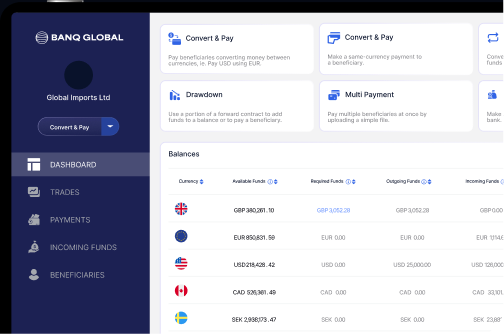
Depending on eligibility and the financial partner, specialist account providers such as Banq Global can support UK SPVs requiring access to GBP, EUR, USD and other currencies through multi-currency accounts and international payment networks. For UK SPVs, this includes a UK sort code, account number and GBP IBAN in the company's name.
This can reduce the need to maintain multiple separate accounts simply to manage investments, funding and transactions across different currencies.
Can a UK SPV Make International Payments?
Yes. A UK SPV can make domestic and international payments, subject to the capabilities of the selected account provider and applicable compliance requirements.
Common requirements may include:
- Faster Payments for domestic GBP transfers
- CHAPS for high-value, time-sensitive GBP payments
- SWIFT international payments
- SEPA payments for EUR transactions, where supported
- GBP, USD and EUR receipts
- Foreign exchange
- International investor funding
- Shareholder loan and financing payments
- Acquisition and investment payments
- Dividends and investment distributions
- Professional fees and counterparty payments
The UK has established domestic payment systems, including Faster Payments for near-instant GBP transfers and CHAPS for high-value sterling settlements.
The important consideration is that the SPV's expected payment activity should be clearly disclosed during onboarding.
For example, a UK acquisition SPV receiving £5 million from overseas investors and making one substantial acquisition payment presents a very different account profile from an investment SPV making hundreds of international distributions each month.
The account provider needs to understand the expected transaction values, counterparties, currencies and flow of funds before the account becomes operational.
Should You Arrange the Business Account Before or After Incorporating the SPV?
For a UK private limited company, the business account is generally opened after incorporation, although planning should begin earlier.
UK company law does not require share capital to be deposited into a bank account or a capital-blocking certificate to be obtained before incorporation.
Once the SPV has been registered with Companies House, it receives a Certificate of Incorporation and company registration number, which account providers will normally require when opening the business account.
However, for investment, acquisition and financing SPVs, arranging banking should not be left until the transaction is ready to complete.
For example, a UK SPV established to acquire a £5 million investment may need to receive substantial international funding and subsequently make a large acquisition payment. The account provider must be able to support the expected balances, currencies, counterparties and payment arrangements.
It is therefore advisable to establish the SPV's banking requirements during the incorporation process, allowing the ownership structure, source of funds and expected transactions to be assessed as early as possible.
For UK SPVs, early banking preparation can help avoid unnecessary delays between incorporation, receiving investment capital and completing the intended transaction.
How Banq Global Supports UK SPVs
Banq Global is a specialist provider of business account solutions for UK companies and SPVs, including internationally owned and more complex corporate structures.
We provide an account solution covering the banking requirements of a UK SPV, from opening a dedicated GBP business account with a UK sort code and account number through to multi-currency accounts, international payments and foreign exchange.
This includes:
- UK business accounts in the company's name
- Dedicated GBP sort codes and account numbers
- GBP IBAN
- Business accounts for UK SPVs
- Support for non-resident directors and international UBOs
- Support for complex international ownership structures
- GBP and multi-currency accounts
- Faster Payments, SEPA and SWIFT payments
- Foreign exchange
- International incoming and outgoing payments
- Investment funding, acquisition payments and distributions
- Additional account and payment requirements
Our Process
1. Tell Us About Your SPV
Tell us about your UK SPV, ownership and what you need.
2. We Assess Your Requirements
We review your structure, account requirements, currencies and expected payment activity.
3. We Provide Your Account Solution
We arrange a suitable business-account solution for your UK SPV, including the relevant local account details, multi-currency capabilities, international payments and foreign exchange, subject to eligibility and approval.
We bring together the business-account, payment and currency requirements of your UK SPV through one straightforward solution, even where the requirement is complex, international or time-sensitive.
Is the United Kingdom the Right Jurisdiction for Your SPV?
The United Kingdom can be a strong choice for international investors establishing acquisition vehicles, holding companies, investment structures and financing SPVs, particularly where the transaction involves UK assets, international investor funding or GBP payments.
However, the benefits of establishing a UK SPV should be weighed against public ownership disclosure requirements, ongoing Companies House and HMRC reporting obligations, and the applicable Corporation Tax treatment.
Ultimately, the right jurisdiction depends on the SPV's investment purpose, ownership structure, underlying assets, regulatory obligations and banking requirements.
Frequently Asked Questions
1. What is an SPV in the UK?
A UK Special Purpose Vehicle (SPV) is a company established for a defined transaction or activity, such as acquiring a business, holding an investment, financing an asset or operating a joint venture.
It is not a separate legal entity category. Most straightforward UK corporate SPVs use a private company limited by shares.
2. Is an SPV just a limited company?
Usually, yes. A UK SPV is often an ordinary private limited company used for a particular investment or transaction.
Its separate legal personality helps distinguish its assets and liabilities from those of shareholders. Limited Liability Partnerships (LLPs) and limited partnerships can also be used for certain investment structures.
3. How do I set up an SPV in the UK?
For a typical UK private limited company SPV:
- Define the transaction and ownership structure.
- Appoint at least one director and establish a UK registered office.
- Verify directors' identities and provide PSC information.
- Submit the incorporation details to Companies House.
Online registration costs £100 and is usually completed within 24 hours.
4. How much does it cost to set up an SPV in the UK?
Companies House charges £100 for online incorporation, £124 for paper applications and £156 for same-day registration through software.
These are statutory registration fees, not the complete cost of a transaction-ready SPV. Legal structuring, investment documentation, tax advice, corporate administration and specialist banking can add substantially to the overall establishment budget.
5. Can a non-resident or foreign-owned company set up a UK SPV?
Yes. Overseas individuals and companies can own shares in a UK SPV, and directors do not need to live in the UK. At least one director must be an individual rather than a company.
A UK registered office is required. Persons with Significant Control (PSCs), including those controlling more than 25% of shares or votes, must be disclosed to Companies House and meet applicable identity-verification requirements. Their name, nationality, country of residence and month and year of birth appear on the public register.
6. How long does it take to set up an SPV in the UK?
A straightforward private limited company is usually registered online by Companies House within 24 hours once its application is submitted.
Preparing bespoke legal documents, verifying identities or documenting a complex ownership chain can take longer. Incorporation and subsequent business-account approval are separate processes, so transaction planning should account for both.
7. Can a UK SPV open a business account?
Yes. UK SPVs can apply for business accounts, including newly incorporated companies without a trading history.
Approval depends on the provider's eligibility and compliance assessment, particularly the SPV's ownership, purpose, source of funds, underlying investments and expected payment flows. The Companies House registration itself does not guarantee account approval.
8. What documents are needed to open a UK SPV business account?
Account providers may request:
- Certificate of Incorporation, Articles of Association and Companies House details.
- Shareholder, director, PSC and beneficial-ownership information.
- Identity and address evidence for relevant individuals.
- Source-of-funds and source-of-wealth evidence.
- Investment, acquisition or loan agreements, plus expected account flows.
Requirements vary with the transaction and ownership complexity.
9. Is Banq Global a bank, and are funds protected?
No. Banq Global is a specialist business-account provider, not a bank.
Its business-account services are delivered through FCA-regulated financial partners that safeguard relevant customer funds.
Safeguarding differs from UK bank deposit protection: money held with an electronic-money institution is not protected by the Financial Services Compensation Scheme (FSCS) if that institution fails.
10. What ongoing compliance does a UK SPV have?
A UK private limited company SPV generally has these obligations:
- File annual accounts with Companies House, normally within nine months of year-end.
- Submit a confirmation statement every 12 months.
- File Company Tax Returns when required, generally within 12 months of the accounting period.
- Pay Corporation Tax when due and keep PSC information current.