
Open A Business Account in South Africa
For international companies trading with South Africa that need control over payments, FX, and trapped funds
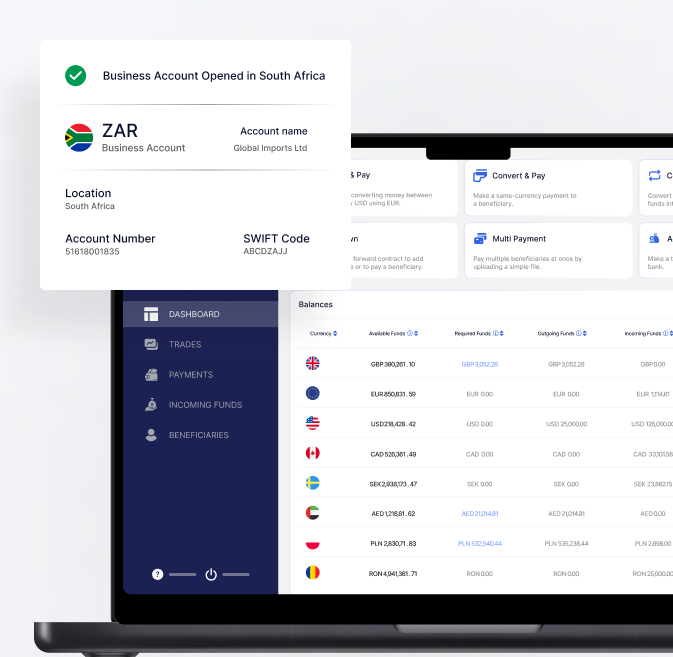
Overview
If your company trades with South Africa but lacks appropriate local banking and regulatory infrastructure, you are likely experiencing delays, restrictions, and unnecessary risk.
Many international companies operating in South Africa face the same issues:
Challenge 1: Trapped funds
Funds often accumulate in South Africa due to FX limits, approval delays, or lack of access to USD. Delays are often caused by exchange control approvals, incomplete KYC files, or the account being classified as non-resident under SARB rules.
Challenge 2: Currency devaluation risk
Holding ZAR balances exposes companies to depreciation, especially during periods of volatility, causing potential losses while funds remain trapped and inactive.
Challenge 3: Outbound payment limits
Many companies face caps on how much can be sent offshore, creating cash flow issues, uncertainty, and time spent managing workarounds.
Challenge 4: Operational delays
Without a South African account, even simple settlements can take weeks, often resulting in delays, strained relationships with suppliers and customers, and operational disruption.
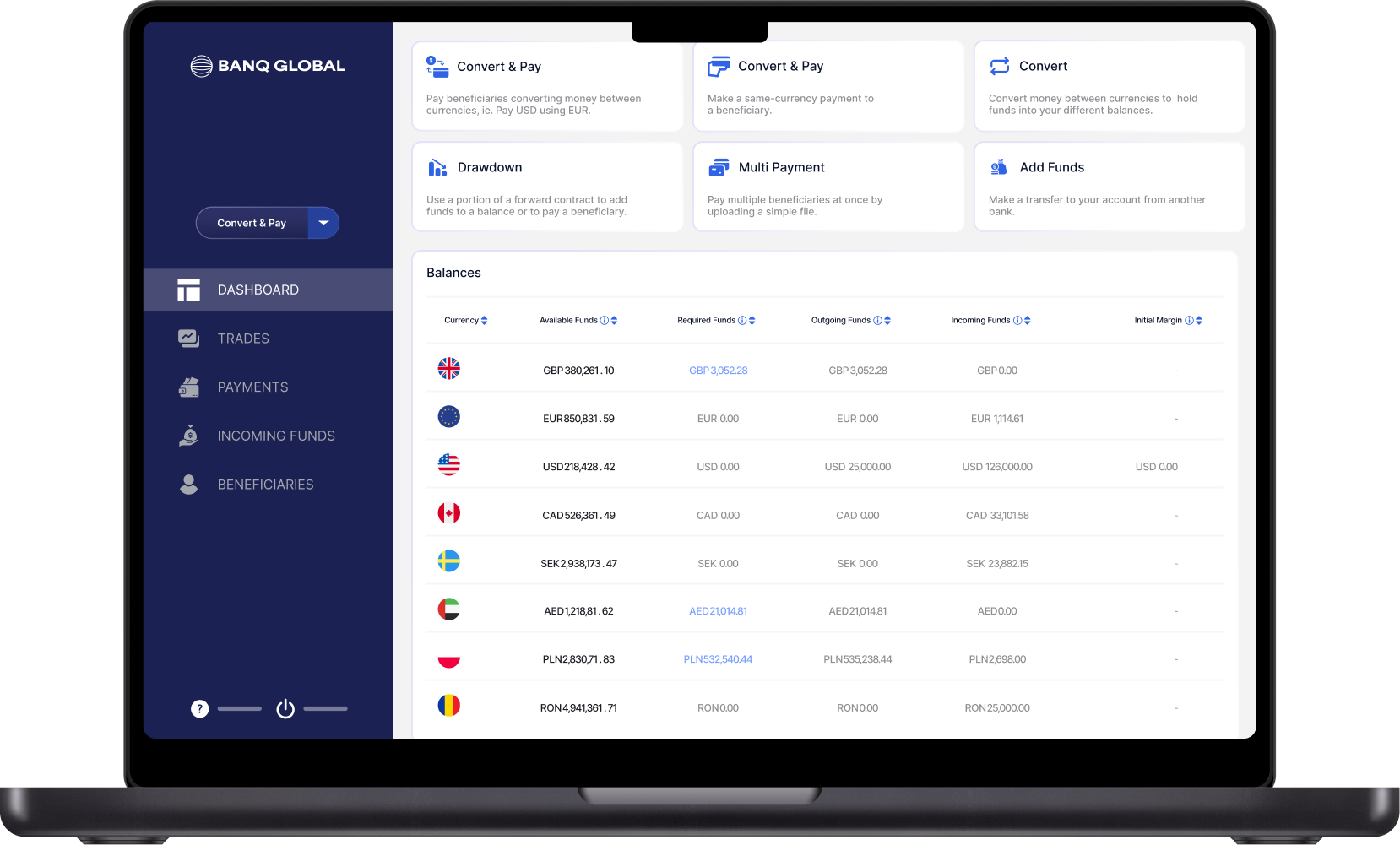
Who this solution is designed for
It is designed for established, mid-sized to large international companies with customers or suppliers in South Africa that generate large Rand inflows (typically $500k+ equivalent per month) and face challenges repatriating funds. It is built for businesses seeking a secure, compliant, and cost-effective way to convert currency in South Africa and move funds internationally.
International operating companies
Holding companies and group structures
Investment funds and asset managers
Family offices
Multinational trading and services businesses
Corporates with South African subsidiaries or counterparties
This is not a retail or SME banking product.
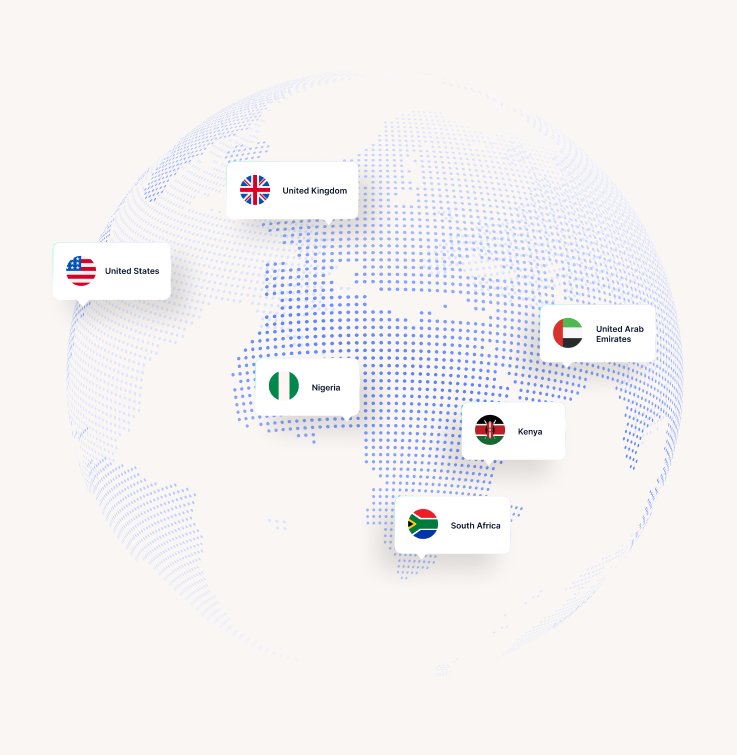
Next steps
Submit initial company details
Compliance and structure review
South African business account opened
FX access and global payments enabled
FAQs
Can non-residents open a business account in South Africa?
Yes. Non-residents and foreign companies can open a South African business bank account, but the account must be structured correctly under South African exchange control regulations.
Traditional banks often impose additional requirements on non-resident applications, which is where many applications stall or are rejected.
Do I need to be a South African resident or have a local director?
No. A South African resident director is not required when opening an account with Banq Global.
What matters most is the business structure, source of funds, and compliance documentation - not residency.
Why do traditional banks reject non-resident applications?
Rejections usually occur due to:
- Incomplete or outdated company registration documents.
- Unclear source of funds.
- Documents not properly certified or legalised.
- Misclassification of the account as resident or non-resident.
Many banks also require in-branch visits and full FICA files, which creates delays for foreign nationals.
What documents are required to open a business bank account in South Africa?
Documents include:
- Certified company registration documents
- Director passports and proof of address
- Business structure and ownership details
- Source of funds explanation
- Recent bank statements
Requirements vary depending on where the company is registered and how funds will move.
Are non-resident accounts subject to exchange control rules?
Non-resident business bank accounts fall under South African Reserve Bank exchange control regulations. With traditional South African banks, this affects how funds are received, converted, and repatriated offshore.
With a Banq Global business account, international companies can easily receive, exchange and move funds.
Can I convert ZAR to USD or EUR and move funds offshore?
Yes. With the Banq Global, ZAR can be converted into foreign currency and repatriated without unnecessary delays or informal workarounds. This allows for improved business operations and liquidity.
Is this suitable for SMEs or sole proprietors?
No. This solution is designed for established businesses with meaningful transaction volumes.
It is not a retail banking product and is not suitable for sole proprietors or startups.
How can I receive payments in South African Rand (ZAR)?
Banq Global enables your business to receive payments locally in South African Rand through a regulated South African account. This allows customers, partners, and counterparties to pay you in ZAR without using offshore or intermediary arrangements.
How can I access trapped funds in South Africa?
Trapped funds usually arise when Rand balances cannot be converted or moved offshore. Banq Global structures accounts and transaction flows to allow compliant access to South African funds, enabling conversion and repatriation instead of leaving money stuck locally.
How can I pay South African payroll from outside the country?
Business accounts can be used to pay South African payroll in Rand, allowing international businesses to settle local salaries while keeping overall cash management centralised.
How can I pay South African taxes as a foreign company?
Banq Global supports local ZAR payments, enabling foreign-owned businesses to pay South African taxes and statutory obligations directly from their South African account.
How can I protect my business from South African Rand (ZAR) currency fluctuations?
The South African Rand is one of the more volatile emerging-market currencies, which can materially impact businesses holding large ZAR balances.
Banq Global helps businesses reduce exposure by enabling timely conversion of ZAR into major currencies and structured repatriation, rather than leaving funds idle and exposed to depreciation.