
Open A Business Account In Nigeria
For international companies trading with Nigeria that need control over payments, FX, and trapped funds
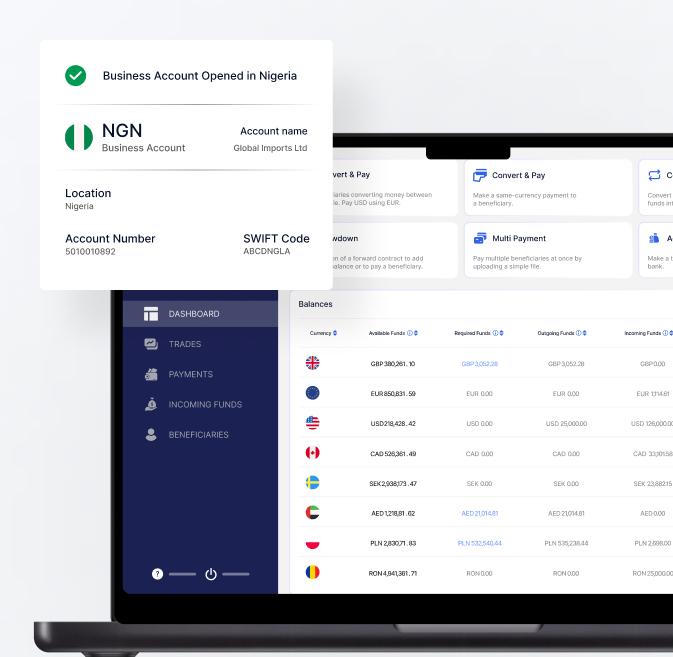
Overview
If your company trades with Nigeria but lacks appropriate local banking and regulatory infrastructure, you are likely experiencing delays, restrictions, and unnecessary risk.
The Nigerian banking industry has a unique regulatory environment which can present challenges for foreign businesses seeking to establish accounts and operate locally.
Many international companies operating in Nigeria face the same issues:
Challenge 1: Trapped funds
Funds often accumulate in Nigeria due to FX limits, approval delays, or lack of access to USD.This results in capital being stuck, reduced cash flow visibility, and limited ability to deploy funds elsewhere.
Challenge 2: Currency devaluation risk
Holding NGN balances exposes companies to depreciation, causing potential losses while funds remain trapped and inactive.
Challenge 3: Outbound payment limits
Many companies face caps on how much can be sent offshore, creating cash flow issues, uncertainty, and time spent managing workarounds.
Challenge 4: Operational delays
Without a Nigerian account, even simple settlements can take weeks, often resulting in delays, strained relationships with suppliers and customers, and operational disruption.
Who this solution is designed for
It is designed for established, mid-sized to large international companies with customers or suppliers in Nigeria that generate large Naira inflows (typically $500k+ per month) and face challenges repatriating funds. It is built for businesses seeking a secure, compliant, and cost-effective way to convert currency in Nigeria and move funds internationally.
International operating companies
Holding companies and group structures
Investment funds and asset managers
Family offices
Multinational trading and services businesses
Corporates with Nigerian subsidiaries or counterparties
This is not a retail or SME banking product.

Next steps
Submit initial company details
Compliance and structure review
Nigerian business account opened
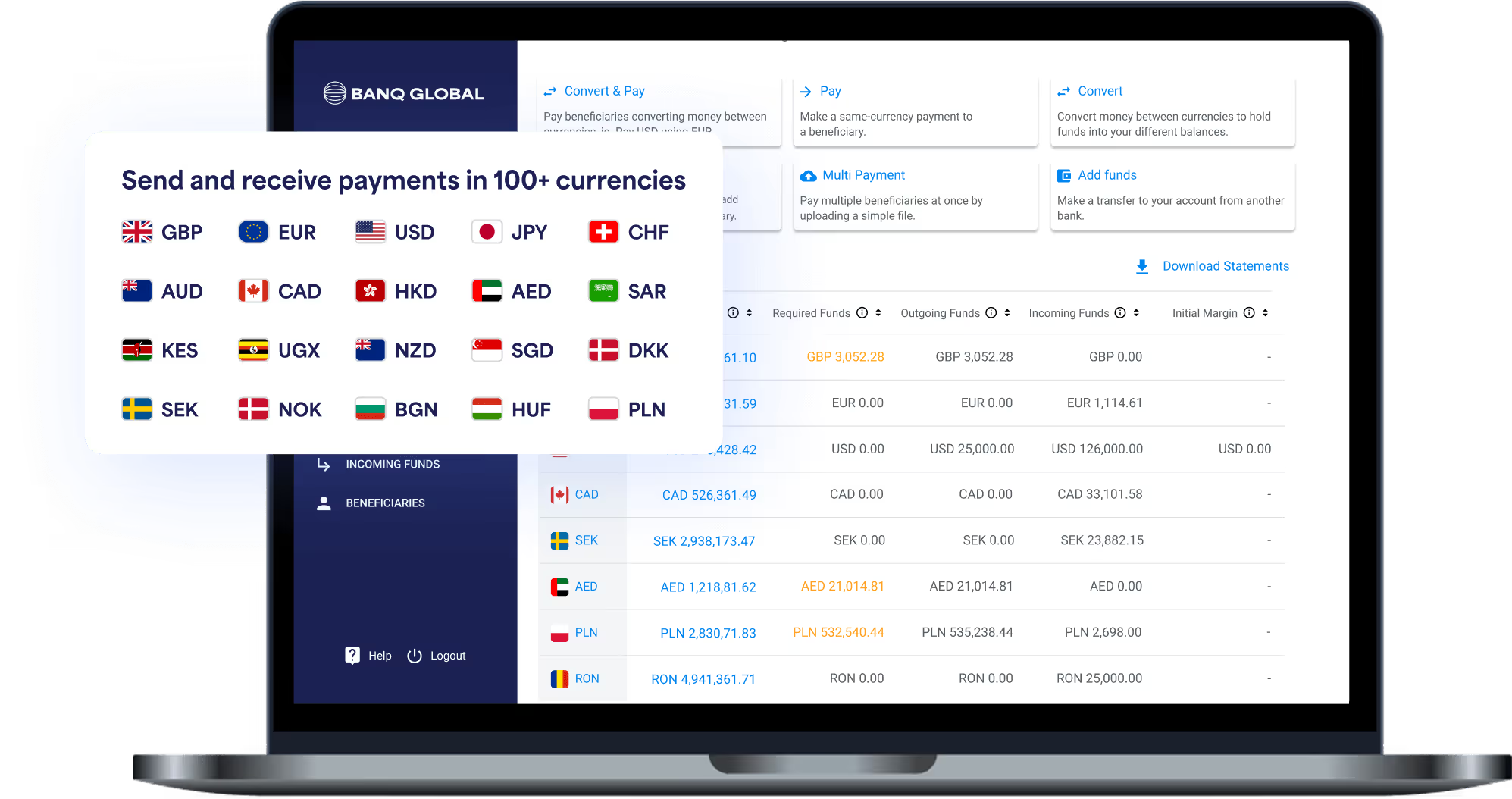
FX access and global payments enabled
FAQs
Can foreigners open a Nigerian business account?
Yes. Foreign-owned companies and non-resident directors can open a Nigerian business account, provided the correct corporate and compliance documentation is supplied. This includes foreign address details and supporting identity documents for all directors and shareholders.
Do you support diaspora banking services for Nigeria?
Yes. We support diaspora banking services, including assistance to open diaspora accounts and diaspora domiciliary accounts for businesses with ownership or management outside Nigeria. This structure is commonly used by international founders operating Nigerian entities remotely.
What is a diaspora domiciliary account?
A diaspora domiciliary account is a foreign currency account held in Nigeria. It allows businesses to receive, hold, and transact in foreign currency rather than naira. This is commonly used for international trade, dividend payments, and cross-border transfers.
What currencies can the account hold?
Accounts can be structured as domestic naira accounts or foreign currency accounts. Domiciliary accounts typically support major foreign currencies and are used alongside transactional accounts to separate local operations from international flows.
Is online account opening available?
Yes. The account opening process is handled remotely. Online account opening is supported, with documentation submitted digitally as part of the banking application request and onboarding process.
What documents are required to open a Nigerian business account?
The following documents are typically required:
- Certificate of incorporation and company documents
- Passport copies for directors and shareholders
- Proof of foreign address, such as a utility bill or foreign bank statement
- Completed reference forms and indemnity form
- Confirmation of the minimum opening balance
Additional documents may be requested depending on the account structure and regulatory requirements.
Can the account handle domestic and foreign transfers?
Yes. Accounts support both domestic and foreign transfers, including local payments within Nigeria and international transfers to and from other banks. Businesses can maintain transactional accounts for day-to-day operations and settlements.
Will the business receive an account number and online access?
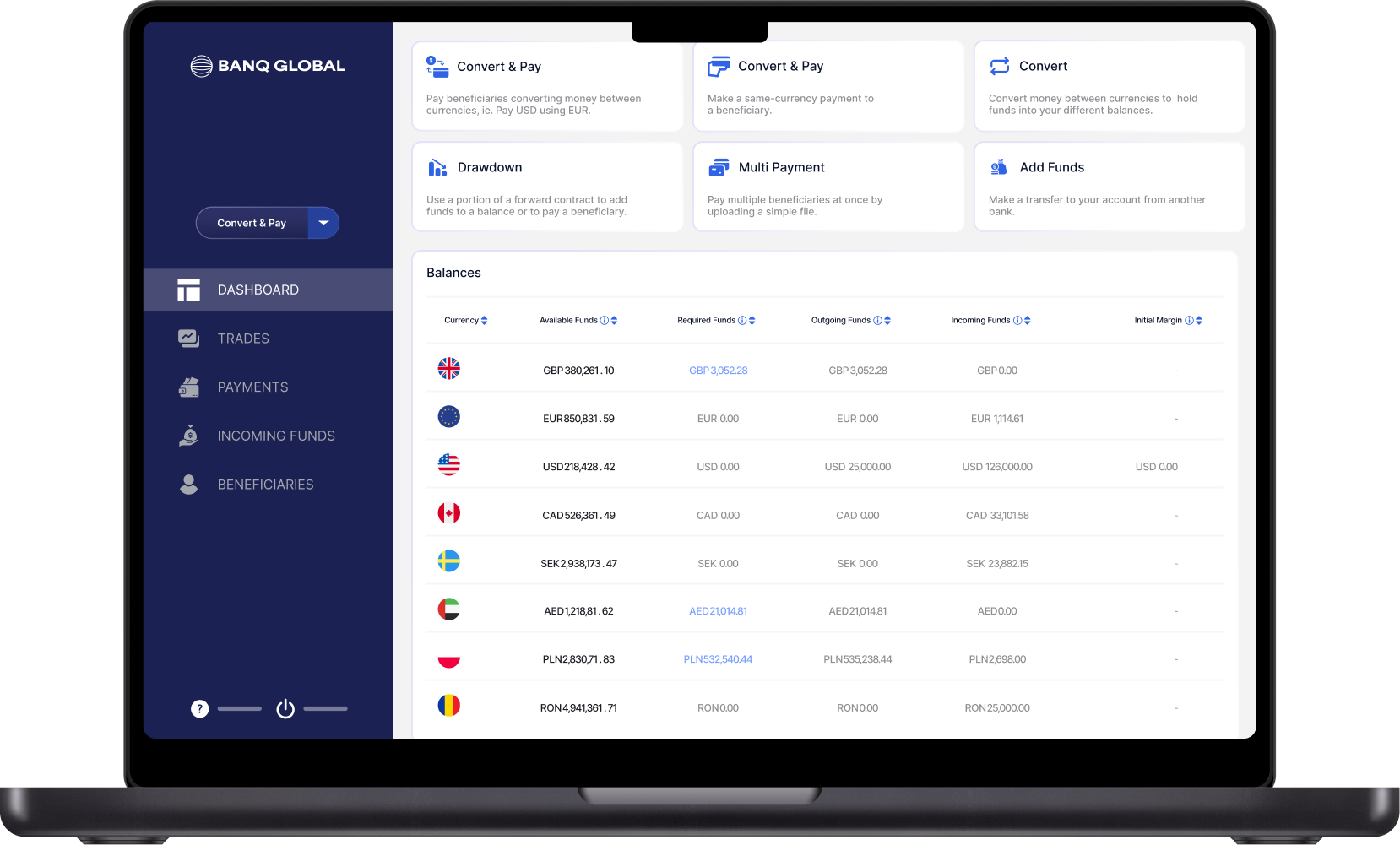
Yes. Once approved, the business is issued with a local account number and secure online access to their account, allowing account holders to manage payments, view statements, and operate the account remotely.
How long does it take to open a Nigerian business account?
Timelines vary depending on the ownership structure and documentation provided. Most compliant applications progress within a few days, subject to regulatory approvals.
Are fees and minimum balances involved?
Yes. Nigerian business accounts require a minimum opening balance, and standard banking fees apply. These vary based on whether the account is a naira account, foreign currency account, or domiciliary structure.
Can I open a Nigerian business bank account myself?
Technically, yes. It is possible to open a Nigerian business bank account independently. However, this typically requires a local presence or agent, a detailed understanding of Nigerian banking regulations, and direct coordination with local banks.
Businesses that open accounts independently often face limitations such as reduced international transfer capability, difficulty accessing foreign currency, slower onboarding, and a higher risk of funds becoming trapped due to account structure or compliance gaps. A globally structured account setup helps mitigate these risks by aligning the account with international banking standards and cross-border transaction requirements from the outset.
How do I get money out of Nigeria as a foreign business?
Foreign businesses can move money out of Nigeria where permitted by regulation, but this often depends on how the bank account is structured. Using a Nigerian business account with foreign currency or domiciliary capability helps separate local naira activity from international funds and supports compliant outbound transfers.
The ability to move funds typically requires clear transaction history, supporting documentation, and an account designed for both domestic and foreign transfers rather than local-only use.
Why do funds get trapped in Nigerian bank accounts?
Funds commonly become trapped when accounts are limited to domestic naira transactions or lack access to foreign currency settlement. In many cases, the issue is not the source of funds, but the account structure, FX access, or transfer routing.
Accounts that include foreign currency or domiciliary features are better suited for businesses with international revenue or cross-border obligations.
Can a Nigerian business account be used to repatriate profits?
Yes, in many cases. A Nigerian business account with foreign currency capability can be used to repatriate profits where regulatory conditions are met. This typically involves maintaining compliant transactional accounts, documenting income sources, and using approved domestic and foreign transfer routes.
Profit repatriation is subject to local regulations and bank review, but the correct account setup significantly reduces operational friction.
Is a domiciliary account required to move money out of Nigeria?
A domiciliary account is not always mandatory, but it is commonly used by foreign-owned businesses to hold and transfer foreign currency. Domiciliary accounts are often preferred for cross-border payments, dividend settlements, and international transfers compared to standard naira-only accounts.
How can I manage FX risk when dealing with Nigerian Naira (NGN)?
Currency risk in Nigeria is often driven by FX availability, rate discrepancies, and timing constraints. Banq Global helps businesses manage this by structuring accounts to support controlled conversion and offshore repatriation, reducing exposure to sudden Naira movements.
Can Banq Global help mitigate currency volatility and FX access risk in Nigeria?
Yes. Banq Global helps businesses manage both currency volatility and FX access risk in Nigeria through structured foreign exchange risk management solutions. This can include access to forward contracts and other hedging instruments, alongside frameworks that support timely FX conversion and offshore settlement.
In a market where FX availability, timing, and rate certainty can vary, this allows businesses to reduce exposure to sudden Naira movements, avoid prolonged uncertainty around access to foreign currency, and maintain greater predictability over cash flows and value preservation.