How to Open a Business Account in the UK as a Non-Resident?
Under UK corporate and financial law, there is no statutory prohibition against non-residents owning UK companies or holding UK business bank accounts. Unlike countries such as Australia or Singapore, the UK does not require the appointment of a resident director, and there are no legal restrictions on transferring capital or profits from a UK business account to overseas destinations. While the UK maintains an open framework for foreign business ownership, access to banking is determined by banks and financial institutions rather than company law, making approval for a UK business account for non-residents the key challenge for international operators, finance professionals, and corporate service providers managing UK entities.
Why Is Opening a UK Business Account Difficult for Non-Residents?
Banks and financial institutions must comply with strict KYC verification and AML compliance requirements, which means they conduct detailed checks on company ownership, business activities, and the source of company funds. Applications involving overseas owners, multinational groups, holding companies, or complex ownership structures frequently undergo enhanced due diligence. Providers may also assess whether the business has a genuine operational connection to the UK. As a result, where information is incomplete or the risk profile is considered higher, onboarding can take longer, and approval may be more difficult to obtain.
Why Do Non-Residents Need to Open a Business Account in the UK?
Operating solely from an overseas account often brings higher international money transfer costs and compliance or processing friction with bodies like HMRC. By contrast, a UK business account for non-residents can make operating a UK company more efficient.
For Day-to-Day Operations
A UK business account provides access to UK domestic payment rails, including faster payments, BACS payments, and CHAPS transfers. A GBP business account enables businesses to receive and hold GBP payments without repeated foreign exchange conversions and allows UK suppliers, contractors, and employees to be paid on local terms.
For Credibility and Compliance
Many UK clients, suppliers, and service providers expect businesses to have a UK sort code and account number. A local account also simplifies payments to HMRC, including corporation tax, VAT, and PAYE obligations, and is often required for integrations with UK marketplaces, payment gateways, and business platforms.
For International Structures
For holding companies, multinational groups, and foreign-owned UK companies, a dedicated UK account can support cleaner treasury management by separating UK transactions from overseas operations. Many providers also offer multi-currency accounts with SEPA and SWIFT payment capabilities, allowing businesses to hold different currencies and reduce FX fees compared with routing all transactions through an overseas account.
What Documents are Required to Open a UK Business Account as a Non-Resident?
To open a UK business account as a non-resident director, banks and account providers require specific documents to complete KYC verification and AML compliance checks. Most providers will request documents in two categories: company documents and personal identification documents.
Company Documents
- Certificate of incorporation: Proves your company’s legal existence and registration number.
- Memorandum of association and articles of association (or LLP agreement): Your constitutional documents defining the scope of business.
- Companies House filing confirmation: The official gateway confirmation and the latest confirmation statement (CS01), if the company has been active for more than 12 months.
- Evidence of the registered office address: A formal document verifying your official UK correspondence address (e.g., a virtual business address or agent service lease).
Personal Documents (per director and beneficial owner)
- Valid passport or government-issued photo ID for each director and ultimate beneficial owner.
- Proof of residential address, not a registered office address (utility bill, electricity bill or bank statement issued within the last 3 months).
- Source of funds documentation for complex structures with corporate non-resident shareholders or multiple non-resident directors.
- For companies with corporate shareholders, providers typically require UBO disclosure showing the full ownership chain through each layer of the structure until the ultimate beneficial owner is identified. This information should be consistent with any applicable beneficial ownership register filings.
- Some providers may request evidence of the tax residency of directors, beneficial owners, or the business.
Document Legalisation and Translation Requirements
To open a UK business account as a non-resident, any document that is not originally in English must be accompanied by a certified translation. In addition, banks may require certified documents or apostilled documents where an overseas parent company or an overseas company UK branch is involved.
For documents originating in countries that are part of the 1961 Hague Convention, the standard method of validation is attaching an apostille certificate. This confirms that the document is authentic and can be legally recognised in the UK. In many cases, before an apostille can be issued, the document must first be authenticated by a local notary public or authorised registered agent.
Note: Document requirements can vary strictly by bank. Always check directly with your chosen UK banking provider to understand their precise document translation and certification policies before submission.
Which UK Banks Allow Non-Residents to Open Business Accounts?
Three options are available for opening a business account in the UK as non-residents, i.e., traditional banks, digital account providers, and specialist account providers. The right route depends on the company structure, ownership profile, and how much friction the operator is prepared to absorb.
Traditional Banks
Traditional banks such as NatWest, Barclays, and HSBC require at least one UK-resident director and in-person branch visits for non-resident applications. A virtual or registered office address alone does not satisfy personal proof of residence requirements. Moreover, traditional banks take several weeks to open a UK business account, making them less suitable for fully remote international operators. Barclays' international accounts (Isle of Man account) are an option for some non-residents but typically require a large minimum balance threshold and are classified as offshore accounts with separate entry and compliance implications.
Traditional UK banking only works if
- You have a UK-based co-director.
- You or a partner is willing to travel to the UK for branch visits.
Digital Providers
Digital providers and Electronic Money Institutions (EMI licence holders) such as Wise Business, Revolut Business, and Starling focus on fast online onboarding and work best for straightforward applications, including UK companies with a simple ownership structure, a sole non-resident director, and operations in a low-risk jurisdiction. However, their heavily automated KYC systems frequently reject complex, multi-layered, or heavily international corporate structures, making them an unsuitable option for non-resident-majority ownership, corporate shareholders, holding structures, or multi-layer UBO chains.
- This route works best for:
- A simple UK private limited company.
- One or two non-resident individual owners.
- Low-complexity business activities.
Specialist Providers
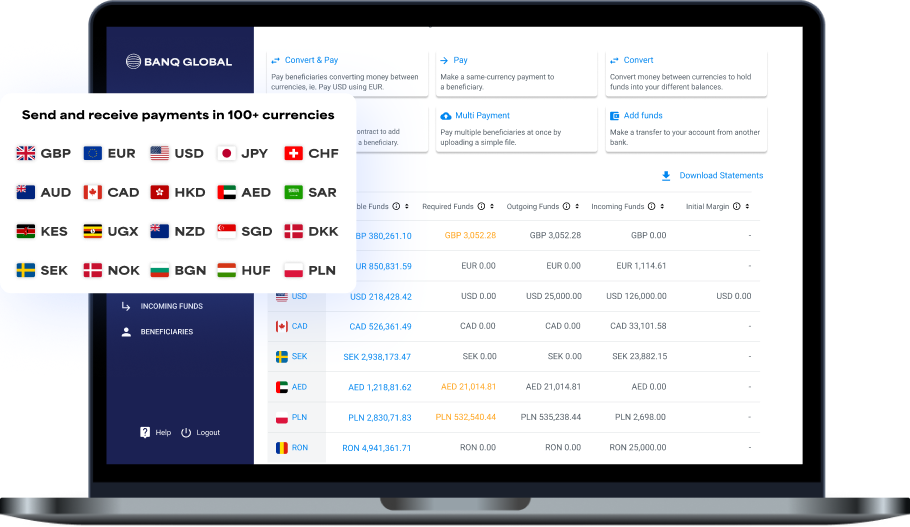
Specialist account providers such as Banq Global are built specifically for international businesses that fall outside the risk appetite of traditional banks and digital providers. They are designed to support foreign-owned UK companies, international ownership structures, and businesses that require a specialist business account rather than a standard retail banking solution. Common distinguishing features include a 100% digital application process, acceptance of non-residents across a wide range of jurisdictions, strategy-led onboarding that reduces rejection risk for complex structures, and dedicated support throughout the application process.
This route works best for:
- Foreign-owned UK companies.
- Multinational groups.
- Holding company structures.
- SPVs.
- Non-resident-only ownership structures.
- Businesses that have previously been declined by traditional banks or digital providers.
How Do Company Structures Affect Non-Resident UK Business Banking and Capital Requirements?
The company structure determines documentation requirements, how providers assess risk, and which routes are actually available.
UK Private Limited Company (Ltd)
A UK Private Limited Company (Ltd) is a separate legal entity registered at Companies House. It is the most common and bank-friendly structure for non-resident-owned businesses. Key features include the following:
- No minimum share capital requirement beyond £1.
- Non-residents can be the sole director and sole shareholder.
- Personal assets are protected, as liability is limited to the nominal value of the shares.
- Provides a universally recognised Certificate of Incorporation and Articles of Association that global payment providers, banks, and merchants easily accept.
- It offers a straightforward and relatively rapid company registration process.
- Recommended for: foreign-owned subsidiaries, holding structures, and most international groups.
UK Limited Liability Partnership (LLP)
A UK limited liability partnership (LLP) requires a minimum of two members, with at least two appointed as LLP designated members responsible for legal and statutory compliance. Key features include the following:
- An LLP typically benefits from pass-through taxation, meaning profits are taxed at the member level rather than at the entity level.
- Banking is generally available, but providers may apply additional scrutiny to LLPs with 100% non-resident members.
- Instead of the Articles of Association used by Ltds, LLPs operate under an internal, confidential LLP agreement.
- Less common for foreign-owned structures.
- Less straightforward for corporate-owned international groups.
- Recommended For: Professional services structures (e.g., law and accounting firms), joint ventures, and partnerships where flexible profit distribution is a priority.
UK Branch of an Overseas Company (UK Establishment)
An overseas company can register a UK establishment at Companies House without forming a separate legal entity. The UK establishment registration requirement applies before the branch can legally operate and before most banking providers will consider an application. Key features include the following:
- The branch is an extension of the parent, not an independent entity.
- Banking is more complex as providers need documentation from both the overseas parent and the UK establishment.
- Traditional banks are particularly cautious; specialists and some digital providers handle this more readily.
- Document requirements typically include overseas company constitutional documents (apostilled or certified), UK establishment registration confirmation, and details of the authorised person(s) operating the branch.
Is a UK business account mandatory for a UK limited company?
No legal requirement exists. However, operating purely from an overseas account creates practical friction: most UK clients and suppliers expect UK bank details, HMRC payments are simpler with a UK account, and GBP receipts without constant FX conversion are easier to manage. A UK account is strongly recommended for any company with meaningful UK operations.
What UK company structure is best for non-resident owners?
A UK private limited company (Ltd) is the most straightforward structure for non-resident ownership and the most widely accepted by business account providers. It can be formed entirely online with non-resident directors and shareholders and produces the documentation (certificate of incorporation and articles of association) that all provider types recognise. UK branches of overseas companies are possible but more complex for banking purposes.
Application Process to Open a UK Business Account for Non-Resident
Many platforms allow you to complete the application entirely remotely.
Steps Involved
Incorporate your company
Complete your UK limited company formation, LLP incorporation, or UK establishment registration through Companies House before applying for a business account.
Apply online
Select your digital banking provider and fill out their online application form.
Upload documents
Submit digital copies of your passport, incorporation documents, and personal identification documents.
Verify identity
Complete a biometric ID check, biometric verification process, or video interview as required by the provider. Once approved, the authorised signatory may also be required to complete a bank mandate before the account can be activated.
Fund the account
Make the initial account deposit if required by your chosen provider.
How Long Does It Take to Open a UK Business Account as a Non-Resident?
It varies significantly by route. Traditional banks typically take several weeks. Digital providers can be faster, but complex applications often take longer or are declined. Specialist providers such as Banq Global can approve accounts within 24 hours for eligible applications, with onboarding completed entirely online.
FAQs
Can a non-UK resident open a business bank account in the UK?
Yes. There is no legal restriction at Companies House or the FCA level. However, many traditional banks impose their own internal requirements, including in-person visits and UK-resident directors, which make the process difficult in practice. Specialist providers and some digital platforms are built specifically to serve non-residents without a UK address.
Do I need a UK address for a non-resident UK business banking setup?
You do not need to be personally resident in the UK. Your company does need a registered office address, but most providers will not accept this as proof of personal residence. Personal proof of residential address for each director and beneficial owner is required separately.
Can Banq open a business account for an overseas company UK branch?
Yes. Banq Global accepts non-resident directors and shareholders from 190+ countries and its onboarding process is 100% online. It is designed for international businesses that need a local UK IBAN, access to domestic payment rails, and multi-currency capabilities without requiring a UK presence.
Are Banq business accounts protected and regulated?
Banq Global operates through a network of FCA-authorised partners.
- Business account services are provided by Modulr FS Limited, an FCA-regulated Electronic Money Institution (FRN 900573).
- Currency services are provided by Currencycloud, which holds FCA authorisation under the Electronic Money Regulations 2011 (FRN 900199).
- For client money protection, funds are held in safeguarded fund accounts at regulated banks, ring-fenced from Banq's own operational funds.
What ongoing compliance applies to non-residents with a UK company?
- Non-resident directors must ensure the company meets its Companies House obligations and maintains any required HMRC registration, including corporation tax, VAT registration, and PAYE obligations where applicable.
- Beneficial ownership must be disclosed on the People with Significant Control register (PSC register).
- Many account providers will also request periodic document refresh as part of their own AML obligations.