Opening a Business Account in the UK: Everything You Need to Know
The United Kingdom is widely recognised as one of the most attractive destinations for investment in Europe. It benefits from a competitive corporate tax rate of 25%, which is among the lowest in the G7. These benefits, combined with support from regional and national inward investment teams, attract a wide range of organisations, including holding companies and special purpose vehicles (SPVs), private equity funds, family offices, and international companies looking to establish a presence in the UK market.
Opening a business account in the UK can be straightforward for some businesses, but requirements vary significantly depending on the company structure, ownership profile, and residency status of directors and shareholders. Regulatory checks, identity verification, and ownership reviews now form a central part of the application process, particularly for non-resident and complex ownership structures.
Benefits of a UK Business Account
Opening a business account in the UK provides several operational and commercial benefits, including:
- Enhances professional credibility by providing local UK payment details, including a sort code and account number, which are often expected by customers, suppliers, and procurement teams.
- Enables access to UK payment systems, including Faster Payments (real-time), BACS (payroll/direct debits, 3-day cycle), and CHAPS (same-day high-value settlement), and international transfers through the SWIFT network. An international company cannot access these directly from a foreign account.
- Supports HMRC compliance by maintaining a clear audit trail for corporation tax, VAT, and PAYE obligations while helping limited companies separate business and personal finances.
- Allows businesses to pay UK employees and contractors in GBP and reduce unnecessary foreign exchange costs associated with international payments.
- Many providers also offer a multi-currency account and GBP IBAN functionality, making it easier for international companies to manage cross-border transactions.
- For international companies, local UK account details can signal a genuine market presence and are often a prerequisite for securing enterprise and government contracts.
What Types of Business Bank Accounts Are Available in the UK?
Before opening a business account in the UK, it is important to understand the different types of business accounts available in the UK, as each is designed to support specific operational, financial, and international banking requirements.
Current Accounts
Business current accounts are designed for daily transactions such as payments, deposits, and withdrawals. They usually include online banking, debit cards, and payment services, making them ideal for everyday business operations.
Savings Accounts
Business savings accounts help companies earn interest on surplus funds. They are suitable for setting aside cash reserves that do not need to be accessed regularly.
Multi-Currency Accounts
Multi-currency accounts allow businesses to hold and manage different currencies in one place. They are useful for companies that work with international customers, suppliers, or partners.
Digital and Online-Only Accounts
Digital business accounts offer quick setup, online access, and lower fees. They are a popular choice for businesses seeking flexible and convenient banking without relying on physical branches.
Three Types of UK Business Account Providers
In addition to choosing the right type of business account, businesses must also decide which type of provider best matches their residency status, ownership structure and global reach before opening a business account in the UK. The UK offers three categories of providers: traditional banks, digital banks and specialist account providers.
Traditional local banks
Traditional local banks such as NatWest, Barclays, and HSBC provide full UK banking functionality, in-branch support, access to all payment rails, potential for business lending and, where eligible, FSCS protection for customer deposits. However, providers impose rigid know your customer verification & anti-money laundering compliance requirements, almost always requiring UK-resident directors and rejecting complex or majority-foreign ownership structures. Furthermore, their international application processing times stretch significantly from four weeks to three months, and they command high foreign exchange (FX) markups averaging 3% to 5% alongside fixed transfer fees. This makes them best suited for straightforward, UK-headquartered companies with domestic management.
Digital and challenger banks
Digital and challenger banks such as Wise Business, Revolut Business, and Starling strip away physical branch networks to deliver digital onboarding, minimal monthly fees, and highly streamlined web and mobile application experiences. However, eligibility requirements can be more restrictive, with many providers preferring UK-resident directors or persons with significant control (PSCs) and limiting support for holding companies, investment vehicles, and other complex structures. They also tend to offer less specialist compliance support for irregular business models and operate as electronic money institutions (EMIs) rather than fully licensed banks.
Global business account specialists
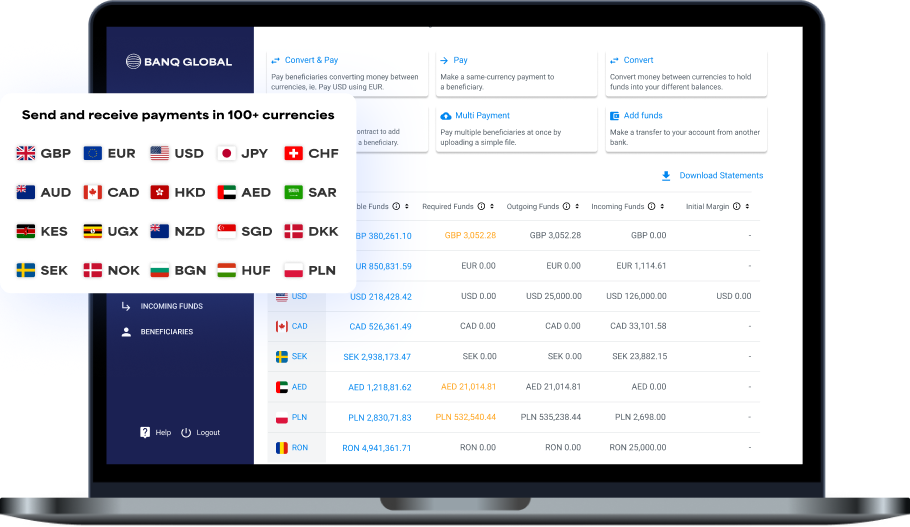
Specialist business account providers, such as Banq Global, offer an alternative route for international companies, holding companies, and businesses with non-resident directors who require more flexibility than is typically available through traditional or digital banking providers. They provide access to multi-currency business accounts (supporting 130 currencies) through FCA-authorised partners, and user balances are held as safeguarded funds in strictly segregated accounts. With dedicated compliance teams experienced in onboarding non-resident directors and shareholders from over 190 countries, the entire onboarding process is completed 100% online, making it faster and more accessible for globally structured businesses.
Business Account UK Documents Requirements
Opening a business account in the UK requires a combination of identity, business verification, ownership, and company formation documents.
- Proof of identity (photo ID or passport) and proof of address (issued within the last three months) for all directors and persons with significant control (PSCs).
- Certificate of incorporation and Companies House registration number details for incorporated entities.
- Memorandum of association, articles of association, and, where applicable, a shareholders' agreement.
- Details of beneficial ownership, including the PSC register and information on any ultimate beneficial owner (UBO) meeting the 25% ownership threshold.
- Business information such as a registered office address, trading address, HMRC correspondence, and VAT registration number, where applicable.
- Bank mandate or signatory authority documentation identifying individuals authorised to operate the business account.
For complex ownership structures, providers may also request a full ownership chart tracing ownership to the UBO level, together with constitutional documents relevant to the structure as part of enhanced due diligence (EDD) procedures.
Non-resident shareholders and directors may also be required to provide apostilled or notarised documents, particularly where records originate from overseas jurisdictions.
Note: All providers run KYC and AML compliance checks; preparing documents in full before applying reduces review time at any provider type.
Business Structures and UK Business Account Requirements
UK business account requirements are largely determined by your chosen legal structure (standard or complex), which influences both the documentation required and the types of providers likely to accept your application.
Standard Structures
Standard structures are generally the easiest to onboard and are widely accepted by traditional and digital business account providers. The most common include sole traders, limited companies, limited liability partnerships (LLPs), and partnerships.
Sole Traders / Sole Proprietorships
The simplest application type, with business assets and personal liabilities remaining combined. There is no legal requirement for a separate business account, and applications generally require basic identity documents, including photo ID, proof of address, and basic business verification.
Limited Companies (Ltd.)
Limited companies are legally required to separate business finances. Applications typically require a certificate of incorporation, memorandum and articles of association, and a PSC (Persons with Significant Control) register identifying individuals meeting the 25% ownership threshold. Standard providers generally accommodate these structures where directors and PSCs are UK residents.
Limited Liability Partnerships (LLPs) and Partnerships
LLPs and partnerships typically require all partners or designated members to provide photo ID and proof of address. Providers may also request a partnership agreement or LLP deed confirming the names of members, signatory authority, and the business address.
Complex and International Structures
Complex and international structures typically require additional ownership, verification, and compliance documentation. These structures often involve more detailed reviews and may have fewer provider options.
Holding Companies
Holding companies generally require a full group ownership chart tracing ownership through every corporate layer to the ultimate beneficial owner (UBO). Each UBO is typically required to provide proof of identity and proof of address as part of the verification process.
Special Purpose Vehicles (SPVs) and Investment Funds
SPVs, private equity funds, venture capital funds, hedge funds, and alternative investment funds (AIFs) usually require additional constitutional documents. Depending on the structure, providers may request a limited partnership agreement (LPA), fund prospectus, trust deed, or FCA registration confirmation.
Foreign-Incorporated Companies
Foreign-incorporated companies are generally required to provide incorporation documents from their home jurisdiction. Providers may also request apostilled documents and notarised translations where records are not in English.
These structures often involve more extensive ownership and compliance reviews than standard business structures.
How to Open a Business Account in the UK?
Step 1: Establish and Register Your Business
Establishing your legal structure and registering with the appropriate governing body (such as Companies House) is the essential first step before opening a business bank account.
- Limited companies and LLPs must be registered with Companies House to obtain a certificate of incorporation and a Companies House registration number.
- Holding companies and SPVs are typically incorporated as limited companies and therefore follow the same registration process.
- Foreign-incorporated companies can generally apply using incorporation documents from their home jurisdiction, subject to provider requirements.
Step 2: Choose business account type and provider
For example, businesses trading internationally may benefit from providers offering multi-currency accounts, while holding companies, SPVs, investment funds, and other specialised structures may require providers with dedicated support for complex ownership arrangements.
Step 3: Submit Your Application
Complete the provider's application process by submitting your business and ownership information through its online platform, relationship manager, or branch network. The application will then enter the review stage.
Step 4: Undergo Compliance Review
The provider will assess your application, verify the information supplied, and conduct any required onboarding and compliance checks. Complex ownership structures and international businesses may require additional review before approval.
Step 5: Receive Approval and Activate Your Account
Once approved, you will receive your account details and can activate the account according to the provider's instructions. You can then begin sending and receiving payments, managing company funds, and accessing any associated banking services.
How Long Does It Take To Open a Business Account in the UK?
The time required to open a business account in the UK depends on the provider type, business structure, and complexity of the application.
- Traditional banks typically take between 4 weeks and 3 months to process international applications. Complex ownership structures can extend these timelines further, while in-person meetings may add delays for non-UK applicants.
- Digital banks can often complete the process within the same day or a few days for eligible businesses with straightforward ownership structures.
- Opening a UK business account with a specialist provider like Banq Global can take as little as 24 hours following approval. A dedicated account manager handles the paperwork, compliance checks, and verification process, which may take up to 5 days for more complex entity structures.
Common Reasons Business Account Applications in the UK Are Delayed or Rejected
Business account applications are not always approved immediately. Common reasons for delays and rejections include the following:
- Inability to verify ultimate beneficial owners (UBOs).
- Ownership structures spanning multiple jurisdictions.
- Missing or incomplete PSC (Persons with Significant Control) information.
- Businesses operating in high-risk or restricted sectors.
- Inconsistent source-of-funds or source-of-wealth information.
- Non-English documents submitted without certified translations.
- Dormant or newly incorporated entities with limited evidence of business activity.
- Sanctions screening or adverse media concerns.
If an application is declined, businesses can request further information from the provider and consider applying through a specialist business account provider with experience supporting international and complex ownership structures
FAQs
Which provider is best for a UK business account?
There is no single best provider for a UK business account. Traditional and digital providers are often suitable for straightforward UK businesses with simple ownership structures. Specialist providers are generally better suited to international companies, non-resident directors, and complex ownership arrangements.
How much does a UK business account cost?
UK business bank accounts typically cost anywhere from £0 to £30 per month in maintenance fees, depending on the provider and your business turnover. The highest hidden costs arise from international transfers and correspondent banking fees, which can easily add £5 to £40 per transaction.
Can a non-resident open a UK business account?
Yes. There is no legal restriction preventing a non-resident from opening a UK business account. However, traditional banks often have stricter eligibility and compliance requirements for non-resident applicants. Specialist providers are generally more accessible and may support non-resident directors, overseas shareholders, and international business structures.
Do UK business account requirements include a minimum deposit?
No, UK business account requirements do not generally include a minimum deposit. However, providers may ask about your expected annual turnover and business activity during the application process. Some providers also apply minimum or maximum turnover thresholds when deciding whether to accept new customers.
What ongoing compliance obligations apply after opening a UK business account?
Companies must comply with HMRC obligations, including Corporation Tax registration, CT600 filings, VAT registration where required, and PAYE reporting for employees. They must also meet Companies House requirements, including filing annual accounts and confirmation statements and completing identity verification for PSCs. In addition, businesses should retain financial records for at least six years