Set Up an SPV and Open a Bank Account in Luxembourg
Luxembourg is one of Europe's most established jurisdictions for Special Purpose Vehicles (SPVs), particularly for structured finance, investment, securitisation, asset holding and cross-border transactions.
Its position within the European Union, sophisticated corporate framework and established financial-services ecosystem have made Luxembourg a common choice for international investors, asset managers, private equity firms, corporate groups and transaction sponsors looking to establish an SPV in Europe.
However, establishing the company is only one part of the process.
An SPV will normally also require an operational business account to receive capital, hold funds, make investment or acquisition payments, pay professional advisers and transact with counterparties.
For internationally owned SPVs, opening that account can sometimes be more challenging than incorporating the company itself.
This guide explains both sides of the process:
- How to establish an SPV in Luxembourg
- The principal Luxembourg SPV structures
- Share capital and blocking certificate requirements
- Luxembourg incorporation and notary requirements
- Incorporation timelines and costs
- Tax and ongoing reporting requirements
- How to open a bank account for a Luxembourg SPV
- Foreign ownership and non-resident directors
- What account providers assess during onboarding
- Documents required to open the account
- Multi-currency and international payment requirements
Luxembourg SPV at a Glance
Requirement | Luxembourg |
|---|---|
Common SPV structures | SARL, SA, SCS and SCSp |
Most common corporate structures | SARL and SA |
Minimum SARL capital | €12,000, fully subscribed (payment can be deferred for up to 12 months) |
Minimum SA capital | €30,000, with 25% paid at incorporation |
Minimum directors | SARL: one manager. SA: three directors, or one if the SA has a single shareholder |
Minimum shareholders | One |
Registered office | Required in Luxembourg |
Company secretary | Not required |
Typical formation time | Approximately 5–10 business days once documentation and KYC are complete |
Beneficial ownership registration | Required |
Standard VAT rate | 17% |
Business bank account | Required for operational banking and for the share capital deposit |
Non-resident ownership | Permitted for foreign shareholders and beneficial owners |
Multi-currency requirements | Available through specialist account providers |
Why Set Up an SPV in Luxembourg?
Luxembourg is a leading European jurisdiction for SPVs, particularly for cross-border investment, securitisation and structured-finance transactions. Its key advantages are its dedicated legal framework, flexible structuring options and established financial-services ecosystem.
Dedicated Securitisation Framework
Luxembourg's Law of 22 March 2004 on securitisation provides a dedicated legal framework for securitisation vehicles, giving investors and transaction parties greater legal certainty when structuring investments and financing transactions.
Segregated Compartments
Luxembourg securitisation vehicles can establish multiple legally segregated compartments, allowing different assets, liabilities, investors or transactions to be separated within a single vehicle.
Flexible SPV Structures
SPVs can be established using several legal forms, including SARL, SA, SCS and SCSp, allowing the structure to be tailored to different ownership, investment and financing requirements.
Cross-Border Investment
Luxembourg's position within the EU, extensive double-tax-treaty network and established cross-border investment framework make it particularly attractive for international investment and holding structures.
Extensive Tax Treaty Network
Luxembourg has more than 80 bilateral double-tax treaties in force, including agreements with major international investment markets such as the UK, US, Germany, France and Singapore. This extensive treaty network can be particularly relevant when structuring cross-border investments, although the tax treatment and availability of treaty benefits depend on the specific SPV and transaction.
Specialist Financial Ecosystem
Luxembourg has an established network of banks, lawyers, administrators, corporate-service providers and investment professionals experienced in establishing and servicing SPVs and international investment structures.
These advantages have made Luxembourg particularly relevant for investment holding, private equity, securitisation, structured finance and cross-border investment structures.
What Types of SPV Can Be Established in Luxembourg?
An SPV is a commercial description rather than one single legal company type.
Several different Luxembourg legal entities can therefore be used to establish an SPV.
The most commonly used structures include:
Société à responsabilité limitée — SARL
A SARL is a Luxembourg private limited liability company.
It is frequently used for mid-sized transactions, investment structures and privately held SPVs.
For many straightforward corporate or investment SPVs, this may be one of the first structures considered.
The minimum capital is €12,000. Since 2 June 2026, founders can pay it before incorporation or defer payment for up to 12 months after incorporation.
Société anonyme — SA
An SA is a Luxembourg public limited liability company.
It may be more appropriate for larger structures, multiple investors or transactions involving securities issuance.
The minimum capital is €30,000, of which at least 25% must be paid at incorporation.
Société en commandite simple — SCS
The SCS is a Luxembourg limited partnership requiring at least one general partner and one limited partner.
The general partner has unlimited liability for the partnership's obligations, while the limited partner's liability is generally limited to its contribution.
There is no statutory minimum capital, and contributions can be made in cash, in kind or through services and do not necessarily need to be fully contributed at incorporation.
This flexibility can make the SCS suitable for certain investment, financing and partnership-led SPV structures.
Société en commandite spéciale — SCSp
The SCSp is a special limited partnership and can provide additional flexibility for certain investment-led structures.
The 2022 changes to Luxembourg's securitisation legislation increased the ability to use SCS and SCSp structures within securitisation arrangements.
The correct structure depends on what the SPV will actually do.
That is an important distinction.
An acquisition SPV, property-holding SPV, securitisation vehicle and private-equity investment structure may have very different legal, tax and operational requirements.
Professional legal and tax advice should therefore be obtained before choosing the entity.
How to Set Up an SPV in Luxembourg
The exact formation process depends on the company type and transaction, but a typical Luxembourg corporate SPV will generally involve several stages.
Step 1 — Determine the purpose of the SPV
Before incorporation, the parties should clearly establish:
- What assets the SPV will own
- What transaction it will undertake
- Who will own the company
- How it will be funded
- Where the funding will originate
- Who its counterparties will be
- Which countries it will transact with
- Whether it will issue debt or securities
- What currencies it will need
- How cash will enter and leave the structure
This information is not only important for legal structuring.
It will also later become important when opening the Luxembourg business account and completing KYC.
Step 2 — Select the legal structure
The parties then determine whether the SPV should be established as a SARL, SA, partnership or another appropriate Luxembourg structure.
Step 3 — Establish the ownership structure
The shareholders and Ultimate Beneficial Owners (UBOs) need to be established.
For international groups this can involve several layers, for example:
Individual UBO
↓
International Holding Company
↓
Luxembourg SPV
↓
Underlying Investment or Asset
The more complex the ownership structure becomes, the more important it is that the commercial rationale for each layer can be clearly explained.
Step 4 — Appoint the management or directors
The management structure depends on the Luxembourg legal form selected. A SARL is managed by one or more managers. An SA needs a board of at least three directors, unless it has a single shareholder, in which case one director is enough.
The appropriate composition should reflect the structure, substance requirements, tax considerations and intended activities.
Step 5 — Establish a Luxembourg registered office
A registered office in Luxembourg is required.
This is often provided through a professional corporate-services or administration provider.
Step 6 — Deposit the required share capital
This is an especially important part of Luxembourg incorporation.
For Luxembourg capital companies, the required share capital is deposited into an account before incorporation and a blocking certificate is issued for the notarial incorporation process.
For a SARL incorporated from 2 June 2026, founders can instead defer payment of the €12,000 for up to 12 months after incorporation, provided the deferral terms are set out in the articles of association. Any capital above €12,000 and any share premium must still be paid at incorporation.
For a SARL, the minimum capital is:
€12,000, paid before incorporation or within 12 months of it.
For an SA:
€30,000, with at least 25% paid at incorporation.
Step 7 — Complete incorporation
Once the required documentation, KYC and capital requirements have been satisfied, the incorporation documentation can be completed and the entity registered with the Luxembourg Trade and Companies Register (RCS).
A Luxembourg SPV can typically be established within approximately five to ten business days once documentation and KYC checks are complete.
The total project timeline will depend on the ownership structure and the required legal, notarial, banking and regulatory work.
What Documents Are Usually Required to Establish a Luxembourg SPV?
Requirements vary depending on the legal form and structure, but information and documentation will generally include:
- Luxembourg company-name availability confirmation
- Luxembourg registered-office address
- Draft Articles of Association or incorporation deed
- Defined corporate purpose and duration of the SPV
- Shareholder identities, addresses and shareholdings
- Manager or director details and authority to bind the company
- Ultimate Beneficial Owner (UBO) details
- Official identification for non-resident UBOs without a Luxembourg identification number
- Corporate registration details for foreign corporate shareholders
- Luxembourg share-capital blocking certificate where required
- Amount of subscribed capital and applicable share classes
- Details and valuation of contributions in kind where applicable
- Luxembourg Trade and Companies Register (RCS) filing documentation
- Register of Beneficial Owners (RBE) filing documentation
- Notarial deed for SARL and SA structures
For SARL and SA structures, incorporation takes place before a Luxembourg notary. The constitutional documents are subsequently filed with the RCS and published through the RESA, while beneficial ownership information is filed separately with the RBE
How Much Does It Cost to Establish an SPV in Luxembourg?
Costs depend heavily on the structure and professional advisers involved.
Incorporation costs are approximately €5,500, comprising around €3,000 in establishment costs and €2,500 in notarial fees.
However, the true cost of establishing an SPV may be higher once additional requirements are included, such as:
- Corporate-services provider
- Registered office
- Directors
- Legal advice
- Tax advice
- Accounting
- Administration
- Audit
- Banking
- Regulatory reporting
- Economic-substance requirements
For a sophisticated structured-finance vehicle, the total cost can therefore be materially different from the basic company-incorporation cost.
What Are the Tax Considerations for a Luxembourg SPV?
Luxembourg SPV taxation depends on the legal form, activities and assets held by the vehicle.
For a Luxembourg corporate SPV, the key tax considerations include:
- Corporate income tax: 14% on taxable income up to €175,000, €24,500 plus 30% of the income above €175,000 for taxable income between €175,000 and €200,000, and 16% on taxable income above €200,000. A 7% solidarity surtax applies to the corporate income tax due.
- Municipal business tax: The rate depends on the municipality. In Luxembourg City, the effective municipal business tax rate for companies is 6.75%. Combined with corporate income tax and the solidarity surtax, the overall rate in Luxembourg City is 23.87%.
- Net wealth tax: Luxembourg SARLs and SAs are generally subject to annual net wealth tax on their taxable net assets, subject to applicable exemptions and reductions.
- Participation exemption: Qualifying shareholdings can benefit from Luxembourg's parent-subsidiary regime, which can exempt eligible dividend income, capital gains and shareholdings from certain Luxembourg taxes when the relevant conditions are met.
- Dividend withholding tax: Luxembourg companies generally apply a 15% withholding tax to dividends, although exemptions or reduced rates can apply under Luxembourg law or an applicable double-tax treaty.
- Double-tax treaties: Luxembourg has an extensive treaty network covering major investment jurisdictions including the UK, US, France, Germany and many other international markets.
- FATCA and CRS: Luxembourg entities must assess whether they fall within FATCA and CRS classification and reporting requirements.
- Securitisation vehicles: Luxembourg securitisation structures have specific tax considerations depending on their legal form, financing and distributions.
Tax treatment should never be assumed simply because an entity is described as an SPV.
A property SPV, financing vehicle, securitisation company, partnership and holding structure can have significantly different tax outcomes.
Independent Luxembourg tax advice is therefore essential before establishing the structure.
What Are the Ongoing Reporting Requirements?
Establishing the SPV is only the beginning.
Luxembourg entities have continuing accounting, tax, corporate and beneficial-ownership obligations.
For a Luxembourg corporate SPV, the key ongoing requirements can include:
- Annual accounts: SARLs and SAs must approve their annual accounts within six months of the financial year-end and file them with the Luxembourg Trade and Companies Register (RCS) within one month of approval, and no later than seven months after year-end.
- eCDF filing: Companies filing annual accounts generally validate their financial data through Luxembourg's electronic financial-data collection platform (eCDF) before filing with the RCS.
- RESA publication: The filing of annual accounts and certain corporate changes is published through Luxembourg's Electronic Compendium of Companies and Associations (RESA).
- Beneficial ownership: Changes to information held in the Luxembourg Register of Beneficial Owners (RBE) must be filed within one month after the entity becomes, or should have become, aware of the change.
- Corporate tax returns: Luxembourg companies subject to corporate taxation file their returns with the Luxembourg Inland Revenue (ACD), with the statutory filing deadline generally falling on 31 December of the following year.
- FATCA and CRS: Luxembourg reporting financial institutions must submit applicable FATCA and CRS reporting to the ACD by 30 June following the relevant reporting year.
- Audit requirements: The level of statutory audit or financial-statement oversight depends on the legal form, size and activities of the Luxembourg SPV.
- Securitisation reporting: Regulated securitisation undertakings and certain other financial structures can have additional CSSF, Central Bank of Luxembourg or regulatory reporting requirements.
The exact reporting obligations depend on whether the SPV is structured as a SARL, SA, partnership, securitisation vehicle or other Luxembourg structure, as well as its size, activities and regulatory status.
These ongoing obligations should be considered when comparing Luxembourg with alternative jurisdictions.
Opening a Business Account for a Luxembourg SPV
Once the SPV has been established, the next major operational requirement is usually the business account.
This is where the process can become more difficult.
SPVs do not always fit the standard profile used by conventional business-account providers.
A typical operating company may have employees, customers, suppliers and recurring trading revenue.
An SPV might instead:
- Hold one investment
- Receive funding from shareholders
- Purchase a single asset
- Receive investment proceeds
- Make occasional large-value payments
- Hold funds for an extended period
- Receive money from another group entity
- Operate across several jurisdictions
None of those characteristics necessarily make the company unsuitable for an account.
They do, however, mean that the financial institution will normally want to understand why the SPV exists and exactly how the account will be used.
Can a Luxembourg SPV Open a Business Account?
Yes. A Luxembourg SPV can open a business account. Approval depends on the SPV’s legal structure, ownership, purpose, funding and expected account activity.
For a Luxembourg SPV, account providers will typically assess:
- Legal structure: Whether the SPV is a SARL, SA, SCS, SCSp or other Luxembourg structure
- Corporate purpose: Why the Luxembourg SPV has been established and the activity permitted under its constitutional documents
- Ownership and UBOs: The complete ownership structure and the individuals who ultimately own or control the SPV
- RCS and RBE information: The entity’s Luxembourg corporate-registration and beneficial-ownership information
- Source of funds: Where the capital entering the SPV originates
- Source of wealth: How the UBOs or investors accumulated the wealth supporting the structure
- Underlying assets: The investment, property, securities or other assets the SPV will hold
- Expected account activity: Anticipated balances, transaction volumes, counterparties and payment flows
- Countries and currencies: The jurisdictions involved and currencies the SPV needs to receive, hold or pay
- Supporting evidence: Agreements, investment documentation, financial information or other evidence supporting the proposed activity
A newly incorporated Luxembourg SPV does not need a long trading history to apply for a business account. For new entities, the account-opening assessment instead focuses heavily on the ownership structure, source of funds, purpose of the SPV and evidence supporting its expected activity.
The clearer and better documented the Luxembourg structure and proposed payment flows are, the easier it is for an account provider to assess whether the SPV meets its eligibility and compliance requirements.
Working with a specialist business-account provider experienced in SPVs and international corporate structures can also help identify suitable account solutions and make the account-opening process simpler, quicker and more manageable.
Can a Foreign-Owned Luxembourg SPV Open an Account?
Yes. A foreign-owned Luxembourg SPV can open a business account.
International ownership is common within cross-border structures.
A financial institution will normally look beyond the Luxembourg company itself and assess the entire ownership chain.
For example:
UAE Resident UBO
↓
UAE Holding Company
↓
Luxembourg SPV
↓
European Investment
The financial institution will assess:
- Why Luxembourg was selected
- Why the UAE holding company exists
- Who ultimately controls the structure
- Where the investment capital originated
- What the underlying asset is
- How funds will move through the account
- Which counterparties will send and receive funds
The clearer the commercial rationale, ownership structure and source of funds, the easier it is for the financial institution to assess the application.
Can an SPV With Non-Resident Directors Open an Account?
Yes. A Luxembourg SPV with non-resident directors can open a business account.
Luxembourg law permits non-resident directors of an SA, while SARL managers can also be third-country nationals.
Account approval is separate and depends on the provider's eligibility and compliance assessment, including the SPV's ownership, UBOs, source of funds, underlying assets and expected account activity.
For Luxembourg capital companies, the account may also be required during incorporation to deposit share capital and obtain a blocking certificate for the Luxembourg notary.
For internationally managed SPVs, arranging the business account and capital-blocking solution early can make the Luxembourg incorporation process simpler and more manageable.
What Will an Account Provider Want to Understand?
When opening a business account for a Luxembourg SPV, the account provider will focus on four core areas:
1. Who owns the Luxembourg SPV?
The provider will establish the shareholders, UBOs and complete ownership chain, including any foreign holding companies, corporate shareholders or trusts.
2. Why was the SPV established?
The commercial purpose should be clear, whether the Luxembourg SPV is being used for investment holding, an acquisition, securitisation, property, financing or another specific transaction.
3. Where will the money come from?
The provider will establish the source of funds and source of wealth, including shareholder capital, investor funding, financing, investment proceeds or other funding entering the SPV.
4. How will the account operate?
The expected countries, counterparties, transaction values, currencies, payment frequency and purpose of payments should be established before account opening.
A well-prepared Luxembourg SPV application explains these four areas clearly and provides supporting documentation from the outset.
What Documents May Be Required to Open the Business Account?
Depending on the provider and structure, documents may include:
- Luxembourg certificate of incorporation
- Articles of Association
- Luxembourg RCS extract
- Ownership chart
- Shareholder register
- Director or manager details
- RBE / UBO details
- Passport copies
- Proof of address
- Foreign corporate shareholder documents
- Source of funds evidence
- Source of wealth evidence
- Investment agreements
- Loan agreements
- Purchase agreements
- Underlying asset documents
- Investor documentation
- SPV transaction overview
- Expected account-flow information
More complex international structures may require additional documentation.
Can a Luxembourg SPV Hold Multiple Currencies?
Yes.
A Luxembourg SPV involved in international investment or financing may need to receive and hold currencies other than euros.
For example, a Luxembourg investment SPV may receive investor funding in USD while making expenses or acquisitions in EUR.
Another may receive GBP distributions and subsequently convert funds into EUR.
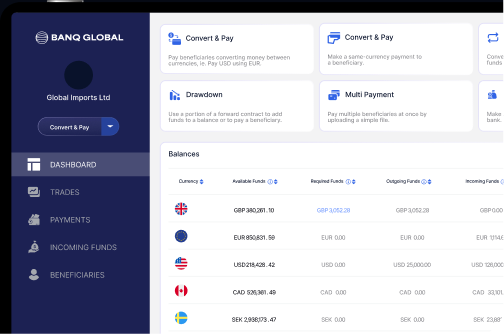
Depending on eligibility and the financial partner, specialist account providers such as Banq Global can support Luxembourg SPVs requiring access to multiple currencies through global account and payment networks.
This can reduce the need to operate several disconnected account relationships purely because different Luxembourg SPV transactions occur in different currencies.
Can a Luxembourg SPV Make International Payments?
Yes, subject to the capabilities of the selected account provider and regulatory approval.
Common requirements may include:
- SEPA payments
- SWIFT payments
- EUR receipts
- USD payments
- GBP payments
- Foreign exchange
- International investor receipts
- Professional-fee payments
- Acquisition payments
- Supplier or counterparty payments
The important consideration is that these requirements should be disclosed clearly during onboarding.
An SPV expecting a single €5 million acquisition payment presents a very different account profile from an SPV making 200 international payments every month.
The provider needs to understand which profile actually applies.
Should You Arrange the Business Account Before or After Incorporating the SPV?
For a Luxembourg SA, and for a SARL paying its capital upfront, the share-capital account must be arranged before incorporation is completed.
This is an important feature of the Luxembourg formation process.
Before the notarial incorporation, the required share capital is deposited with a bank or other eligible financial institution. The institution then issues a blocking certificate confirming that the capital has been deposited.
For a SARL, this means depositing at least:
€12,000, unless payment is deferred.
For an SA:
€30,000, with at least 25% paid at incorporation.
The blocking certificate is provided to the Luxembourg notary as part of the incorporation process. Following incorporation, the notary issues the documentation required for the deposited capital to be released.
The capital-deposit account should not automatically be treated as the SPV's permanent operating account. The provider must also be able to support the company's ownership, activity, expected transactions, currencies and international payment requirements.
For Luxembourg SPVs, banking should therefore be considered as part of the incorporation process rather than as a step that begins after the company has been established.
How Banq Global Supports Luxembourg SPVs
Banq Global is a specialist provider of business-account solutions for Luxembourg companies and SPVs, including internationally owned and more complex corporate structures.
We provide a simple all-in-one account solution covering the different banking stages a Luxembourg SPV can require — from the initial share-capital deposit and blocking certificate through to the company's ongoing business account, international payments and foreign exchange requirements.
This can include:
- Share-capital deposit accounts
- Luxembourg blocking certificates
- Business accounts for Luxembourg SPVs
- Support for non-resident directors and international UBOs
- Support for international ownership structures
- EUR and multi-currency accounts
- SEPA and SWIFT payments
- Foreign exchange
- International incoming and outgoing payments
- Additional account and payment requirements
Our Process
1. Tell Us About Your SPV
Tell us about your Luxembourg SPV, ownership and what you need.
2. We Assess Your Requirements
We review your structure, account requirements, currencies and expected payment activity.
3. We Provide Your Complete Account Solution
We provide everything you need — from the capital deposit account and blocking certificate to your ongoing business account, multi-currency payments and foreign exchange.
Our objective is simple: to provide everything your Luxembourg SPV needs in one place, through one simple account solution — even where the requirement is complex, international or time-sensitive.
Is Luxembourg the Right Jurisdiction for Your SPV?
Luxembourg is particularly well suited to cross-border investment, securitisation, private equity, financing and investment-holding structures.
Its key advantages include:
- Dedicated securitisation law: Luxembourg's Law of 22 March 2004 provides a specific legal framework for securitisation structures.
- Flexible structures: SPVs can use structures including SARL, SA, SCS and SCSp depending on the transaction.
- Segregated compartments: Securitisation vehicles can separate different assets and liabilities into individual compartments.
- European location: Luxembourg provides an established EU base for international investment structures.
- Tax framework: Luxembourg offers participation-exemption rules and an extensive double-tax-treaty network for qualifying structures.
- Specialist ecosystem: The jurisdiction has an established network of lawyers, administrators, corporate-service providers, banks and investment professionals.
- Established banking process: Luxembourg SARLs require €12,000 of share capital, which can be paid at incorporation or within 12 months of it.
Luxembourg is therefore particularly relevant where an SPV will hold international investments, raise or deploy capital, undertake securitisation or financing transactions, or sit within a wider cross-border investment structure.
The final decision should reflect the SPV's assets, investors, ownership, tax position, regulatory requirements and banking needs.
Overall, for complex international SPVs, Luxembourg’s real advantage is not one individual benefit — it is the combination of legal flexibility, an established tax and regulatory framework, investment expertise and specialist banking infrastructure, all working together within one of Europe’s leading financial centres.
Frequently Asked Questions
What is a Luxembourg SPV?
A Luxembourg SPV is a Luxembourg legal entity established for a specific purpose, such as holding an investment, acquiring an asset, undertaking a financing transaction or facilitating a securitisation or structured-finance transaction.
How long does it take to establish an SPV in Luxembourg?
A straightforward Luxembourg SPV can typically be established within approximately five to ten business days once the required documentation and KYC checks are complete. Complex ownership, financing or regulatory requirements can extend the overall timeline.
How much capital is required for a Luxembourg SPV?
A Luxembourg SARL requires minimum share capital of €12,000, fully subscribed at incorporation, with payment deferrable for up to 12 months. An SA requires minimum share capital of €30,000.
Can the €12,000 SARL share capital be deposited before the company is incorporated?
Yes. For a Luxembourg capital company, the required capital is deposited into an account before incorporation. The financial institution issues a blocking certificate, which is provided to the notary. The capital is released following incorporation and receipt of the notary's release certificate. Founders can also defer payment for up to 12 months after incorporation under the law of 18 May 2026.
Is a notary required to incorporate a Luxembourg SPV?
For a SARL or SA, yes. Luxembourg requires the constitutional documents of these limited-liability companies to be executed before a notary. An SCS can instead be established by private deed or before a notary.
Does a Luxembourg SPV need a local registered office?
Yes. A Luxembourg company must have its registered office in Luxembourg.
Can foreigners own a Luxembourg SPV?
Yes. Luxembourg SARLs and SAs can have natural or legal persons as shareholders, including foreign shareholders. The ownership and UBO structure must still satisfy the applicable registration, tax and AML requirements.
Can a Luxembourg SPV open a business account?
Yes. Account approval depends on the SPV's ownership, purpose, source of funds, underlying assets and expected account activity. Newly incorporated SPVs do not need an established trading history simply to apply for an account.
Can a Luxembourg SPV have non-resident UBOs?
Yes. Non-resident UBOs are permitted. The account provider must identify and verify the individuals who ultimately own or control the structure and understand the complete ownership chain.
Can a Luxembourg SPV hold EUR, USD and GBP in one account?
Yes, where supported by the selected account solution. Specialist multi-currency account providers can provide Luxembourg SPVs with access to currencies including EUR, USD and GBP, allowing international investment and payment activity to be managed through one account relationship.
Does a Luxembourg securitisation vehicle need CSSF authorisation?
Not automatically. Under Luxembourg's Securitisation Law, CSSF authorisation is required where a securitisation undertaking issues financial instruments to the public on a continuous basis. Both conditions must be met for the authorisation requirement to apply.
Can one Luxembourg securitisation vehicle have multiple compartments?
Yes. Luxembourg securitisation undertakings can establish separate compartments, allowing different pools of assets and liabilities to be segregated within the same vehicle.
Should I arrange the account before establishing the Luxembourg SPV?
For Luxembourg capital companies, banking forms part of the incorporation process. The required share capital is deposited before incorporation and a blocking certificate is provided to the Luxembourg notary. Arranging the capital-deposit and ongoing business-account requirements early can therefore make the formation process considerably simpler.