Opening a business account in Poland: Everything you need to know
According to the World Bank, Poland ranks among the top 40 economies globally for ease of doing business, making it a strong destination for international companies. However, this ease cannot be achieved without a Polish business account and, in many cases, professional support. Strict AML and KYC requirements for foreign investors, along with mandatory identity verification, in-person meetings, and document signing, make the process complex.
Tax considerations also play an important role, as banks closely review whether a foreign company has genuine business activity in Poland. They carefully review both individual and corporate documentation to ensure compliance. In practice, opening an account without a clear Polish business link is difficult. Demonstrating local contracts, clients, or commercial relationships significantly increases the chances of approval.
Business Bank Account Options And Financial Institutions In Poland
Poland has a well-developed business banking market for accounts. Options range from large domestic commercial banks to digital fintech platforms and specialist providers focused on international payments. For most companies, the right choice depends less on headline account fees and more on day-to-day usage. Common needs include
- local salary payments
- supplier transfers in PLN
- lending
- multicurrency collections
- frequent cross-border flows
Banks connect to established payment rails such as Elixir for standard transfers and Express Elixir for real-time payments, both operated by KIR (the National Clearing House and the National Bank of Poland). In addition, BLIK has become a widely used method for online and mobile payments. These rails often overlap and come together in interesting patterns, enabling businesses to manage local transactions efficiently while also accessing international payment networks such as SEPA and SWIFT for cross-border operations.
Types Of Providers: Bank Accounts, Fintechs, and Other Financial Institutions
Commercial Banks (Traditional Business Accounts)
Commercial banks are the strongest option for businesses operating locally in Poland. They handle everyday needs such as payroll, tax payments, and supplier transfers, and are fully connected to local payment systems. They also offer lending, credit, and treasury services, which makes them a good fit for established companies or those planning to grow. In addition, having an account with a local bank can also make it easier to deal with authorities, partners, and clients. Client funds are held as deposits and are protected under deposit guarantee schemes (typically up to €100,000 per depositor, per bank). Major banks serving corporate clients include:
It is worth stressing that onboarding can be slower, and requirements are often stricter, especially for non-resident or newly formed companies.
Alternative Providers
Alternative providers offer a fast, flexible and digital alternative to traditional banks. This includes fintech platforms and other non-bank financial institutions that are used to manage international payments and multicurrency accounts. They are particularly strong for fast onboarding, multicurrency use cases, and cross-border payment UX, making them easier to use for international transactions.
Funds are not held as bank deposits. Instead, they are safeguarded, meaning they are kept separate from the provider’s own funds but are not covered by deposit guarantee schemes. Examples serving corporate clients in Poland include:
Main Channels to Submit the Application For Company Accounts In Poland
Businesses in Poland open company accounts through several channels, including:
- Branch visit
- Through the relationship manager
- Online Application
- Hybrid onboarding
Branch Visit
Traditional banks often require companies to open accounts by visiting a branch in person. Bank officers review documents and verify identities during the meeting. They also assess the business profile. The approach suits medium to large local companies that can attend in person.
Through Relationship Manager
Some banks handle applications through a dedicated relationship manager. The manager communicates with the company by email or phone. They collect required documents and guide the application process. This option works well for businesses that cannot visit a branch immediately. It also provides structured support during onboarding.
Online Application
Some banks and most fintech providers offer online applications for sole traders, LLCs (sp. z o.o.), and simple partnerships. Businesses submit corporate and identity documents through mobile apps, email, or secure uploads. Banks may require identity verification through a live video call (video KYC) as part of compliance checks. It suits international companies that operate outside Poland.
Hybrid Onboarding
Even if you start the process online, banks may still ask you to visit in person or sign documents physically at a later stage. That’s why many providers use a hybrid approach, i.e., begin the application online and complete the process by submitting original documents or signing forms in person.
Documents required to open a Business Bank Account In Poland
The scope of required documents is risk-based and may expand for complex ownership structures or non-resident cases. Whether through in-person or online applications, banks usually ask for the following documents to understand your company, who owns it, and how it operates.
Identification Documents
- Valid passports or national IDs of directors and authorised signatories.
- Signature specimen card
- Proof of address (Utility bills or lease agreements for authorised persons)
Corporate documents
- KRS / CEIDG extract: Confirmation of registration in the Polish business register
- Articles of Association / Memorandum: Notarised copies
- NIP & REGON: Tax and statistical identification numbers
Ownership documents
- List of shareholders
- UBO details (25%+ ownership): Name, date of birth, address, nationality
- UBO declaration (signed)
- Ownership structure chart (full chain of ownership)
Business Activity & Supporting Documents
- Business plan
- Description of products or services
- Source of funds and expected income
- Draft contracts with Polish partners
- Office lease agreement or registered address proof
- CVs of management board members or directors
Substance documents
- Company website
- Draft contracts and invoices
- Group structure chart
- Expected payment flows
- Clear rationale for opening an account in Poland
Note: Prepare supporting substance documents in advance to strengthen your application.
Step-By-Step: How To Open A Business Account In Poland
Opening a business bank account in Poland is not a routine administrative step, especially for foreign companies with complex structures. It is a risk-based decision conducted by the bank’s compliance department and a lack of "local substance" can lead to rejection without appeal.
Step 1: Choose Provider and Account Type
Start by researching Polish banks that match your needs. Consider factors like multi-currency support (EUR, USD, PLN), fees, digital tools, lending, merchant services, and English-language online banking. Large banks are reliable but conservative, often requiring in-person onboarding for non-residents.
Step 2: Prepare Documents & Submit Application
Complete the bank forms and submit them along with all the aforementioned documents. If the official documents are in a foreign language, they must also be translated into Polish by a sworn translator and legalised where required before submission along with a bank form.
It's important to note here that some international or fintech providers may accept English documents initially, but traditional banks in Poland almost always require Polish versions for final approval.
Step 3: Complete KYC (Know Your Customer)
After submitting the application, the banks will perform KYC checks to assess the financial reputation of the company, shareholders, and directors. These checks apply to all applicants, whether from EU or non-EU countries. You will usually need to complete detailed questionnaires. Be mindful of,
- If your company is a startup without a financial track record, office, or employees, the bank will apply closer scrutiny.
- If your company has Polish shareholders and local board members, the bank may follow a simpler process.
Step 4: Provide UBO Evidence
Polish banks require detailed information (names, identity documents, and addresses) about the company’s ultimate beneficial owners, in line with the AML Act of 1 March 2018. A UBO is any individual who directly or indirectly controls more than 25% of the company.
To complete this verification, companies need to prepare a clear ownership structure chart showing the full chain of ownership up to the final beneficial owners. If the parent company is foreign, additional supporting documents must be provided to trace ownership across jurisdictions. UBOs are also required to sign declarations confirming they are not listed on international sanctions registers.
Step 5: Answer Clarification Questions (Compliance Review)
It is the most important step in the process of opening a Polish business account, so be cautious while answering. As any unclear information may lead to direct rejection without appeal.
You may encounter questions about your complex structure as a non-resident company.
- The nature of business activities
- Products or services offered
- Key clients, suppliers, or contractors
- Source of funds and initial capital
- Expected transaction volumes & frequency
- Projected income or turnover for the current or upcoming year
- How will the business operate in Poland?
- How will the account be used (e.g. payments, payroll, tax obligations)?
- Reasons for opening a bank account in Poland
- Locations of main business partners (Poland or international)
This questionnaire is effortless if your company is already operating in Poland. However, banks may still ask additional questions regarding your financial statements to confirm turnover and assess liquidity.
Step 6: Provider Decision (Compliance Outcome)
The bank’s compliance department at the head office reviews the application.
- If rejected, the application is closed with no option to appeal, and the bank typically does not disclose the reason for the decision. You may need to apply at a different bank or use a licensed fintech/payment institution (EMI).
- If approved, the account opening process moves forward, and the bank will proceed with the final onboarding steps.
Step 8: Sign Agreement
After a positive decision, the bank informs the customer and invites you to sign the bank account agreement. Some fintechs and alternative providers offer
- Mobile app signing (Confirmation via SMS authorisation codes)
- Remote signing tools (Through secure digital onboarding platforms)
- Electronic signature rare for foreign entities (ePUAP)
However, in-person signing remains the standard requirement for most non-resident companies.
Step 9: Activate Online Banking
After signing, the bank activates your account within 1–2 days or occasionally the same day. You will receive security tokens, card credentials, and e-banking access. Make sure you set up mobile authentication (SMS or banking app) on your registered phone to conduct transactions.
Step 10: Test Key Functions
But right before funding the account, perform a test transfer. Test both internal (PLN) and external transfers (foreign currency). Don't forget to add your bank account to the official Register of VAT Taxpayers (the white list) to comply with Polish tax regulations.
How Long Does It Take to Open a Business Bank Account in Poland?
Timelines vary depending on the company structure and compliance complexity.
- Fast track (simple cases): 5–10 business days
- Typical cases (foreign-owned companies): 3–4 weeks
- Complex or high-risk cases: 1–3 months.
Top Rejection & Delay Triggers in Poland
Since banks in Poland apply strict compliance checks, even small inconsistencies can lead to delays or rejection. The main reasons are
- Unclear source of funds (SoF), especially from outside the EU or EEA
- CRBR records do not match UBO details, or failure to register UBOs within the 14-day statutory deadline.
- Weak Polish rationale, such as no local clients, employees, or presence
- Missing or incomplete translations
- Opaque or complex ownership structures that hide true beneficial owners.
- Slow or inconsistent responses during compliance checks
- High-risk activities and digital onboarding issues.
Mitigation Steps to Reduce Rejection Risk While Opening a Business Account In Poland
To avoid rejection, keep your funds and ownership details clear and register the beneficial owners in the CRBR as soon as possible. Make sure all documents are properly translated into Polish.
Another thing to keep in mind is to always use a physical office instead of a virtual one to strengthen your application in Poland. Where possible, involve a local accountant or legal advisor early.
Another helpful mitigating step is to ask the bank by email to share the AML form so you can understand what they will ask and prepare your answers in advance.
Ongoing KYC and Compliance for Corporate Clients
Opening a business account in Poland is not just a one-time document submission process. It is part of an ongoing compliance framework where banks continuously perform KYC checks to monitor the risk profile of the company, its owners, and its financial activity.
The banks keep on reviewing transactions, account activities, and overall risk exposure to make sure everything matches the business profile provided during onboarding. If there are changes in ownership, business activity, or transaction patterns, the bank may ask for updated information or further clarification.
How Do Business Account Features Support Financial Management?
Managing company finances in Poland depends on having the right tools in place, not just a business account. When choosing a provider, it’s important to compare the following features.
Online Banking and Payment Control
User permissions, approval workflows, statements, integrations, and real-time tracking are all part of online banking and help keep control over payments and day-to-day activity.
Multicurrency Accounts
Multicurrency accounts allow international businesses to hold, send, and receive payments in multiple currencies without constant conversion. This helps reduce FX costs and simplifies cross-border operations.
Treasury Best Practices
In our view, along with the above-mentioned features, reducing the number of banking partners and choosing a provider that offers a treasury management system can help reduce operational costs for foreign startups in Poland.
Trade Finance, Payments, and Corporate Treasury for Business Accounts
For companies operating internationally, access to trade finance and payment capabilities are paramount factors to consider when choosing a provider to open a business bank account in Poland.
International Trade Finance
It helps international companies by mitigating the risk of non-payment and improving cash flow management through tools such as Letters of Credit (LCs), bank guarantees, and factoring. These instruments provide security, with banks acting as intermediaries.
Mass Payments (or mass payouts) and Global-payments
These capabilities help businesses to send high volumes of payments to multiple recipients worldwide simultaneously, rather than processing each one individually.
Escrow Options and Risk-Management Tools
These help in cross-border transactions by preventing erosion of transaction value. In Poland, you can choose from specialised fintech escrow providers, traditional bank escrow services, or integrate third-party FX hedging tools alongside a neutral escrow account.
Choosing Between Bank Accounts and Alternative Business Accounts
Business banking in Poland requires moving beyond simple "convenience" (low fees) to a needs-based selection framework that aligns with your company’s operational reality in 2026. The ideal provider should be chosen based on core operational needs, not just brand name or app usability.
- If your company operates locally in Poland and requires credit, payroll, and tax integration, a traditional bank may be more suitable.
- If your focus is cross-border transactions, fast onboarding, and multicurrency use, an alternative provider may be a better fit.
Banq Global: Business Account Solutions for Companies in Poland
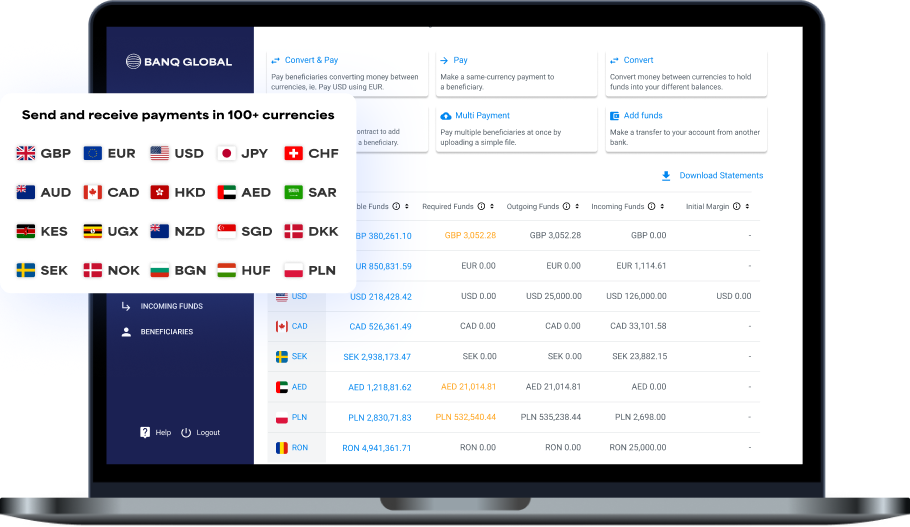
Banq Global offers a simpler route for non-resident businesses facing strict Polish banking requirements. It suits startups, e-commerce companies, consultants, and globally operating firms, including foreign-owned entities and non-resident shareholders, that do not require a full traditional banking relationship in Poland. It offers
- Multicurrency accounts with full online banking and international payment control features
- Supports international payments in over 130 currencies, with foreign exchange mark-ups starting from 0.2%.
- Faster onboarding and dedicated account manager support.
- Provision of escrow options, risk management tools, international trade finance solutions, and treasury-related services where required, through its partner networks.
How much does it cost to open a business account in Poland with Banq Global?
Opening a standard business account with Banq Global to manage Polish Zloty (PLN) is subject to pricing based on the latest approved commercial terms at the time of account setup in Poland. Bespoke plans are available for high-turnover businesses or complex corporate structures with no hidden fees.
What Are the Eligibility Criteria To Open a Business Account in Poland with Banq Global?
Eligibility is typically based on the existence of a registered legal entity, a clearly defined business model, and a transparent ownership structure, supported by standard KYC and UBO documentation.
How to Open a Banq Global Business Account for Poland?
The onboarding process is straightforward with Banq Global:
- Verify eligibility
- Submit application
- Provide KYC and UBO evidence
- Send the document pack to the assigned manager
- Await response
- Receive account details
- Activate access.
Practical Checklist: Preparing to Open a Business Bank Account in Poland
Before starting your application, make sure you have the following ready:
- Company registration documents (KRS, NIP, REGON)
- Identification documents for directors and shareholders
- UBO (beneficial ownership) information
- A clear explanation of your business activities and the source of funds
- Properly translated documents (into Polish, where required)
- A decision on the type of provider (traditional bank or alternative)
FAQs
What types of bank accounts are available?
Polish banks offer several types of business accounts, including
- Standard accounts for small local companies
- Merchant accounts for accepting payments
- Multicurrency accounts for international transactions
- SME-focused accounts, startup accounts with flexible terms, and
- Corporate accounts for larger businesses require advanced financial services.
Do you need to register a company before opening a business bank account in Poland?
Yes, in Poland, you must register your company before opening a business bank account. Because banks ask for official registration numbers, including KRS (National Court Register), NIP (Tax Identification Number), and REGON (Statistical Number), which are obtained within 1–3 weeks for traditional, or 48 hours for S24 registration.
What risk factors can affect opening a Polish business account?
Banks may treat companies as higher risk if they operate in sensitive sectors (e.g. metals, fuel, crypto, gambling), have complex ownership, use real estate commercially, or involve high-risk countries (per Financial Action Task Force (FATF) lists).
How do FX tools help businesses pay suppliers or receive revenue in different currencies?
Foreign Exchange (FX) tools help businesses in managing international operations. They reduce the risk of currency fluctuations and lower transaction costs, so that cash flow predictability improves a lot. By implementing these solutions, companies can pay foreign suppliers on time, manage multi-currency revenue, and avoid the high fees associated with traditional banking.
What are the post obligations and best practices for businesses in Poland?
- Keep UBO records accurate and aligned with CRBR and bank records
- Set up VAT, payroll, and social security payments correctly
- Monitor account activity to match your business profile
- Keep records for large or important transactions
- Regularly review user access and approval controls to reduce risk