Challenges of Opening a Polish Business Account: What Foreign Companies Need to Know
Opening a corporate bank account in Poland is often misconstrued as a simple administrative procedure. However, in reality, it is a strict compliance-led approval process, especially for the companies that do business in Poland but are not actually based there, i.e., non-resident corporations and international businesses. According to Poland's National Risk Assessment, the country faces a high risk of money laundering (rated 3 on a 4-level scale), with estimated illicit proceeds reaching roughly 3.3% of its GDP. To mitigate this risk, AML efforts in Poland have intensified, with investigations increasing by nearly 30% between 2020 and 2025. Against this backdrop, many guides suggest quick online onboarding, but this is often not the case. In practice, approval is not guaranteed, timelines are unpredictable, and rejection can occur without explanation.
Why Is Opening A Business Account In Poland More Difficult Than Expected?
Because Poland is implementing EU AML directives (AMLD5 and AMLD6) to align with a stricter EU-wide framework. Moreover, the creation of the Anti-Money Laundering Authority (AMLA), alongside stronger supervision by the General Inspector of Financial Information (GIIF) and the National Revenue Administration (KAS), has pushed Polish banks to take a far more cautious approach.
A central feature of this system is AML risk scoring, where banks assign low, medium, or high risk levels to customers and transactions. It focuses on five factors to identify money laundering.
- Customer risk (who are you)
- Geographic risk (where you operate)
- Products/service risk (what financial products you use)
- Transaction risk (how money moves)
- Delivery channel risk (how services are provided, e.g., online vs in-person)
From a Polish banking perspective, if a business has foreign owners, operates in multiple countries, or handles international payments, it is usually seen as higher risk. It means more AML checks and increased scrutiny.
KYC And Compliance: The Core Barrier Sanctions Screening
Compliance is one of the most important challenges while opening a Polish business account. It includes know-your-customer (KYC) procedures, sanctions screening, and verification of ultimate beneficial ownership (UBO) in addition to AML checks.
For international founders, the challenge lies not in submitting an application, but in meeting compliance requirements for foreign shareholders and addressing enhanced due diligence (EDD) related to beneficial ownership, source of funds, and the business model.
Banks also screen companies against sanctions lists such as the EU sanctions list, the UN sanctions list, and the OFAC list, as well as a national sanctions list to make sure they are not dealing with restricted individuals, companies, or countries.
In the end, compliance is the key decision-making factor in approval or rejection of an account application.
Foreign Ownership And Risk Perception
Limited local accountability, increased cross-border payments, and opacity in ownership structures make non-resident directors and shareholders a higher risk because they are harder to verify and monitor by Polish banks.
If we talk about red flags related to foreign ownership, they will be the following:
- Offshore or low-transparency jurisdictions
- Multi-layered or complex ownership chains
- Shareholders outside the EU
These factors increase risk perception, resulting in more checks and additional documents. On top of that, they reduce approval chances and slow down onboarding. You can consider them one of the top challenges to overcome when opening a Polish business account.
Lack Of Local Presence And Substance Requirements
Polish banks expect a clear local business rationale. It means they want a real business connection to Poland, such as clients, contracts, or operational activity in the country. They require it.
- To confirm your business is genuine and active, not just set up for convenience.
- To ensure the account will be used for real operations in Poland.
- To reduce risk from companies with no clear local presence or purpose.
“Lack of local presence and substance requirements" in the context of opening a business bank account in Poland means that Polish banks are increasingly rejecting applications from foreign companies that exist only on paper and do not have an active economic footprint within Poland.
Inconsistent Bank Requirements And Internal Policies
Since Poland is enforcing some of Central Europe's most rigorous Know Your Customer (KYC) and Anti-Money Laundering (AML) regulations, in line with EU directives. The Polish account opening process is primarily shaped by how individual banks interpret these regulations.
Each institution applies a different internal risk appetite, meaning the level of compliance, operational, and reputational risk a bank is willing to accept varies. These inconsistent bank requirements create acute unpredictability, especially when the applicant is a foreign company.
As a result, similar applications may receive different outcomes depending on the provider. For example, some banks in Poland actively avoid non-resident clients, while others accept them under strict compliance rules.
Documentation Burden And Verification Issues
At the core of all the previous challenges lies documentation, which may include:
- Identification documentation for directors and shareholders (IDs, signature specimen card, proof of address)
- Corporate documents including KRS / CEIDG extract, Articles of Association / Memorandum, NIP & REGON.
- Ownership documents such as list of shareholders, UBO details, UBO declaration, etc.
- Business activity documents like business plan, contracts, invoices, etc.
In addition to the above-mentioned documents, institutions may request additional documentation depending on the complexity of your company structure. Documents must also include certified translations into Polish, meet notarisation requirements, and undergo verification of foreign-issued documents. It is also worth stressing that even minor inconsistencies across documents can result in delays or outright rejection.
High Rejection Rates And Lack Of Transparency
The high rejection rates and lack of transparency in business bank account opening, particularly for international firms, have created a "black-box" experience in which applications are often rejected without any actionable feedback. Common triggers include:
- Unclear or unverifiable source of funds
- Weak or unconvincing business rationale
- Incomplete or inconsistent documentation
- Links to higher-risk jurisdictions
Long Timelines And Delays In Polish Business Account Opening Process
Contrary to expectations, opening a Polish business account is full of challenges, and delays are common.
- Simpler cases may be completed within 2 to 4 weeks
- Foreign ownership or more complex corporate structures can take 2 to 3 months or longer.
These long timelines result from banks carrying out multiple rounds of checks, frequently returning with additional document requests. Moreover, applications may be escalated internally for further review.
As a foreign owner, you may perceive it as a non-linear process, with frequent back-and-forth with the bank and progress depending on how quickly you respond to additional requests.
Physical Presence And Onboarding Constraints
Even if you meet compliance requirements, including KYC and AML checks, and provide all required documentation, Polish banks may still require you to be physically present to verify your identity. Most common in-person challenges international companies face while opening a Polish business account are the following:
- Mandatory visits for directors or authorised representatives
- Physical signatures on bank opening agreement and KRS documents
- In-Person Interviews (KYC)
- Personal visit to a local office in Poland to have a Polish PESEL number (Personal Identification Number)
- Limited remote onboarding options
Risk Of Account Freezes And Ongoing Monitoring
Approval is not the end of the compliance process. Banks keep on monitoring account activities under AML regulations. They also monitor transactions using the STIR system, operated by the National Clearing House (KIR).
In this complex regulatory environment, foreign investors and businesses increasingly face a challenging obstacle, bank account blockades or account freezes. Under Polish law, a bank account can initially be frozen for up to 72 hours. This period may be extended (3–6 months or more) by authorities such as the General Inspector of Financial Information (GIIF) or prosecutors during investigations.
The primary reasons behind such actions are suspicions of money laundering, VAT fraud, or missing KYC documentation.
Choosing Between Banks, Digital Providers And Specialist Providers
Choosing the right provider is important to overcome challenges when opening a Polish business account. As this choice directly affects your approval chances, timelines, and overall experience.
Traditional Banks
Traditional banks offer strong regulatory and local integration. However, they follow strict onboarding rules. They ask for more documents and take longer to review applications. For non-resident or complex structures, rejection rates are generally higher.
Fintech Providers
Fintech providers focus on speed and usability. They typically offer faster onboarding, user-friendly platforms, and competitive FX and payment solutions. However, they often do not accept businesses with complex ownership structures or higher risk profiles.
Specialist Providers
Specialist providers are specifically designed for cross-border and non-resident clients. They understand complex corporate structures, UBO requirements, and international transaction flows. For many international businesses, especially those facing challenges with traditional banks or fintechs, specialist providers offer a more practical alternative route for opening a business account in Poland.
Banq Global: A Simpler Alternative Route For Non-Resident Businesses
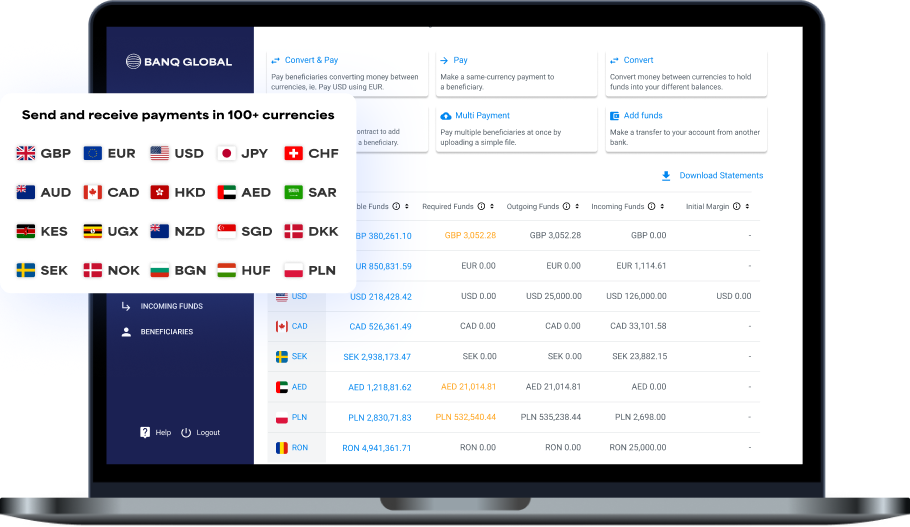
Banq Global offers a practical alternative route for non-resident businesses who are facing strict Polish banking requirements. It provides fast, fully remote onboarding without physical presence. Businesses get multicurrency accounts, international payment support, and dedicated account managers. Its guided onboarding process aligns with KYC and compliance requirements, even for complex structures.
It also supports ongoing monitoring through early-stage compliance checks and transaction transparency, which helps reduce the risk of account freezes over time.
How Can Companies Reduce The Risks Of Rejection When Opening A Polish Business Account?
International companies with non-resident directors and complex ownership can reduce the risk of rejection by:
- Preparing complete and consistent document packages with no gaps.
- Ensuring full transparency of your UBO (ultimate beneficial owner) structure.
- Providing a clear and credible business rationale explaining why you need an account in Poland.
- Showing genuine links to Poland, such as clients, suppliers, or contracts.
- Responding quickly to any additional requests from the bank.
- Selecting an account provider who understands the needs of your business.
FAQs
Is it easy to open a bank account in Poland?
Opening a bank account in Poland is easy for residents with a PESEL number, a passport, and a local address. The process usually takes 5 days to 2 weeks, and banks often require an in-branch visit. For non-residents, the process is far more challenging, and rejection rates are quite high with no clear appeal process. They can use specialist providers as an alternative route.
Why do Polish banks reject business account applications?
Polish banks often reject business account applications, particularly for non-residents or foreign-owned companies, due to strict compliance with anti-money laundering (AML) regulations, "Know Your Customers" (KYC) protocols, and internal risk policies.
What is an ultimate beneficial owner in Poland?
According to the Polish AML Act, an ultimate beneficial owner (UBO) is the person who ultimately owns or controls a company, either directly or indirectly, and has the power to make important decisions about how the business operates.
What is the PESEL identification number and does it require when opening a Polish business account?
The PESEL is composed of an 11-digit identification number in Poland that includes your birth date, a unique number, gender, & a control digit. It is commonly required for activities such as tax filing, employment registration, healthcare access. It is also required for many legal and banking processes, including opening a bank account.
What is the STIR system in Poland and can it affect your Polish business account?
The STIR system is a Polish anti-fraud tool that checks bank transactions in real time to detect VAT fraud. Managed by KIR, it uses data to identify unusual activity. In high-risk cases, tax authorities can temporarily block business accounts for up to 72 hours, which may disrupt operations.