How to Pay Polish Suppliers: Methods, Accounts, and International Payments
In recent years, approximately 25,000 foreign-owned companies have been operating in the Polish market, with total investment reaching 262.4 billion PLN (Statistics Poland). This reflects a high volume of international transactions and the need for reliable payment methods in the country to pay Polish suppliers. However, international corporates and finance teams must handle PLN currency conversions, compliance requirements and sanctions screening, as well as different payment rails depending on location and urgency. At a practical level, it includes PLN vs EUR payments, SEPA vs SWIFT routing, VAT-related checks such as the white list, and foreign exchange costs typically ranging from 1–3% per transaction. Payment efficiency also depends on using the right account structure, particularly multicurrency solutions, to avoid delays and rejections.
Polish Payment Market and Polish Customers
Poland has a highly developed payment market where bank transfers dominate B2B transactions. Because they are fast, low-cost, and secure, around 70–80% of corporate payments are settled via bank transfers. Domestic rails include
- ELIXIR (same-day settlement),
- Express Elixir (instant 24/7 payments) and
- SORBNET2 (high-value transactions).
Alongside bank transfers, mobile solutions like BLIK have seen rapid adoption. It is a key method for retail mobile payments, with over 15–18 million users and more than 1 billion transactions annually. This growth is supported by a booming e-commerce sector, which is expanding at around 10–15% per year and with over 75% of internet users shopping online. It reflects a growing preference among Polish customers for digital payments, with smartphones increasingly replacing traditional card payment methods.
Digital Payment Methods To Use When Paying Polish Suppliers?
Polish suppliers prefer reliable domestic bank payments (PLN or EUR) with speed and accuracy. However, international businesses often need alternative methods to pay Polish suppliers across borders, where fees often depend on the transaction value and payment method used. As a result, businesses rely on a mix of bank transfers and international payment options based on location, currency, urgency, and invoice size.
SEPA transfers (Single Euro Payments Area)
For digital payments within the EU, SEPA transfer is the most efficient and secure payment method. It offers low-cost or free payments with settlement usually within one business day. They are typically used for medium to high-value invoices, generally ranging from €1,000 to €50,000 or more. However, they only support EUR payments and are limited to around 36 SEPA countries.
SWIFT (Society for Worldwide Interbank Financial Telecommunication)
For international transactions outside SEPA, SWIFT transfers are commonly used, allowing online payments in PLN or other currencies. They are generally suited for high-value invoices, often starting from €10,000 and extending to much larger amounts. However, they may involve intermediary fees, which are not always visible upfront and can increase the total cost of the transaction, as well as longer processing times (1–3 business days).
Fintechs and neobanks
Providers such as Wise and Airwallex offer a flexible option for international payments, allowing businesses to manage multiple currencies in one account. This payment method is commonly used for medium to high-value invoices, typically ranging from €1,000 to €100,000 or more, especially for recurring payments. They offer fast payment options along with lower FX markups and a user-friendly payment interface, though they may lack full banking services depending on the provider.
Card payments (credit/debit)
In this method, small and immediate payments are processed through card networks such as Mastercard and Visa. They are typically used for low to medium-value invoices, usually under €5,000. They allow instant settlement and short-term liquidity but involve higher processing fees (around 1.5–3% or more) and carry chargeback risk.
Online payment platforms
Providers like PayPal, offer fast and secure payment options, particularly for small or one-off purchases (often under €10,000). A key benefit of this payment method is the ability to store money in a digital wallet and access funds quickly without relying on traditional bank transfers. However, they are usually more expensive due to higher fees and less favourable currency conversion rates when compared to SEPA and fintech providers.
Compliance, Tax, And Localisation Requirements
Compliance requirements for international companies, especially those with complex ownership structures or non-resident directors, are critical rather than administrative when they pay Polish suppliers. Moreover, higher transaction values may require additional compliance checks.
VAT White List (Biała Lista)
For payments exceeding 15,000 PLN, businesses are required to verify that the supplier’s bank account is listed on Poland’s official VAT White List managed by the Polish Ministry of Finance.
Split Payment Mechanism (MPP)
In certain sectors and transaction types, Poland applies a Split Payment Mechanism (MPP). Under this system, the VAT portion of a digital payment must be sent directly to a dedicated VAT account, separate from the supplier’s main account.
Withholding Tax (WHT) on Digital Payments
If you are paying for certain intangible services (e.g., advisory, legal, marketing, or management), royalties, or interest, then withholding tax rules apply, i.e., you may be required to withhold 20% tax (or 19% for dividends).
Invoice and Data Accuracy
Invoices must include the correct legal entity name, tax identification numbers (such as NIP), “mechanizm podzielonej płatności” (if applicable) and verified bank account details. If the invoice is in foreign currency, accurately mention the Polish złoty (PLN) conversion rate.
Mandatory E-Invoicing (KSeF)
Starting in 2026, the National E-Invoicing System (KSeF) will become mandatory for most transactions, requiring invoices to be issued through a central government system.
Permanent Establishment (PE)
If your business, through its operations in Poland, is deemed to have a fixed establishment, you may become liable for Corporate Income Tax (CIT) on profits attributed to that entity. It is generally 19% of net profit for most companies.
Understanding FX Mark-Ups When You Pay Polish Suppliers
Traditional banks often promote “low” or “free” transfers. However, they recover costs through a spread, i.e., the difference between the mid-market rate (the real rate you see on Google) and the rate they offer. This difference is known as an FX mark-up.
In practice, FX mark-ups for international transfers to Poland typically range between 1 and 3%. On a large payment, even a 2% mark-up can result in high hidden costs. On the other hand, specialised fintech platforms often charge far lower margins, sometimes under 0.5%.
Multi-Currency Accounts And International Payments
For businesses making frequent cross-border digital payments, multicurrency accounts allow them to hold balances in PLN, EUR, and other currencies. As a result, foreign entities can avoid repeated foreign exchange conversions, which helps minimise hidden FX mark-up costs. It also enables companies to pay Polish suppliers directly in their preferred currency.
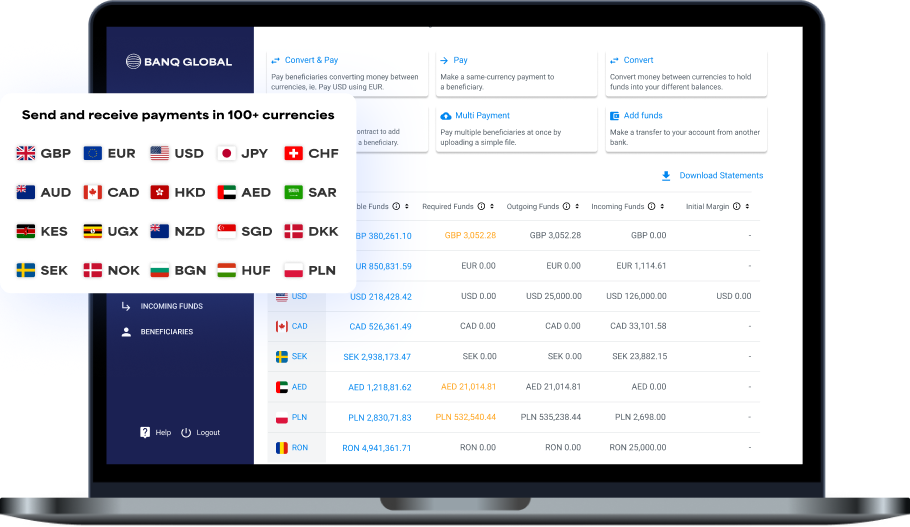
Banq Global is a multicurrency account provider which offers fully remote onboarding for non-resident businesses, removing the need to apply in person. It provides services that support digital and fast payments in over 130 currencies, along with competitive rates, with FX mark-ups starting from around 0.2%. At the same time, integrated compliance and transaction monitoring help ensure smoother operations when businesses pay Polish suppliers. Overall, it offers a full range of solutions, making it a practical option for multinational groups, family offices, and businesses with complex ownership structures.
Managing Currency Conversion Rates and FX Risk
When paying Polish suppliers, choosing between spot and forward rates depends on timing. A spot rate uses the current market rate for immediate payments, while a forward rate allows businesses to lock in an exchange rate for a future date.
Forward contracts are useful for managing currency risk and protecting against PLN volatility, providing cost certainty for future payments. However, they also mean businesses cannot take advantage if exchange rates improve. Additionally, VAT-related payments may need to follow the official rate published by the National Bank of Poland (NBP).
In practice, transparency is essential to have better control over currency conversion rates. Businesses should compare the offered rate against the mid-market rate and ensure all costs, including intermediary fees and FX mark-ups, are clearly disclosed.
Choosing The Right International Payment Route to Pay Polish Suppliers
- For the PLN invoice, use a local bank transfer. If paying from outside Poland, use a local provider that holds PLN to avoid high bank FX conversion rates.
- For an EUR invoice, use SEPA Instant Credit Transfer (SCT Inst). Ensure the recipient bank supports SEPA Instant.
- For a global supplier / non-EUR invoice, use SWIFT gpi or a fintech platform
- For high-volume payments to suppliers, vendors, or affiliates across multiple currencies, use the Multicurrency solution.
Practical Payment Process Checklist For Paying Polish Suppliers
To ensure smooth execution:
- Verify supplier IBAN and legal entity details
- Confirm invoice currency (PLN/EUR)
- Conduct VAT White List check (if applicable)
- Select appropriate payment rail (PLN/SEPA/SWIFT)
- Review FX rate and conversion costs
- Execute payment and retain remittance confirmation
For more complex setups, seeking professional advice can improve payment structures, reduce risks, and support customer satisfaction when paying Polish suppliers.
FAQs
What is the main online payment method in Poland?
Poland’s payment market is led by BLIK for consumers. At the same time, contactless card payment use is widespread. However, when businesses pay Polish suppliers, bank transfers remain the primary method. They often offer same-day settlements for domestic payments. In addition, online gateways like Przelewy24 and PayU support payments by combining transfers, payment cards, and BLIK options.
How long do bank transfers to Poland take?
SEPA transfers (in EUR) usually take one business day to pay Polish suppliers, whereas traditional SWIFT transfers may take 2–3 business days. Modern fintech services often provide faster, same-day processing.
Can I use a credit card to pay Polish suppliers?
Card payments such as Visa and Mastercard are accepted in Poland, but they are less commonly used for B2B transactions, where direct bank transfers or BLIK are preferred. Some smaller suppliers may not support card payments.
What are the standard payment terms in Poland?
Standard payment terms are often within 30 days, but legally, payments in commercial transactions cannot exceed 60 days unless expressly agreed and not grossly unfair to the seller.
How can businesses ensure security and prevent unauthorised transactions in global trade payments?
To ensure security and prevent unauthorised transactions, Polish businesses should use reputable payment providers, implement strict encryption (SSL/TLS) and adopt two-factor authentication (2FA). They must also comply with EU GDPR and anti-money laundering (AML) regulations and use AI-based fraud detection tools where possible.
How to pay Polish suppliers from the UK?
To pay Polish suppliers from the UK, businesses usually use international bank transfers (SWIFT/IBAN), specialist currency providers, or digital payment platforms. The best option depends on how quickly you need to pay and how much you want to save on currency conversion rates and fees.