Non-Resident Business Banking in Mauritius
Mauritius is an established international financial centre serving global businesses, holding companies, Special Purpose Vehicles (SPVs) and family offices managing cross-border investments and financial operations. Its banking ecosystem supports these structures through foreign currency accounts, multi-currency payments, treasury services and international transactions.
However, accessing non-resident business banking in Mauritius is not always straightforward. Banking eligibility, account requirements and onboarding processes vary by provider and depend largely on the company's structure, particularly whether it is a GBC or AC, as well as its ownership, business activities and international banking needs.
Why International Businesses Bank in Mauritius?
Mauritius offers several advantages for international businesses seeking non-resident business banking in Mauritius, including:
Political and Economic Stability
Mauritius ranked 2nd out of 54 African countries in 2024 Ibrahim Index of African Governance (IIAG) and 21st globally in the 2026 Index of Economic Freedom with an overall score of 73.0. Its economic credentials are further supported by Moody’s Baa3 sovereign credit rating, placing it among the few African countries maintaining investment-grade status.
Strategic Investment Gateway
Positioned at the crossroads of Africa and Asia, Mauritius functions as an international financial centre (IFC) for global businesses and investors. Its financial sector supports family offices, trusts and foundations through services such as fund administration, wealth management and international portfolio management.
Hybrid Legal Framework
Mauritius has a hybrid legal system influenced by French Civil Law and English Common Law, providing an established framework for commercial transactions, asset structuring and dispute resolution.
Foreign Exchange Flexibility
Mauritius has a liberal foreign exchange regime with no general exchange controls on international transfers. Businesses can transfer funds abroad without prior government approval, hold and operate multi-currency accounts, and receive foreign currency without statutory caps. Private-sector businesses are also generally not required to bring foreign currency earned abroad back into Mauritius.
Global Compliance Standards
Mauritius maintains FATF compliance through its AML/CFT framework and supports OECD tax transparency through the Common Reporting Standard (CRS) for automatic exchange of financial account information.
Moreover, the country is not included on the EU list of non-cooperative jurisdictions for tax purposes. The Bank of Mauritius (BOM) applies risk-based supervision, while Basel III implementation under the Banking Act 2004 strengthens the regulatory framework for non-resident business banking in Mauritius.
Can a Non-Resident Open a Corporate Bank Account in Mauritius?
Yes, several Mauritius banks and specialist multi-jurisdictional providers accept companies with non-resident directors and shareholders, but eligibility depends heavily on your entity type, economic substance, and the banking institution you choose. Moreover, account providers also assess factors such as nationality, business activity, ownership structure and source of funds before approval, rather than non-resident status alone.
GBC vs AC: Banking Requirements in Mauritius
Mauritius offers two main company structures for international businesses: global business companies (GBCs) and Authorised Companies. Although both structures fall under the same Companies Act, their tax, banking and regulatory requirements differ. Choosing the wrong structure to reduce initial costs may create difficulties when accessing non-resident business banking in Mauritius or qualifying for tax treaty benefits.
Authorised Company (AC)
- Treated as non-resident for tax purposes.
- Not required to hold a domestic Mauritius bank account; can maintain operating accounts outside the jurisdiction.
- Control, management, and business activities must be carried out entirely outside Mauritius.
Global Business Company (GBC)
- Treated as tax-resident in Mauritius.
- Designed for fund management, holding structures, and operational businesses leveraging Mauritius's extensive Double Taxation Avoidance Agreement (DTAA) network.
- Required to maintain a principal bank account in Mauritius as part of its economic substance rules.
What substance requirements must a GBC meet in Mauritius?
Under Mauritius law and the Financial Services Commission (FSC) framework, a GBC must meet local substance and ongoing regulatory requirements. These include at least two resident directors, registered office in Mauritius, carrying out required business activities locally, and being administered by an FSC-licensed management company.
Effective 19 June 2026, the FSC introduced a new authorised bank signatory regime requiring each GBC bank account to include at least one approved officer of its management company among its authorised signatories.
Types of Non-Resident Business Accounts in Mauritius
Non-resident business banking in Mauritius offers different account options depending on the requirements of foreign-owned companies with non-resident directors and shareholders.
Foreign Currency Account
Holds funds in a specific foreign currency, such as USD, EUR or GBP, allowing businesses to receive and hold foreign funds without mandatory conversion to Mauritian Rupees (MUR).
Business Current Account
Supports everyday business transactions, operational expenses, and local payments, with access to internet and mobile banking services.
Corporate Settlement Account
Designed for businesses that need to process, clear, and reconcile high volumes of domestic or international trade and settlement operations.
Multi-Currency Account
Allows businesses to hold and manage multiple currencies, helping reduce unnecessary conversions and manage international cash flows. Depending on the provider, services may include foreign exchange, and access to the IBAN numbering system for supported accounts.
Traditional, Digital and Specialist Options for Non-Resident Business Banking in Mauritius
Corporate advisers should view non-resident business banking in Mauritius through three distinct options: domestic Mauritius banks, international digital providers and specialist multi-jurisdictional providers. Each solves a different operational or regulatory need, and companies may use more than one.
Traditional Mauritius Banks
Domestic Mauritius banks such as MCB, SBM Bank, Absa Bank Mauritius and HSBC Mauritius serve GBCs that must maintain a principal bank account locally. They offer established domestic banking relationships, with services including treasury services, trade financing, wealth management, structured lending and investment banking. However, complex structures and non-resident shareholders can face extensive KYC reviews, compliance checks, documentation, possible in-person requirements and longer onboarding timelines.
Digital Account Providers
Digital account providers such as Wise Business and Revolut Business offer foreign exchange, cross-border transactions and online account management, often with faster digital onboarding and lower transaction costs. They are best suited to straightforward, day-to-day transactional needs rather than GBC substance requirements or complex ownership structures. They cannot replace the principal Mauritius bank account required for a GBC, while eligibility, transaction limits and available services vary between providers.
Specialist Multi-Jurisdictional Providers
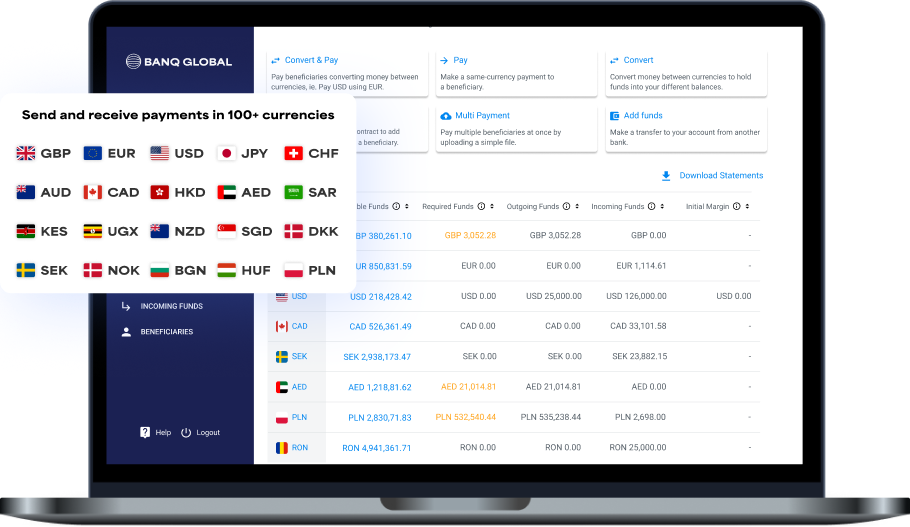
Specialist multi-jurisdictional providers such as Banq Global offer a secondary, multi-jurisdictional account for Mauritius registered companies alongside the mandatory domestic account for GBCs. Banq Global provides access to accounts across 20+ jurisdictions and supports 30+ currencies, with remote onboarding for non-resident directors, international shareholders and complex structures. This option helps international groups manage foreign exchange, payments and operational cash flows across several countries without replacing the principal Mauritius GBC bank account.
Documents Needed to Open a Non-Resident Business Account in Mauritius
To open a non-resident business account or offshore bank account in Mauritius, foreign owned companies typically need:
Corporate Documents
Certificate of incorporation, articles of association, register of directors, board resolution and, where required, a certificate of good standing.
Ownership and KYC Documents
Ownership structure and ultimate beneficial owner details, with certified passports and proof of address for directors, non-resident shareholders, UBOs and authorised signatories.
Source of Funds and Wealth
Evidence establishing the source of funds (SOF) of the company and, where required, the source of wealth (SOW) of its UBOs.
Business Profile
Details of business activities, clients, operating jurisdictions, expected revenue and reasons for undertaking cross-border transactions.
Transaction Profile
Expected currencies, transaction volumes, payment corridors and counterparties, particularly when applying for a multi-currency account or foreign currency account.
Supporting Documents
Financial statements, contracts, bank references and other documents required during the bank’s compliance check.
It is important to note that foreign owned companies involved in higher-risk activities, such as precious metals trading, gaming or foreign exchange services, may also face enhanced due diligence and additional documentation requirements, when applying for non-resident business banking in Mauritius.
How to Open A Mauritius Business Bank Account for Non-Residents
Opening a business account in Mauritius as a foreigner involves the following key steps.
Step 1: Confirm your Company Structure and Banking Requirements
Choose between a GBC and an Authorised Company based on your business activities and banking needs. Register the company with the Corporate and Business Registration Department (CBRD), with the relevant Global Business Licence or AC authorisation obtained from the Financial Services Commission (FSC) through a licensed Management Company.
Step 2: Choose a Bank or Account Provider
Selecting a provider for non-resident business banking in Mauritius depends on your company’s structure, banking needs and international operations. Compare available account types, fees and minimum deposit requirements. Also, confirm whether the provider supports the currencies you need, such as USD, EUR, GBP, ZAR or AUD.
Step 3: Confirm Eligibility and Onboarding Requirements
Confirm account eligibility and onboarding requirements with your chosen bank. For GBCs, an FSC-licensed Management Company helps in
- Verifying directors, shareholders and ultimate beneficial owners (UBOs).
- Conducting initial KYC and due diligence.
- Preparing and coordinating documents for domestic bank account applications.
- Supporting the company's ongoing regulatory compliance.
However, the management Company does not replace the bank's own KYC and AML checks. The bank independently decides whether to approve the account.
Step 4: Prepare and Submit the Application
Complete the non-resident corporate business account Mauritius application and submit the required documents. Ensure all information is complete and consistent to avoid delays during the compliance review.
Step 5: Complete Compliance Review
The provider reviews the application and may request clarification, additional documents or an interview with authorised signatories.
Companies with complex ownership structures, politically exposed persons or higher-risk activities may undergo enhanced due diligence and additional compliance checks.
Step 6: Activate the Business Account
Once approved, complete any remaining account-opening formalities, including the initial deposit where required. The bank then provides account details and access to available internet banking, foreign currency accounts and other approved services.
Non-Resident Business Account Opening Timeline in Mauritius
Opening a non-resident business bank account in Mauritius may take a few weeks for straightforward applications, while complex cases can take longer. Traditional Mauritius banks often have more extensive onboarding & compliance reviews, while digital account providers may offer faster onboarding for straightforward company structures.
In comparison, Banq Global can open a secondary international account for Mauritius-registered holding companies, Special Purpose Vehicles (SPVs), international trading companies, investment vehicles and family offices in around five working days, provided all documents are complete and the application is approved. As processing times and internal risk requirements vary between institutions, businesses should confirm current account-opening timelines directly with their chosen provider.
Ongoing Compliance for Non-Resident Business Accounts in Mauritius
After opening a non-resident business account in Mauritius, maintaining your corporate and banking structure requires strict adherence to ongoing financial and operational compliance frameworks.
Periodic KYC & AML Reviews
Banks periodically review ownership, UBO details, business activities, transaction patterns and source of funds or wealth, and may request updated KYC documents.
Common Reporting Standard (CRS)
To meet CRS requirements, financial institutions report relevant account information annually to the Mauritius Revenue Authority (MRA). The MRA may then share this information with the relevant foreign tax authorities.
FATCA Reporting
Where U.S. tax-reporting requirements apply, banks may require FATCA documentation, such as Form W-8BEN-E or W-9. Reportable account information is submitted through the applicable framework for exchange with the U.S. Internal Revenue Service (IRS).
Maintaining Economic Substance Requirements For GBCs
Under the Financial Services Act and applicable FSC requirements, GBCs must continue to meet Mauritius substance requirements, including maintaining resident directors, an FSC-licensed Management Company, a principal bank account in Mauritius and adequate local substance based on their activities.
Financial Auditing and Statutory Tax Filings
GBCs must also file audited financial statements with the FSC within six months of their financial year-end and an annual corporate tax return with the MRA. Even if your entity qualifies for partial exemption regimes, an accurate and timely return is required to secure a Tax Residence Certificate (TRC).
Why Some Non-Resident Applications Get Rejected
Non-resident business banking applications in Mauritius are commonly rejected due to several key factors:
Incomplete Wealth & Fund Documentation
Banks require clear verification regarding the source of wealth (SoW) and source of funds (SoF). Failing to provide a clear, paper-documented trail of how corporate or personal wealth was built, may delay or prevent approval.
Unclear Business Activity Descriptions
If a bank cannot easily understand how your business generates revenue, it represents an unquantifiable risk. Vague descriptions or overly complex operational models often lead to swift rejections.
Sanctioned-Country Exposure
Any direct or indirect operational, client, or transactional link to sanctioned jurisdictions or high-risk geographic zones will trigger additional sanctions screening and compliance checks.
Opaque Shell-Entity Structures
Corporate structures layered with shell companies, nominee arrangements, or hidden UBOs are heavily scrutinized. Banks will not approve accounts without clear disclosure of beneficial ownership and control.
Uncertain Cross-Border Flow Intent
Mauritian banks require a clear explanation on how and why the account will be used for international transactions before approving cross-border capabilities.
Partnering with experienced business banking advisers helps properly structure applications and mitigate these compliance risks.
Choosing the Right Account for Non-Resident Business Banking in Mauritius
The right banking structure depends on whether your Mauritius company needs a domestic banking relationship, an international account for day-to-day operations, or both.
Do You Need a Domestic Mauritius Account?
If your company holds a Global Business Licence, maintaining a principal bank account in Mauritius is a regulatory requirement. An AC has greater flexibility to maintain accounts domestically or internationally, depending on its business banking needs and provider eligibility.
Do You Need a Flexible International Account for Operations?
If your business receives payments in different currencies, pays overseas suppliers or manages funds across several jurisdictions, an international multi-currency account may be more suitable for its operational needs.
For GBCs, this can serve as a secondary account alongside the mandatory principal Mauritius bank account. Authorised Companies can assess whether an eligible international account meets their needs without maintaining a separate domestic account.
FAQs
Who Can Open a Mauritius Business Bank Account for Non-residents?
Different international companies and investment structures can apply for non-resident business banking in Mauritius, including:
- GBCs
- ACs
- Foreign-owned companies
- Holding companies and SPVs
- International trading companies
- Family offices and structures established by high-net-worth individuals (HNWIs)
Can a foreign-owned company with no physical presence in Mauritius open an account?
Yes. GBCs and ACs with non-resident shareholders and directors can apply for business banking in Mauritius without the foreign owners being physically present in the country. However, banks and account providers will assess the company’s business activities, countries of operation and expected transactions before approving the account
Which banks offer non-resident business banking solutions in Mauritius?
Mauritius-based banks working with non-resident businesses include Bank One, AfrAsia Bank, ABC Banking Corporation and Investec Mauritius, alongside HSBC Mauritius and Absa Bank Mauritius. Each bank applies its own eligibility criteria, minimum deposit requirements and risk assessment when reviewing applications.
Is Banq Global regulated, and how does it differ from a Mauritius bank account?
Banq Global is not a bank but a specialist international business account provider working with regulated financial partners, including Modulr FS Limited, an FCA-authorised Electronic Money Institution (FRN 900573). Rather than replacing the mandatory domestic account a Mauritius GBC must hold, Banq provides a secondary, multi-jurisdictional account for international operations.
What are the fees for non-resident business banking in Mauritius?
Fees for non-resident business banking in Mauritius may include an application fee, minimum initial deposit, monthly maintenance charges and international transfer fees. Costs vary by bank depending on the company structure, jurisdiction, transaction volumes and level of compliance review required.
What currencies can a non-resident business account in Mauritius hold?
Mauritius business accounts can hold MUR alongside major currencies such as USD, EUR and GBP. Depending on the bank, accounts may also support ZAR, AUD, CAD, CHF, HKD, SGD, CNY, INR, JPY and AED. Non-bank secondary multi-currency platforms, such as Banq Global, expand these capabilities to support 30+ currencies for Mauritius-registered companies.