Mauritius Offshore Company: Everything You Need to Know
Today, operating offshore in Mauritius means conducting business within an internationally regulated financial centre (IFC) rather than a secrecy jurisdiction. Demonstrating its commitment to global financial standards and transparency, Mauritius exited the FATF grey list in October 2021 and was also removed from the EU AML high-risk list in March 2022. This regulatory commitment extends to international tax transparency through the OECD's Base Erosion and Profit Shifting (BEPS) initiative and reporting frameworks such as FATCA and the Common Reporting Standard (CRS).
Mauritius offshore company formation within this regulated and tax-transparent environment requires careful consideration of tax treatment, economic substance requirements and ongoing compliance obligations, which differ between Global Business Companies (GBCs) and Authorised Companies (ACs) under the Financial Services Act 2007.
Why Do International Businesses Choose Offshore Company Formation in Mauritius?
International businesses, holding companies, Special Purpose Vehicles (SPVs), investment vehicles and family offices choose Mauritius for offshore company registration because of its:
Strategic Gateway Location
Located in the Indian Ocean, Mauritius serves as a gateway to Africa and connects businesses with markets in Asia and the Middle East.
Stable Business Environment
Mauritius ranks highly in Sub-Saharan Africa for economic freedom, peace and democratic governance, offering a stable environment for international businesses and investment structures.
Hybrid Legal System
Mauritius has a hybrid legal system combining English common law and French civil law, providing a familiar legal framework and greater legal certainty for foreign-owned companies.
Skilled Multilingual Workforce
Mauritius also has a skilled workforce proficient in English and French, with expertise in legal, financial, accounting and corporate services.
Extensive Double Tax Treaty Network
Mauritius has also concluded 45 Double Taxation Agreements (DTAs) with countries across Africa, Asia and Europe, helping eligible businesses reduce double taxation and supporting cross-border investment structuring.
Flexible Corporate Structures
Under the Companies Act 2001, Mauritius permits 100% foreign ownership and generally imposes no statutory minimum share capital for ordinary private companies. It also offers a favourable tax regime and no general foreign exchange controls.
GBC vs AC: Which Structure Fits Your Mauritius Offshore Company?
Choosing the right structure for a non-resident company in Mauritius depends on where the business is managed, the nature of its activities and whether it requires access to Mauritius's DTA network. The two structures differ in the following ways:
Global Business Company Mauritius
- A GBC is fully licensed by the Financial Services Commission (FSC) of Mauritius and must maintain real economic substance within the country.
- It is a tax-resident entity that may access Mauritius's DTA network, subject to tax residency and treaty eligibility requirements.
- GBCs are used for fund management, investment holding, treasury operations, and asset management.
Authorised Company Mauritius
- An AC is an entity incorporated in Mauritius but centrally managed and controlled outside Mauritius.
- It is considered non-resident for tax purposes under Section 73A of the Income Tax Act 1995. Unlike eligible GBCs, ACs cannot access Mauritius's DTA network.
- It is also strictly barred from offering financial services (including banking) as a business activity. However, an AC can hold its own operating bank account for business transactions, subject to bank approval.
- ACs are commonly used for investment holding, international trading, shipping, IT services, and consultancy.
Tax Treatment of a Mauritius Offshore Company
Mauritius's DTAs can help eligible GBCs avoid double taxation on cross-border income, but they do not make Mauritius a tax-free jurisdiction. Instead, it offers a competitive tax system for international structures monitored by the Mauritius Revenue Authority (MRA).
Corporate income tax
GBCs pay 15% corporate tax on chargeable income. However, they may qualify for an 80% partial exemption on certain foreign dividends and interest, bringing the effective tax rate down to around 3%. To qualify, they must meet the eligibility and economic substance requirements.
Foreign-source income generated by ACs is generally not subject to Mauritius corporate income tax (effectively 0%). However, any income sourced locally in Mauritius remains subject to the applicable corporate tax rate.
Capital Gains and Withholding Taxes
Mauritius generally imposes no capital gains tax or withholding tax on dividends paid to non-residents. Certain interest and royalty payments to non-residents may attract 15% withholding tax. However, exemptions and treaty relief may change the outcome.
Tax Losses Carry-Forward Rules
Eligible tax losses can generally be carried forward for five years. However, a change of more than 50% in shareholding may restrict this benefit, subject to statutory exceptions.
Requirements to Set Up a Mauritius Offshore Company
Once the appropriate Mauritius offshore company structure is chosen based on your business needs, international companies must meet the incorporation requirements of the Corporate and Business Registration Department (CBRD) and the licensing or authorisation requirements of the Financial Services Commission.
Mauritius GBC Requirements
- At least one shareholder, who may be a non-resident individual or corporate entity.
- At least two individual directors resident in Mauritius.
- A company secretary and registered office in Mauritius.
- Administration through an FSC-licensed management company.
- A Global Business Licence issued by the FSC.
- A principal bank account maintained in Mauritius (Financial Services Act 2007, Section 71).
- Core income-generating activities, suitably qualified personnel and operating expenditure in Mauritius, as required for the business.
Mauritius AC Requirements
- At least one shareholder and one director, who need not be Mauritius residents.
- A registered office in Mauritius and a management company acting as licensed registered agent.
- Authorisation from the FSC.
- A business plan, ownership information and supporting due diligence documents for the application.
Note: Non-resident shareholders do not need an Occupation Permit, Residence Permit or Permanent Residence Permit to incorporate a company in Mauritius. These permits are only relevant if they intend to live or work in the country, subject to immigration rules.
Mauritius Offshore Company Formation: Step by Step
Mauritius offshore company formation can generally be completed remotely through a management company, without requiring shareholders to travel to Mauritius. The process involves the following steps:
Step 1: Check Company Name Availability
Choose a company name and check its availability with the Registrar of Companies (ROC). Formal name reservation is optional, but the name must meet applicable naming requirements and avoid restricted terms without the necessary approval.
Step 2: Prepare Incorporation and Due Diligence Documentation
Gather the required incorporation documents and Know Your Customer (KYC) information, including certified copies of director and shareholder IDs (passports), proof of address (utility bills under 3 months old), a detailed business plan, and verifiable declarations regarding your source of funds and source of wealth.
Step 3: Submit the Application
The licensed management company coordinates the incorporation application with the CBRD and the relevant licence or authorisation application with the FSC.
Step 4: Complete Regulatory Review
The FSC reviews the application and may request clarification or additional documents. Approval depends on the proposed activities, beneficial ownership structure and satisfaction of applicable regulatory requirements.
Step 5: Receive Incorporation and FSC Approval
Following the required approvals and payment of statutory fees, the Registrar of Companies issues the Certificate of Incorporation and the company receives its applicable FSC licence or authorisation.
Step 6: Arrange Non-Resident Business Banking in Mauritius
Apply for a corporate bank account using the company's incorporation and regulatory documents.
Banking for Your Mauritius Offshore Company
Opening a non-resident business bank account in Mauritius can be more time-consuming than incorporating the company itself, as local banks typically require extensive documentation and due diligence. Since many Mauritius GBCs and ACs conduct international trading, investment or holding activities, they also need to receive and make payments in multiple currencies, regardless of where their bank accounts are held.
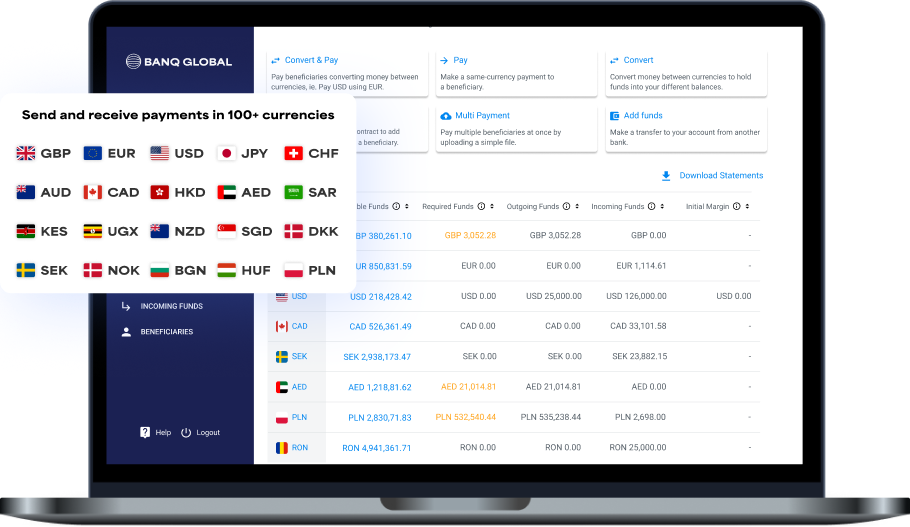
Specialist multi-jurisdictional providers such as Banq Global offer a multi-currency business account for Mauritius-registered GBCs and ACs including holding companies, Special Purpose Vehicles (SPVs), international trading companies, investment vehicles and family offices, to manage their day-to-day international operations after incorporation. Businesses can receive, hold and send payments in 30+ currencies, including USD, EUR and GBP, using local payment networks and international payment rails such as SWIFT. With fully online onboarding, Banq Global supports non-resident directors and shareholders from 190+ countries.
Compliance and Ongoing Obligations
Beyond banking arrangements, a Mauritius offshore company must meet ongoing regulatory, tax and reporting obligations, including:
Audited Financial Statements
GBCs must prepare IFRS-compliant financial statements, have them audited by a Mauritius-approved auditor and file them with the FSC within six months of the financial year-end. ACs submit an annual financial summary instead.
Annual Return to the Registrar of Companies
Meet applicable annual filing requirements and keep statutory registers of directors, shareholders and beneficial owners up to date.
Income Tax Return
Submit an annual corporate tax return to the Mauritius Revenue Authority (MRA) within six months of the financial year-end.
AML/CFT Compliance
Maintain ongoing due diligence, source-of-funds checks and risk assessments for directors, shareholders and beneficial owners in accordance with Anti-Money Laundering (AML) and Combating the Financing of Terrorism (CFT) requirements, through the licensed management company.
Maintaining Substance Requirements
GBCs must maintain economic substance in Mauritius, including holding local board meetings. Failure to meet these ongoing requirements may lead to the loss of applicable tax benefits.
Is a Mauritius Offshore Company Right for Your Business?
Mauritius can be a suitable jurisdiction for holding companies, Special Purpose Vehicles (SPVs), investment vehicles and family offices seeking a stable base for investments across Africa and Asia, particularly where access to Double Taxation Agreements (DTAs) is important.
However, these advantages come with economic substance rules and compliance responsibilities. If your objective is simply to establish a low-cost offshore shell without meaningful operations, Mauritius may not be the right jurisdiction.
FAQs
Can a non-resident open an offshore company in Mauritius?
Yes. Both the GBC and Authorised Company are built for non-resident ownership. A GBC needs resident directors and a resident company secretary administering it locally, but shareholders and ultimate beneficial owners can be based anywhere. An AC goes further: it must be owned and controlled entirely by non-residents.
Are GBCs and ACs the only structures available for offshore company formation in Mauritius?
No. Mauritius also offers specialised structures, including Protected Cell Companies (PCCs) for asset segregation, Limited Partnerships (LPs) for private equity and joint investments, and Variable Capital Companies (VCCs) for investment funds. Mauritius also regulates pooled investment arrangements through Collective Investment Schemes (CIS).
What documents do I need to incorporate a Mauritius offshore company?
Typically proof of identity and address for all directors, shareholders and beneficial owners, a business plan describing the company's activities, source-of-funds and source-of-wealth documentation, and the company's constitutional documents. Expect most of this to be requested again when the company opens its operating bank account.
How long does it take to set up a Mauritius offshore company?
Mauritius offshore company incorporation and FSC approval typically take around 2–4 weeks for straightforward applications, while complex GBC structures may take 4–8 weeks. However, these are indicative estimates, not guaranteed timelines, as processing depends on documentation, due diligence and the FSC's workload. Bank account opening is a separate process and may take additional weeks.
What does it cost to set up and run a Mauritius offshore company?
As of 1 July 2026, FSC application fees are USD 600 for both GBCs and ACs, while annual FSC fees are USD 2,600 for GBCs and USD 1,400 for ACs. Additional costs include CBRD incorporation and annual registration fees, licensed management company charges, registered office services and applicable audit and compliance expenses. Treat upfront incorporation cost and ongoing running cost as two separate budget lines.
Can a Mauritius offshore company use an international business account?
Yes. Banq Global can serve as a secondary multi-currency business account for GBCs alongside their mandatory principal bank account in Mauritius. For Authorised Companies, it may serve as an international operating account for day-to-day transactions, subject to eligibility and approval.