Kenya Foreign Exchange Regulations: What International Businesses Need to Know
Kenya no longer operates capital controls, but multinational groups still face significant operational, tax, banking, and compliance considerations when making a Kenyan Shilling (KES) international transfer. Documentation requirements, tax obligations, banking due diligence, regulatory oversight, and foreign exchange market conditions can all affect the speed, cost, and execution of cross-border transactions, particularly for non-resident companies and foreign-owned subsidiaries.
Kenya foreign exchange regulations shape the broader framework within which Kenyan Shilling (KES) conversions and cross-border transfers are planned and executed. Businesses that understand and plan for these requirements are better positioned to execute cross-border payments efficiently while minimising delays, compliance risks, and unnecessary costs.
Kenya Foreign Exchange Regulations: The Basics
Kenya repealed all formal exchange control laws in 1993 by abolishing the Exchange Control Act, transitioning to a market-determined exchange rate system. As a result, there are generally no government permits required to transfer funds into or out of the country.
That does not mean the foreign exchange market operates without oversight. Instead, the Central Bank of Kenya (CBK) oversees the market through the Forex Code 2023, which sets integrity and conduct standards for the wholesale interbank FX market. The Code governs how market participants behave, not who can move capital. It does not reintroduce exchange controls or place legislative restrictions on the free movement of capital into or out of Kenya.
Does a Foreign-Owned Subsidiary in Kenya Need CBK Approval to Repatriate Profits and Dividends?
Subsidiaries of foreign parents in Kenya can generally make profit remittances by freely repatriating profits and dividends to non-resident companies without needing specific CBK approval or a transfer permit, and currency exchanges rely on free, market-determined rates. However, the bank may still pause, review, or seek further information before executing the payment.
Practical Challenges When Moving Money Out of Kenya
High-Value Transfers and CBK Oversight
Although Kenya foreign exchange regulations allow the free movement of capital, not all international transfers receive the same level of scrutiny. For transfers that meet or exceed the USD 500,000 threshold, the authorised commercial bank and authorised dealers may consult the Central Bank of Kenya (CBK) regarding the amount and purpose of the remittance before processing it.
AML/CTF Documentation Requirements
Depending on the nature of the transaction, businesses may be asked to provide corporate records, beneficial ownership information, tax documents, board or dividend resolutions, invoices, letter of credit, intercompany agreements, purpose-of-payment declarations, and other evidence supporting the transaction. These requirements have become more robust under Kenya's strengthened AML/CTF framework.
FATF Grey List and Correspondent Banking
Kenya’s placement on the Financial Action Task Force (FATF) grey list in February 2024 has added a further practical consideration. Due to which correspondent banks may apply closer risk-based scrutiny to Kenya-originated SWIFT transfers, particularly where payments are large, unusual, involve complex ownership structures, or are not supported by complete documentation. Kenya remained under increased monitoring in the FATF’s February 2026 update.
KES Liquidity and Foreign Exchange Market Conditions
Foreign exchange liquidity can create a separate operational challenge when moving money out of Kenya. Even where Kenya foreign exchange regulations do not restrict capital movement, converting a large amount of Kenyan Shillings (KES) into US dollars may depend on the prevailing USD/KES exchange rate, available KES liquidity, the size and timing of the transaction, and the bank’s access to foreign currency.
Large conversions may consequently require advance notice, staged execution, or wider pricing spreads. The issue is therefore not whether capital may legally leave Kenya, but whether the transaction is fully documented, approved through the bank’s internal controls, and executable under prevailing market conditions.
How long does moving money out of Kenya take?
Processing time depends on more than the sending bank. A straightforward SWIFT payment may clear within several business days, while a transaction referred for sanctions screening, source-of-funds checks, or correspondent-bank review can take longer.
Despite the absence of formal Kenya capital controls, there is no single CBK-mandated processing period for all large outbound transfers. So, businesses should confirm documentary and cut-off requirements with their authorised dealer before initiating payment to to minimise delays and reduce the risk of trapped cash.
Tax Obligations for Repatriating Funds from Kenya
Successfully processing a payment does not complete the repatriation process. Businesses must determine which tax obligations apply based on the nature of the payment and the business structure, when moving money out of Kenya.
Dividend Withholding Tax
Kenya imposes a standard dividend withholding tax (WHT) of 15% on dividends paid to non-resident shareholders. However, applicable Double Taxation Agreements (DTAs) may reduce the rate, with certain treaties lowering it to 10% where the relevant shareholding and beneficial ownership conditions are satisfied. Kenya has DTAs with countries including the UK, Germany, Zambia, and the Netherlands. To claim treaty relief, the foreign shareholder must generally provide a valid certificate of tax residence to the Kenya Revenue Authority (KRA).
Branch Repatriation Tax
The Finance Act 2023, effective 1 January 2024, restructured the taxation of non-resident companies operating in Kenya through a permanent establishment (PE). It introduced a 15% Repatriated Income Tax to align the tax treatment of branches with the dividend withholding tax generally applicable to subsidiaries. For multinational groups operating through a Kenya PE, the new repatriation tax represents an additional tax cost that applies alongside the 30% corporate income tax (down from 37.5%) on branch profits.
How is repatriated income calculated?
Under Section 7B of the Kenyan Income Tax Act, repatriated income is calculated using the following statutory formula:
R = A₁ + (P - T) - A₂
Where
A₁ is the net assets at the beginning of the year.
P is the net profit for the year (calculated using generally accepted accounting principles).
T is the tax payable on chargeable income.
A₂ is the net assets at the end of the year.
Worked Example
To understand the calculation using formula, assume a branch has net assets of KES 100 million at the beginning of the year. During the year, it earns KES 40 million in profit and pays KES 12 million in corporate income tax, leaving after-tax profit of KES 28 million. At the end of the year, the branch's net assets were KES 110 million.
Repatriated income is therefore:
KES 100 million + KES 28 million − KES 110 million = KES 18 million
A 15% Repatriated Income Tax would apply to the KES 18 million, resulting in a tax liability of KES 2.7 million.
Withholding Tax Remittance to the Kenya Revenue Authority (KRA)
Tax deducted from qualifying payments must be remitted to the Kenya Revenue Authority (KRA) within five working days of the deduction being made. Payers must generate both the payment slip and the withholding tax certificate through the KRA iTax Portal. These remittance requirements apply to withholding taxes only and do not include capital gains tax.
How AML/CTF Compliance Supports Kenya Foreign Exchange Regulations?
Kenya's Anti-Money Laundering and Combating the Financing of Terrorism (AML/CFT) framework is built on the Proceeds of Crime and Anti-Money Laundering Act (POCAMLA) and the 2023 Anti-Money Laundering and Combating of Terrorism Financing Laws (Amendment) Act.
- These reforms expanded AML obligations beyond banks to include lawyers, accountants, real estate agents, and digital credit providers.
- Strict UBO disclosure requirements are enforced to ensure that individuals ultimately owning or controlling legal entities are identified, preventing the use of shell companies to hide illicit wealth.
- Responsibility is shared among supervisory bodies such as the Central Bank of Kenya (CBK) and the Capital Markets Authority (CMA), with all suspicious transactions centrally reported to the Financial Reporting Centre (FRC).
- Trade finance instruments, including Letters of Credit and Documentary Collections, receive enhanced scrutiny to combat trade-based money laundering.
How can multinational groups avoid AML/CFT penalties under Kenya foreign exchange regulations?
To avoid AML/CFT penalties in Kenya, multinational group must implement rigorous Customer Due Diligence (CDD), report suspicious transactions to the Financial Reporting Centre, and screen all partners against domestic and international sanctions lists. Leveraging the trade credit and political risk facilities offered by ATIDI may also adds a strong layer of defense for cross-border trade and KES international transfers.
Does Kenya have transfer pricing rules for related party transactions (RPTs)?
Yes. The Kenya Revenue Authority (KRA) enforces strict transfer pricing guidelines aligned with the OECD. Related Party Transactions (RPTs) must be executed at arm's length, and comprehensive transfer pricing documentation is strictly required.
How Kenya Foreign Exchange Regulations Affect KES International Transfers?
Kenyan foreign exchange regulations mandate that all FX transfers are processed exclusively through CBK-authorized dealers, such as licensed commercial banks or approved forex bureaus in Kenya. Forex bureaus operate under CBK oversight but are limited to smaller transactions and are not suitable for large international business transfers, making commercial banks the preferred channel for corporate and cross-border transactions.
The Three-Tier Banking System
Kenyan banks operate on a three-tier system defined by market share, assets, and network:
Tier 1 (Large)
Tier 1 banks in Kenya include Equity Bank Kenya, KCB, ABSA Kenya, Standard Chartered Kenya, Diamond Trust Bank, Cooperative Bank Kenya, and NCBA Bank. These institutions dominate the market, maintain extensive branch networks, and offer direct SWIFT connectivity. For significant outbound payments, they are the standard route due to their correspondent banking networks and ability to support intercompany netting and intra-group transfers.
Tier 2 (Medium)
Moderate market share, expanding footprints, and typically reliant on Tier 1 or global banks for complex cross-border settlements.
Tier 3 (Small)
Niche or localized banks focused on domestic retail and small-scale corporate banking.
Strongest Correspondent Banking Corridors & FATF Grey List impacts
Kenya's listing on the Financial Action Task Force (FATF) grey list makes the use of Tier 1 banks with strong correspondent banking networks and compliance capabilities particularly important for minimising payment friction. The recommended Tier 1 banks for specific corridors include:
Kenya-to-UK
Standard Chartered and ABSA possess the strongest, direct clearing relationships into the UK, drastically reducing intermediary hops.
Kenya-to-EU
Standard Chartered remains a primary conduit, followed by Diamond Trust Bank (DTB) and NCBA.
Kenya-to-US
Equity Bank and KCB Bank offer the strongest US dollar clearing capabilities.
Structuring Banking Arrangements Under Kenya Foreign Exchange Regulations
For multinational groups with broader East Africa business banking requirements, a common banking structure combines a local KES account with a specialist international multi-currency business account. The local account is used for domestic operations, such as payroll, supplier payments, and taxes, while the international account receives and manages funds after they have been repatriated from the Kenya entity.
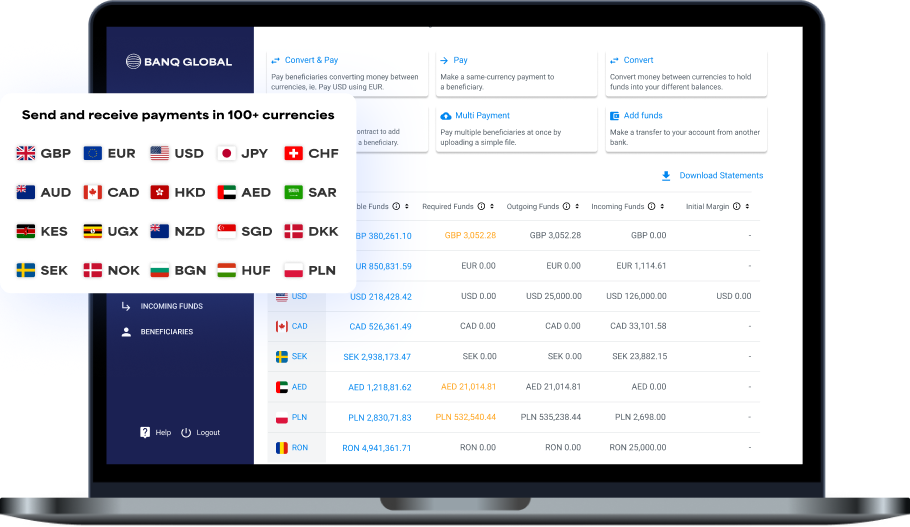
Unlike consumer-focused payment apps, a specialist business account is designed to support large intra-group transfers, complex ownership structures, and SWIFT payments across multiple jurisdictions. Banq provides multi-currency business accounts supporting 130+ currencies, SWIFT access, and applicants from 190+ countries, making it suitable for non-resident directors, shareholders, and multinational holding structures. It complements, rather than replaces, a Tier 1 bank in Kenya, which remains the primary channel for originating outbound transfers from the Kenya entity.
FAQs
Does the Capital Markets Authority (CMA) form part of Kenya foreign exchange regulations?
No. The CBK is the primary regulator of Kenya's foreign exchange market and oversees the Forex Code 2023 and authorised dealers. Whereas, the Capital Markets Authority (CMA) regulates Kenya's capital markets, including licensed investment intermediaries and online forex brokers, rather than routine foreign exchange transactions and cross-border business payments.
How long does an international transfer from Kenya take?
Most international SWIFT transfers from Kenya are completed within 2–5 business days, although some banks indicate processing times of as little as 2–3 working days where no additional checks are required. Although Kenya foreign exchange regulations generally allow the free movement of capital, wire transfers may take longer if correspondent banks perform enhanced due diligence.
What fees apply to outbound transfers from Kenya?
Outbound transfers may incur SWIFT transfer fees, correspondent banking charges, and an FX spread when converting Kenyan Shillings (KES) into another currency. There is generally no government levy on the transfer itself, although 15% dividend withholding tax or branch repatriation tax, where applicable, may reduce the net amount received. Its importmat to note here that bank fees vary by the selected provider and payment corridor.
Does Banq support businesses and holding structures with Kenya operations?
Yes, Banq Global supports businesses and complex holding structures (like SPVs and family offices) with Kenya operations. They provide specialist multi-currency accounts spanning 130+ currencies (including KES) using SWIFT payment rails across 190+ countries. Banq caters to non-resident directors and complex ownership setups, acting as your international receiving and processing hub rather than an in-country Kenya bank.
Can a non-resident director or shareholder of a Kenya entity open a Banq account?
Yes. Banq Global accepts applicants from over 190 countries with a 100% online application and account approval within 24 hours of submitting the required documentation, including certificate of incorporation, memorandum and articles of association, CR12 form, company and personal KRA PINs, board resolution, valid passport, and proof of residential address, to comply with KYC Kenya and AML requirements.
Are tax incentives available to a non-resident company or foreign-owned subsidiary in Kenya?
Yes. A non-resident company Kenya operating through a PE or a foreign-owned subsidiary Kenya may qualify for tax incentives under various investment regimes administered by the Kenya Investment Authority (KenInvest), the Special Economic Zones Authority (SEZA), and the Nairobi International Financial Centre (NIFC). These incentives are subject to the applicable eligibility requirements rather than Kenya foreign exchange regulations.