How Non-Resident Directors Can Open a Business Account in Kenya
Kenya is East Africa's largest economy, hosting over 300 multinational companies and numerous regional headquarters, with foreign direct investment (FDI) inflows reaching a record $3.2 billion (KSh 414 billion) in 2025. Supported by investment promotion initiatives led by KenInvest, the country continues to attract international investment.
As international businesses continue to establish Kenyan entities, opening a business account in Kenya for non-resident directors becomes an essential step in managing domestic operations and cross-border transactions, particularly for foreign-owned Kenyan companies, international operating subsidiaries, and holding structures with Kenyan entities. Legal eligibility, however, does not always translate into straightforward bank approval.
Can a Non-Resident Director Open a Business Account in Kenya?
Yes. There is no legal requirement for a Kenyan company to maintain a local directorship under the Companies Act 2015, and eligible non-residents can open business accounts in Kenya. However, Kenyan banks adhere to strict, independent AML (Anti-Money Laundering) and KYC (Know Your Customer) policies aligned with Financial Action Task Force (FATF) standards. Additionally, banks require the ultimate beneficial owners (UBOs) to be vetted, often requiring in-person verification for non-resident UBOs. This gap between legal eligibility and bank approval can be minimised by choosing a business account provider with experience supporting non-resident directors.
Options for Non-Resident Directors to Open Business Account in Kenya
Opening a Kenyan business account as foreign director is possible through several banking routes. The route chosen determines the applicable Kenyan business account requirements, documentation burden, timeline, and likelihood of approval for an internationally structured company.
Traditional Kenyan Banks
Traditional banks such as KCB Bank, Equity Bank, Standard Chartered Kenya, and Absa Bank Kenya are primarily designed for locally based businesses. For non-resident directors, the account-opening process typically involves enhanced due diligence, including branch visit expectations, apostille requirements for foreign-issued documents where applicable, and additional compliance checks. Moreover, inconsistent guidance from bank staff on what non-residents actually need can result in onboarding timelines of 2–6 weeks, with no clear status updates, and in some cases, rejections without specific reasoning. While some banks offer diaspora banking products, these are generally intended for Kenyan nationals living abroad rather than foreign-owned companies with non-resident directors.
Digital and Fintech Options
Digital business banking is well established in many European and UK markets, but an equivalent option does not currently exist for Kenyan business accounts. Wise and Revolut do not offer Kenyan business accounts, while M-Pesa Business is designed for domestic business payments rather than as a corporate multi-currency account. Businesses that have relied on fintech providers in other jurisdictions will therefore find more limited digital options when seeking to open a business account in Kenya as a non-resident director or shareholder.
Specialist Providers
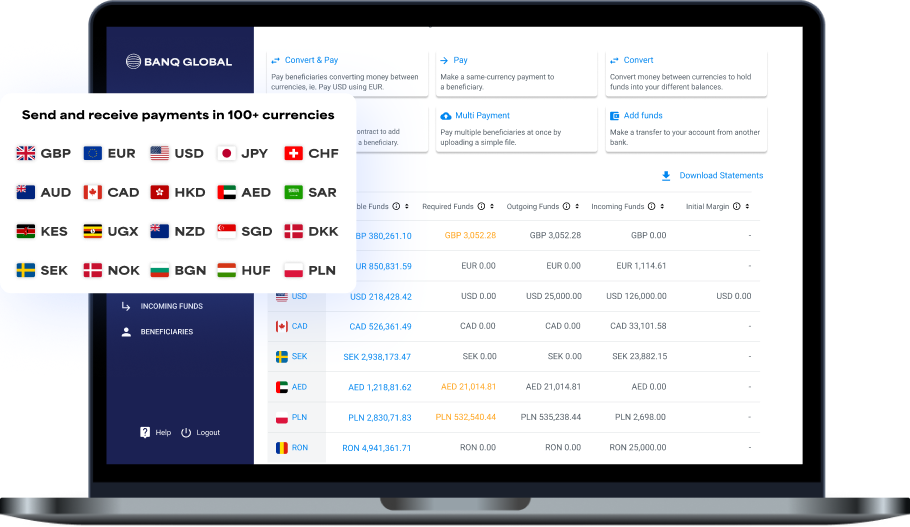
Specialist providers are designed specifically for international businesses that require a Kenyan business account without the structural limitations of traditional banking routes or the absence of a comparable digital alternative. They provide clearly defined document requirements, dedicated onboarding support, and a remote application process tailored to non-resident directors, foreign-owned companies, and complex ownership structures. For example, Banq Global offers a fully online application process with no in-person branch visit, supports non-resident directors and shareholders from more than 190 countries, provides accounts supporting over 130 currencies, and aims for account approval within 24 hours where onboarding requirements are met.
Documents Required to Open a Kenyan Business Account as a Non-Resident Director
To fulfill the Kenyan business account requirements, non-resident directors must provide documents verifying their identity, the company's legal existence, ownership structure, and tax compliance.
Valid Passports (Directors and UBOs)
Banks require this to complete mandatory KYC background checks. Some providers may also request notarised copies of the passport data page and recent passport-sized photographs for directors and authorised signatories.
Certificate of Incorporation
It is issued by the Business Registration Service (BRS) and banks require it to confirm that the company is legally incorporated in Kenya.
Memorandum and Articles of Association
This document outlines your company's rules, goals, and internal management structure. Banks review it to understand your business scope and the rights of your stakeholders.
CR12 Certificate
A CR12 is a register of directors and shareholders issued by Kenya's Business Registration Service. It confirms who holds shares and who sits on the board of a Kenyan company. Banks require it to verify the ownership chain and satisfy their KYC obligations. It is obtained through the BRS, either online via eCitizen or through a local agent. The fee is usually KES 650.
KRA PIN Certificate
This is your tax identification number from the Kenya Revenue Authority (KRA). Banks are legally required to collect it to ensure your business pays taxes in Kenya.
Board Resolution
An official letter signed by the directors and sealed, stating the board's decision to open the bank account at your chosen bank on company letterhead
Proof of Registered Business Address in Kenya
This can be a utility bill, lease agreement, or property document showing your physical Kenyan business address (a P.O. Box is not accepted). Banks require it to confirm your local physical presence. They may also request the CR8 Form, an official Business Registration Service (BRS) record containing the registered residential addresses of the company's directors.
Source of Funds Declaration / Group Structure
These documents explain where your company gets its money and how it connects to parent companies. Traditional banks request them to block illegal money laundering.
It's worth noting that enhanced due diligence for non-resident directors may result in requests for additional documentation. To help applicants preparing to open a business account in Kenya as a non-resident director or shareholder, some specialist providers use clear, step-by-step document checklists throughout the onboarding process.
The KRA PIN Registration: What Non-Resident Directors Need to Know
KRA PIN registration is a mandatory step for non-resident directors seeking to open a business account in Kenya.
- The process of KRA PIN registration begins with each foreign director applying for a personal KRA PIN through the KRA iTax Portal by completing the online registration form and uploading a valid passport.
- Once all foreign directors obtained their personal KRA PINs, the company must be incorporated through the Business Registration Service (BRS) via the eCitizen Kenya portal to receive a Certificate of Incorporation and CR12.
- After incorporation, the business can apply for a company KRA PIN (Non-Individual PIN) via the KRA iTax Portal by providing the company's details, the directors' personal KRA PINs, and supporting documents, including the Certificate of Incorporation, CR12, and personal KRA PIN certificates.
Can a foreign director open a business account in Kenya without a KRA PIN?
It is important to note that the KRA PIN is a regulatory prerequisite rather than part of the bank’s own account-opening process. In practice, the sequence is personal KRA PIN registration for each foreign director, company incorporation, company KRA PIN registration, and finally the business account application. Some specialist providers may also help businesses understand or coordinate these requirements during onboarding, although the level of support varies by provider.
Step-by-Step Process to Open a Business Account in Kenya as a Non-Resident Director
Step 1: Complete the Regulatory Prerequisites
Ensure the company has been incorporated and all required KRA PIN registrations have been completed before approaching an account provider.
Step 2: Choose the Right Account Provider
Select a provider that suits your ownership structure and business requirements. Consider whether the provider supports remote onboarding, non-resident directors, and international business operations.
Step 3: Compile Paperwork
Gather all original documents and clear photocopies required for your specific business structure (sole trader versus limited company).
Step 4: Submit the Business Account Application
Complete the application through your chosen provider. Depending on the provider, the process may require an in-person visit or may be completed entirely online.
Step 5: Complete Due Diligence and Activate the Account
Respond to any additional KYC or AML requests during the review process. Once the application is approved, the account can be activated and used for business transactions.
Currency Controls and KES: What International Companies Should Know
Although Kenya no longer operates formal exchange controls, international businesses must comply with Central Bank of Kenya (CBK) foreign exchange rules and banking documentation requirements when converting and transferring funds internationally.
KES Is Not Freely Convertible Offshore
The Kenyan Shilling (KES) is not freely convertible outside Kenya, so international businesses must convert KES to USD and other foreign currencies through Central Bank of Kenya (CBK)-authorised banks or licensed foreign exchange providers rather than international currency markets.
Foreign Exchange Conversion Takes Place Through the Domestic Market
Authorised banks and foreign exchange providers process currency conversions through Kenya's domestic interbank market. Converting KES to USD and other foreign currencies relies on domestic market supply and demand using prevailing local exchange rates.
Holding KES Creates Currency Devaluation Risk
Businesses holding significant KES balances may be exposed to currency devaluation if the Kenyan Shilling weakens before funds are converted or transferred. Delays in foreign exchange processing or international transfers can also result in trapped funds, affecting liquidity and treasury management.
Outbound Payments Require Compliance
International payments and profit repatriation are generally permitted, but outbound payment limits and compliance requirements in Kenya depend largely on the transfer channel and the amount being sent.
To satisfy Central Bank of Kenya (CBK), forex, and anti-money laundering regulations, you must provide supporting documentation. Supporting documentation may include commercial invoices or contracts, evidence of tax compliance, and proof of the source of funds to satisfy CBK, foreign exchange, and anti-money laundering requirements.
Foreign Currency Accounts Are Available with Conditions
Some Kenyan banks offer foreign currency accounts (FCAs) denominated in USD, EUR and GBP alongside KES. However, availability and eligibility vary by institution and are subject to KYC, AML, and account opening requirements.
For international businesses managing cross-border payments, the ability to hold, convert, and transfer foreign currency efficiently is often just as important as the business account itself. Choosing a provider that combines a multi-currency account with regulated foreign exchange services and efficient SWIFT payment capabilities can simplify international treasury management and help reduce exposure to currency devaluation.
FAQs
Does a Kenyan business account support SWIFT and RTGS payments?
Yes. Most Kenyan business accounts support both SWIFT and RTGS payments. SWIFT is used for international wire transfers in multiple currencies, while RTGS (Real-Time Gross Settlement), operated through KEPSS, enables high-value domestic interbank transfers with same-day settlement during banking hours.
How long does it take to open a business account in Kenya as a non-resident?
Opening a business account in Kenya as a non-resident typically takes 2 to 6 weeks with traditional banks due to enhanced due diligence and background checks. Some specialist providers can complete the onboarding process within a few days once all required documents have been submitted. However, the exact timeframe depends on the chosen institution, the completeness of your documentation, and the complexity of the company's ownership structure.
Do I need to travel to Kenya to open a business account as a non-resident director?
You do not need to travel to Kenya if you use the right route. Traditional Kenyan banks often expect an in-person visit at some point in the process. Specialist providers designed for internationally-structured businesses typically allow the full application to be completed online, with no travel required. For example, platforms like Banq Global allow overseas directors to open Kenyan business accounts completely remotely.
Is Banq Global regulated and authorised to provide business accounts in Kenya?
Yes. Banq Global provides fully regulated accounts authorised by the Central Bank of Kenya (CBK), offering a secure and compliant solution for international companies opening business accounts in Kenya. Banq Global also provides regulated foreign exchange (FX) access and Kenyan business accounts in the company's legal name.
What are the ongoing compliance requirements for a non-resident holding a Kenyan business account?
Ongoing requirements include annual confirmation statements filed with the Business Registration Service, KRA tax compliance obligations, CBK reporting for certain cross-border transactions, and regular KYC updates with your account provider. Directors based outside Kenya should confirm their provider has a clear process for managing these obligations remotely.