How to Open a Business Account in Kenya
Opening a business account in Kenya starts long before you submit a banking application. Unlike many jurisdictions, Kenyan banks expect businesses to complete a specific sequence: register the business, obtain a KRA PIN, and then apply for a business account. Missing any of these steps can delay or prevent account approval. The process also varies depending on whether you operate as a sole proprietorship, partnership, private limited company, or branch of a foreign company. Non-resident directors and foreign-owned businesses face additional documentation and statutory compliance requirements, making it important to understand the registration and banking process before approaching a provider.
Register Your Business Before You Approach Bank
Opening a business account in Kenya begins with business registration rather than banking. Before approaching a bank, you must register your business through the Business Registration Service (BRS) on the eCitizen portal. The registration process covers the main business structures, including
- Sole proprietorships (registered as a business name)
- Partnerships
- Private limited companies (Ltd)
- Branches of foreign companies.
Once approved, you will receive either a Certificate of Registration (sole trader or partnership) or a Certificate of Incorporation (private limited companies). These certificates serve as official proof of registration and include the company or business name, registration number, and registration date. They form a core part of the business account in Kenya requirements.
Note: Registration fees vary depending on the business structure and are updated periodically. Check the eCitizen platform for the latest government fees before submitting an application.
KRA PIN and Business Account Kenya Requirements
Businesses must obtain a KRA PIN from the Kenya Revenue Authority (KRA) through the iTax platform before most banks will process a business account application. A KRA PIN is an 11-character personal identification number issued for tax purposes.
For private limited companies, the company KRA PIN application requires the Certificate of Incorporation, Memorandum and Articles of Association, and a valid CR12 from the Registrar of Companies, which confirms the company's current directors and shareholders. The application also requires the individual KRA PINs of the company's directors, so directors should obtain their personal KRA PINs before applying for the company's PIN. Banks typically require the company's KRA PIN Certificate together with the registration documents as part of the account opening process.
For sole proprietorships, a separate business KRA PIN (non-individual) is not required. The proprietor uses their existing personal KRA PIN to register the business and open the business account.
Documentation Requirements For Business Account in Kenya
The documents required to open a business account in Kenya vary depending on the legal structure and ownership of the business.
Sole Proprietorship
- Certificate of Registration (from BRS). National ID (Kenyan citizens) or valid passport (non-Kenyans).
- KRA PIN Certificate.
- Passport-size photograph of the proprietor.
- Proof of physical business address.
Private Limited Company
- Certificate of Incorporation.
- Memorandum and Articles of Association.
- CR12 (Certificate of Shareholders from the Registrar of Companies, typically valid 3 months).
- Board Resolution or Director's Resolution authorising account opening and naming signatories.
- KRA PIN Certificates for the company and all signatories.
- Valid ID or passport for all directors and signatories.
- Proof of registered office address.
- Latest audited financial statements (where available or requested by the provider).
Branch of a Foreign Company
- Certificate of Incorporation from country of origin (apostilled or certified as required).
- Certificate of Registration issued following branch registration with Kenya's Registrar of Companies.
- Memorandum and Articles of Association.
- Board Resolution authorising the branch and nominating signatories.
- KRA PIN Certificate for the branch.
- Valid passports for all directors and signatories.
- Proof of the branch's registered Kenyan address.
Non-Resident Directors and Shareholders
In addition to the documents required for the relevant business structure mentioned above, non-resident directors and shareholders are typically required to provide the following:
- Valid passport (data page and signature page).
- Proof of residential address from country of residence: utility bill por bank statement, typically within 3 months.
- Some providers require notarised or apostilled copies for foreign nationals.
Note: In addition to the entity-specific documents listed above, most banks require a completed account opening form as part of the business account application process.
Provider Options to Open a Business Account in Kenya
Kenya offers three main business banking paths to open a business account: traditional banks, digital providers, and specialist providers. Each serves a different business type. Choices range from slow but local branch setups to fast, fully remote, global platforms. The right choice depends on your business setup, need for physical branches, and whether you have directors who live outside Kenya.
Traditional Banks
Traditional banks such as KCB, Equity Bank, Absa Kenya and Co-operative Bank are well suited to businesses operating primarily within Kenya, offering business current accounts, payment facilities, and payroll services. However, business account applications typically involve branch-based identity verification and submission of original corporate documents as part of statutory compliance, and due diligence procedures. Account opening generally takes one to three weeks after a complete application is submitted, although non-resident directors and foreign-owned companies may face additional document verification and longer review periods. Some banks also require a minimum opening deposit depending on the account type.
Digital Providers
Digital providers such as M-Pesa Business and Wise offer faster onboarding for straightforward business structures and day-to-day payment needs. However, they are generally less suitable for foreign company business account Kenya requirements, non-resident shareholders, or businesses that need SWIFT connectivity, foreign currency accounts, or broader multi-currency account capabilities for international trade.
Specialist Providers
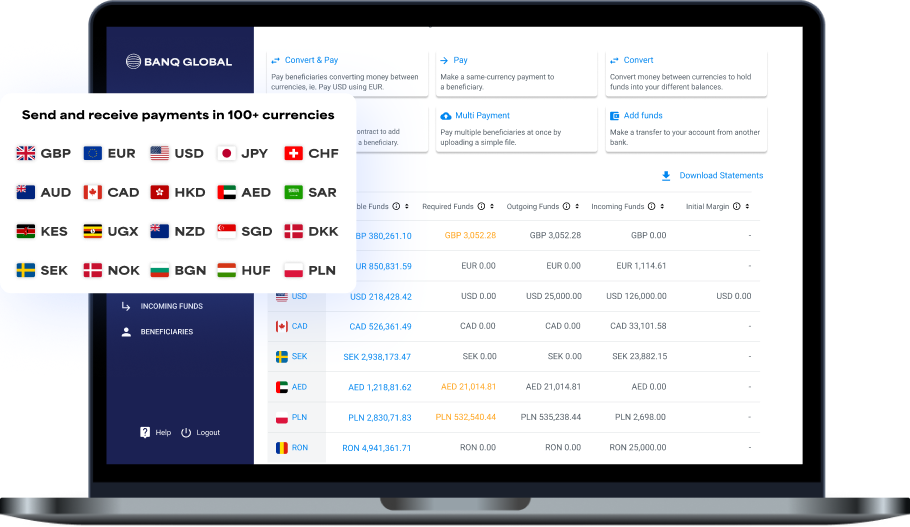
Specialist providers are designed for internationally owned businesses and companies with cross-border banking requirements. Providers such as Banq Global offer fully online onboarding, support directors and shareholders from 190+ countries, enable access to 130+ currencies, and can approve applications within 24 hours. For businesses that require multi-currency accounts, international SWIFT payments, or banking solutions that accommodate non-resident ownership structures, this approach can provide a more practical alternative to traditional branch-based onboarding.
What Non-Resident and Foreign-Owned Businesses Need to Know
Foreign Ownership and Compliance
Kenya generally permits 100% foreign ownership of private limited companies and registered branches, allowing foreign nationals to establish a business and open a business account.
Foreign-owned businesses are typically subject to enhanced AML and KYC due diligence, including verification of shareholders, beneficial ownership declarations, and source-of-funds documentation. Banks may also request additional supporting documents depending on the ownership structure and risk profile.
Foreign Exchange Regulations
International transactions into and out of Kenya are subject to Central Bank of Kenya foreign exchange regulations. All foreign exchange (FX) businesses and international wire transfers must go through CBK-authorized dealers, such as licensed commercial banks and registered forex bureaus.
Kenyan Payment Systems
Kenya’s banking network handles foreign and local currencies through three main systems:
RTGS (Real-Time Gross Settlement)
This is used for domestic, high-value transfers. Similar to sending a direct, same-day wire transfer, it moves money securely but operates only during Kenyan banking hours (typically 8:30 am to 4:00 pm EAT).
PesaLink
This is a digital network that links over 80 financial institutions in Kenya. It allows individuals and businesses to make secure, near instant interbank transfers (24/7). Fees for using PesaLink vary by bank, with some offering discounted or flat rates.
SWIFT
Used for all international payments. Because Kenya does not use IBAN (International Bank Account Number) or SEPA (Single Euro Payments Area), international payments require specific SWIFT/BIC codes for processing. Kenyan banks typically send and receive cross-border payments through correspondent banking relationships with overseas financial institutions.
Managing Foreign Currency
If your business frequently transacts in global currencies like USD, EUR, or GBP, opening a multi-currency business account in Kenya can be highly beneficial. It allows you to hold multiple currencies in one place, helping you avoid frequent conversion fees.
FAQs
Can a non-resident open a business account in Kenya online?
Yes. Non-residents can open a business account in Kenya, but the documentation requirements are more detailed than for resident-owned businesses. Proof of foreign residential address, certified identity documents, and a full corporate documentation set are typically required. Some providers require notarised or apostilled documents for foreign nationals.
Which bank is best for a business account in Kenya?
The right choice depends on structure and needs.
- Traditional banks (KCB, Equity Bank, Absa Kenya, Co-operative Bank) suit established businesses with local operations and the capacity for branch-based onboarding.
- Digital providers like M-Pesa Business or Wise work for straightforward structures but are limited for foreign-owned companies or complex ownership.
- Specialist providers like Banq are positioned for international and non-resident businesses needing multi-currency access and fully online onboarding.
How long does it take to open a business account in Kenya?
Traditional banks typically take one to three weeks from document submission to account activation. Non-resident or foreign-owned structures may take longer due to additional AML review. Specialist providers can approve accounts within 24 hours, with the full process completed online.
What is a CR12 and why do banks ask for it?
A CR12 is a certificate issued by Kenya's Registrar of Companies confirming the current registered shareholders of a private limited company. Banks require it when you open a business account in Kenya to verify beneficial ownership and meet AML and KYC obligations. It is obtained through the Business Registration Service via eCitizen and is typically valid for three months.
Are there minimum balance requirements for business accounts in Kenya?
Minimum balance requirements for business accounts in Kenya vary by bank and account type. For example, KCB Bank may require a small opening deposit, such as KES 1,000, while Stanbic Bank's standard business current accounts may require an opening balance of KES 5,000. Many specialist providers operate without minimum balance requirements. Because bank tariffs change frequently, it is always a best practice to check the official fee guide before applying.
What payment rails do businesses use in Kenya?
Businesses in Kenya use M-Pesa for mobile money, PesaLink for instant interbank transfers, and RTGS (Real Time Gross Settlement) for large B2B payments. Global payments rely on SWIFT. Europe's SEPA and IBAN systems do not work in Kenya. Businesses that transact internationally should ensure their account has SWIFT access and multi-currency support.