How to Repatriate Profits from Kenya: A Guide for International Businesses
Kenya allows foreign investors to repatriate profits, but the process is not simply a matter of transferring funds overseas. The applicable tax treatment depends on whether the business operates through a branch or a Kenyan-incorporated subsidiary, while foreign exchange rules and banking requirements also affect the transfer process. Businesses must comply with the Foreign Investment Protection Act (FIPA), the Income Tax Act, and Central Bank of Kenya (CBK) requirements before funds can leave the country. Understanding these legal, tax, and regulatory requirements is essential to completing profit repatriation from Kenya efficiently and in compliance with Kenyan law.
Profit Repatriation From Kenya: Legal Rights Under FIPA
Foreign investors in Kenya are guaranteed the right to dividends, interest and capital repatriation under the Foreign Investments Protection Act (FIPA) Cap 518, once all applicable taxes have been paid. FIPA protects after-tax profits, uncapitalized retained profits, loan proceeds, and investment proceeds.
To benefit from these statutory guarantees, investors should obtain a Certificate of Approved Enterprise from the Ministry of Finance/Kenya Investment Authority (KenInvest), ideally when establishing or approving the investment.
Separate from the domestic FIPA framework, Kenya also maintains a bilateral investment treaty (BIT) with countries including the UK, Germany, France, Switzerland, the UAE, Japan, and South Korea which offers additional safeguards against expropriation and arbitrary treatment.
However, while FIPA gives you the legal right to repatriate profits, you must fulfill Kenya’s applicable tax, banking and regulatory requirements before and during profit repatriation in Kenya.
Tax Obligations Before the Transfer Leaves Kenya
Before profits can be transferred out of Kenya, businesses must consider three main tax obligations. Which of these applies depends on the entity type and the category of payment.
Branch Repatriation Tax
The Finance Act 2023 introduced a 15% branch repatriation tax on profits remitted by non-resident companies operating through a permanent establishment or branch in Kenya (effective 1 January 2024). It is in addition to the 30% corporate income tax on branch profits (reduced from 37.5%) because remittances to the foreign head office are treated as repatriated income rather than dividends.
Net Assets Formula
The PE repatriation tax is determined by the following statutory net assets formula:
R = A1 + (P - T) - A2
(Repatriated income = opening net assets + net profit - tax payable on the chargeable income - closing net assets).
Kenyan-incorporated subsidiaries do not face this formula-driven branch repatriation tax. Instead, distributed profits are generally subject to dividend withholding tax (WHT), which may make a subsidiary structure more tax-efficient than a branch for some multinational groups.
Withholding Tax (WHT) on Dividends
A 15% non-resident WHT applies to dividends paid by a Kenyan resident company to a non-resident shareholder. Where Kenya has a Double Tax Agreement (DTA) with the shareholders' jurisdiction, a lower treaty rate may apply.
Treaty Relief Under Kenya's DTAs
Kenya has more than 14 active DTAs. For example, the dividend withholding tax rate is 10% under the France treaty, 15% under the UK, Germany, and Sweden treaties, and 5% under the UAE treaty (subject to treaty conditions). As Kenya does not currently have a DTA in force with the Netherlands, the standard 15% domestic rate generally applies.
Dividend WHT Payment Deadline and iTax Filing
The company paying the dividend must deduct withholding tax at source and remit it to the Kenya Revenue Authority (KRA) within five working days of the payment. The payment is processed through the KRA iTax portal by generating a payment slip and paying through an appointed bank. Once the tax has been successfully remitted, a Withholding Tax Certificate is sent to the taxpayer’s registered iTax email address.
Other WHT Categories International Groups Need to Account for
Multinationals often use various fee categories to move value out of Kenya alongside dividends. Each carries its own WHT obligation and potential DTA relief:
- Management fees to non-residents: 20% WHT. Often reduced to 10%–15% under applicable DTAs.
- Royalties to non-residents: 20% WHT. Often reduced to 10%–15% under treaty relief.
- Technical services fees: varies.
All arrangements require arm's-length pricing and documentation (Master Files, Local Files, and Country-by-Country (CbC) reports) to withstand KRA transfer pricing scrutiny.
Kenya Foreign Exchange Regulations and Documentation for Profit Repatriation
Kenya operates a liberalised capital account with no blanket prohibition on outward transfers. The Kenya Foreign Exchange Control Code (FX Code March 2023) sets conduct, governance, and compliance standards for authorised dealers rather than imposing exchange controls on cross-border payments.
Under the CBK Foreign Exchange Guidelines, authorised dealers must obtain and retain appropriate supporting documents for transactions exceeding the equivalent of USD 10,000, while banks may also request documentation for lower-value transfers to satisfy their KYC and AML obligations.
- For dividend repatriation, this typically includes evidence of WHT payment to the KRA, a board resolution authorising the distribution, audited financial statements (or management accounts, where accepted), a certified shareholder register and, where requested by the authorised dealer or required for the transaction, a valid KRA Tax Compliance Certificate.
- For management fees or royalties, businesses should also provide the relevant service agreement, transfer pricing documentation (where applicable), and the corresponding invoice.
Banking Process to Transfer Money Out of Kenya Businesses
Outward remittances from Kenya must be processed through a Central Bank of Kenya (CBK) licensed Authorized Dealer, which includes major commercial banks like KCB Bank, Equity Bank, Co-operative Bank, and NCBA.
The dealer bank verifies the required documentation and handles the conversion from KES to your desired foreign currency and processes the payment (usually via SWIFT transfer). Standard settlement takes 1 to 2 business days (often slightly longer for more exotic currencies or complex destination countries). However, traditional Kenyan commercial banks may apply additional scrutiny to non-resident-owned entities, complex ownership structures, or large one-off repatriation events, which can extend processing times.
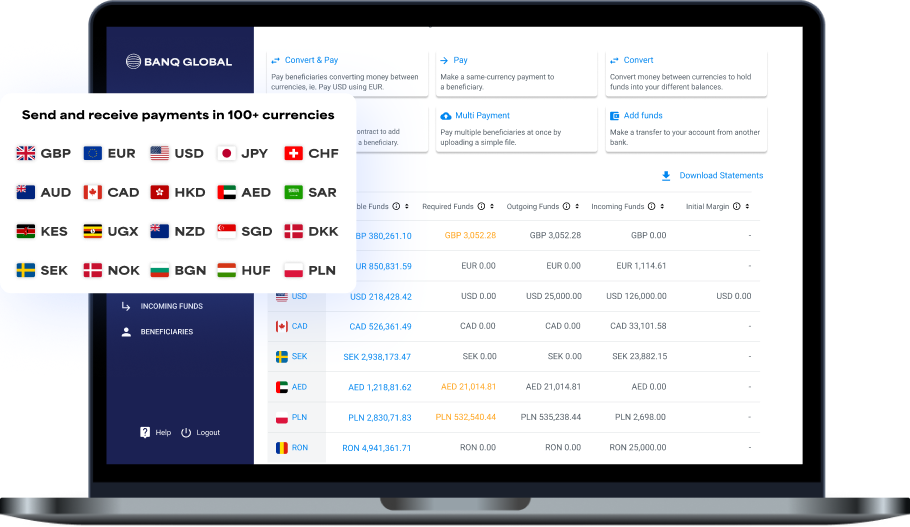
Businesses that regularly repatriate funds from Kenya or consolidate KES repatriation flows from multiple jurisdictions often benefit from a multi-currency business account. Banq's specialist multi-currency business account supports more than 130 currencies and is designed for international treasury and cross-border fund management.
Structuring Considerations For International Groups
When planning profit repatriation from Kenya, the following considerations can help international groups minimise tax and compliance risks.
Choose the Right Business Structure
A Kenyan subsidiary is generally subject to 30% corporate income tax, with dividends paid to a non-resident shareholder subject to 15% WHT unless treaty relief applies. A branch is also subject to 30% corporate income tax, but repatriated income is additionally subject to the 15% branch repatriation tax under the statutory formula.
Confirm Your Eligibility for Treaty Benefits
Confirm that the recipient qualifies under the relevant DTA before applying a reduced WHT rate. Because, the applicable treaty terms may depend on tax residence, beneficial ownership, shareholding and limitation-of-benefits requirements.
Plan Related-Party Payments Carefully
Dividends are typically declared annually, while management fee and royalty arrangements require commercial substance, transfer pricing documentation, and arm's-length pricing.
Consider FIPA Protection Early
Obtain a Certificate of Approved Enterprise if you intend to rely on the statutory protections available under FIPA.
Obtain Local Tax and Legal Advice
Engage a Kenyan tax adviser for WHT compliance and a lawyer when applying for a Certificate of Approved Enterprise under FIPA.
FAQs
What withholding tax rate applies to profits repatriated from Kenya to a non-resident?
The standard non-resident WHT rate on dividends paid to a foreign parent company is 15%. If Kenya has a double tax agreement (DTA) with your home jurisdiction and you qualify under the limitation of benefits provisions, a lower treaty rate may apply. Confirm the applicable rate under your specific DTA before declaring a dividend, as the difference can be significant for a large distribution.
Can a non-resident-owned company open an account to receive repatriated profits from Kenya?
Yes. Both Kenyan commercial banks and international specialist business account providers accept non-resident-owned entities. For the outward transfer from Kenya, the instruction must go through a CBK-authorized dealer bank in Kenya.
For the receiving account outside Kenya, a specialist multi-currency business account is often a better fit than a traditional bank, particularly for groups consolidating repatriation flows from multiple markets.
Can Banq Global help with the international side of profit repatriation in Kenya?
Banq Global provides specialist multi-currency business accounts designed for international and non-resident-owned entities. For groups repatriating profits from Kenya into a central treasury or holding structure, Banq's account supports 130+ currencies and SWIFT payments and is built to handle the complex ownership structures common in international groups. The outward transfer from Kenya still requires a CBK-authorized dealer bank, but Banq can serve as the receiving account or the hub through which repatriated funds are managed across multiple currencies.
How long does profit repatriation from Kenya take?
The administrative steps (WHT calculation, KRA remittance, board approvals, documentation preparation) typically take one to three weeks depending on structure complexity and document readiness. The SWIFT transfer itself, once instructed through the authorized dealer, generally settles in one to two business days.
What costs should we budget for beyond the withholding tax?
Beyond WHT (15% standard, or lower under a DTA), costs include the FX spread on KES-to-foreign-currency conversion at the authorized dealer bank, the SWIFT transfer fee charged by the Kenyan bank, local legal and accounting fees for structuring advice, and transfer pricing documentation costs if management fee or royalty arrangements are involved.
What ongoing compliance is required after profit repatriation in Kenya?
- WHT on each dividend or management fee payment must be remitted to KRA within 5 working days of the payment.
- Transfer pricing documentation is required for all related-party payments and KRA actively scrutinizes these.
- Annual corporate income tax returns and, for branch operators, the branch repatriation tax filing must also be submitted on schedule.
- Lapses in WHT remittance usually attract KRA penalties of 5% of the tax due, together with late payment interest of 1% per month.