Setting Up a Dutch Holding Company: Structure, Tax, and Banking
The Netherlands is a premier holding company jurisdiction, favoured by multinationals for its robust 90+ double tax treaty network, frictionless access to the EU Single Market, and a stable business environment, with foreign investment supported by the NFIA (Netherlands Foreign Investment Agency). Central to its appeal is the participation exemption, which allows for the tax-free flow of eligible dividends and capital gains. These features have made Dutch holding structures a longstanding component of international corporate planning. However, setting up a Dutch holding company is not simply a matter of incorporation. Legal structure, tax position, and business banking must be considered together from the outset, as decisions in one area frequently affect the viability, efficiency, and compliance position of the other two.
Legal Structure for a Dutch Holding Company
A Besloten Vennootschap (BV) is the standard Dutch private limited liability company and the most common legal structure for businesses and holding groups in the Netherlands. Since the 2012 "Flex BV" reform, the minimum share capital requirement is just €0.01.
The Standard Two-Tier Structure
The most common arrangement is a two-tier structure consisting of at least two BVs: a holding BV and an operating BV (also called a Work BV/Daughter BV/OpCo). The entrepreneur or investor holds shares in the Dutch BV holding, which in turn owns the shares of the operating company. This structure separates ownership from operations, facilitates asset ring-fencing, and allows profits to be retained at the holding level where the participation exemption can apply.
The Alternative: Naamloze Vennootschap (NV)
The NV is designed for larger corporate groups and companies seeking public investment. It requires a strict minimum share capital of €45,000. Unlike the Dutch BV holding, shares are typically not restricted, allowing them to be traded on public stock exchanges. Due to high setup costs, heavy administrative burdens, and strict compliance rules, the NV is rarely used as a private holding vehicle.
Netherlands Holding Company Tax Benefits
The legal structure of a Dutch holding company directly determines its tax position. The following provisions form the core of the Nethwrlands holding company tax regime.
Corporate Income Tax (CIT)
The current Dutch Corporate Income Tax (vennootschapsbelasting) framework features a two-rate structure:
- Profits up to €200,000: 19% corporate tax rate
- Profits above €200,000: 25.8% corporate tax rate
It means profits falling within the €200,000 tax bracket are taxed at 19%, while any excess is taxed at 25.8%. However, holding structures and group-level consolidations (fiscal unity) allow businesses to significantly optimise their tax bases and offset losses across entities.
The Fiscal Unity Regime (fiscale eenheid)
By default, each Dutch BV holding is taxed individually. However, if the holding BV owns at least 95% of the OpCo, it can apply for a fiscal unity (tax group). This allows the group to be treated as a single taxpayer, file a single CIT return, and offset the losses of one group company against the profits of another.
OECD Pillar Two impact
In alignment with the EU Pillar Two Directive, the Netherlands also enforces a minimum effective tax rate (ETR) of 15% through the Minimum Tax Act 2024. This rule applies to multinational enterprises (MNEs) with global annual consolidated revenues of at least €750 million. However, smaller or domestic structures under this threshold are exempt.
Dutch Participation Exemption (deelnemingsvrijstelling)
The participation exemption is the central tax advantage for Dutch holding companies. If the holding company owns at least 5% of the nominal paid-up capital in an operating company (OpCo), all dividends and capital gains flow up to the holding company 100% tax-free, eliminating economic double taxation within a corporate group. Capital gains on the disposal of qualifying stakes are also covered.
When Does the Dutch Participation Exemption Apply?
The participation exemption is designed for active business investments rather than passive portfolio holdings. Where a subsidiary does not satisfy the active business motive test, the exemption may still apply if the subsidiary is subject to a realistic profits tax of at least 10% (subject-to-tax test) or if its assets do not predominantly consist of passive investment assets (asset test).
The Exception is Not Automatic
It's important to note here that the Dutch participation exemption is subject to specific statutory conditions and should not be assumed to apply automatically. Businesses should obtain Dutch tax advice to confirm eligibility based on their particular ownership structure, activities, and tax profile.
Dutch Dividend Withholding Tax
The Netherlands levies a statutory dividend withholding tax (dividendbelasting) of 15% on dividend repatriation to foreign shareholders. This rate is frequently reduced or eliminated through bilateral tax treaties, the EU Parent-Subsidiary Directive, or domestic exemptions, provided strict anti-abuse and economic substance conditions (ATAD) are met.
Tax Treaties
The Netherlands has an extensive network of 90+ tax treaties. These frequently reduce the withholding rate to 5% for qualifying corporate shareholders, and in some instances, to 0%.
EU Parent-Subsidiary Directive
No withholding tax is applied on dividends paid to an EU parent company holding at least 5% of the shares for a minimum period of two years, subject to anti-abuse regulations.
Domestic Exemption
The withholding exemption generally applies where the shareholder satisfies the 5% threshold by holding a qualifying participation of at least 5%, provided the arrangement is not deemed artificial under ATAD.
Under ATAD and domestic anti-dividend stripping rules, the Dutch tax authorities may challenge a dividend repatriation exemption if the holding structure is artificial, lacks genuine economic substance, or is utilised primarily to avoid tax.
What are the Substance Requirements for a Dutch Holding Company Structure?
To access treaty benefits and avoid characterisation as a "shell" company, the Dutch tax authorities (Belastingdienst) enforce strict minimum substance requirements. A holding company must:
- Not concurrently considered a tax resident in another country.
- Have its actual management and central administration in the Netherlands (at least half of the board members reside in the Netherlands).
- Maintain adequate staffing, office, and operating infrastructure (at least half of board meetings held in the Netherlands).
- Keep proper accounting records and hold Dutch business accounts with recurring transactions.
- Incur a minimum level of actual operating expenses in the Netherlands (generally around €100,000 annually).
- Consider the impact of ATAD2 anti-hybrid rules on cross-border financing arrangements, particularly in complex international structures.
Professional Dutch tax advice is strongly recommended where cross-border financing, hybrid entities, or multinational ownership structures are involved. Because failing to meet these operational and administrative tests will not legally invalidate your corporate structure, but it can completely block your access to double tax treaty benefits and EU directive exemptions on dividend withholding taxes.
Business Banking Requirements for a Dutch Holding Company
Banks also conduct a parallel substance assessment to comply with the Wwft (Anti-Money Laundering and Anti-Terrorist Financing Act), applying extensive KYC (Know Your Customer) and CDD (Customer Due Diligence) procedures. They rigorously assess the following factors during screening:
- Director and shareholder profiles
- The full corporate ownership chain
- Business activity and countries of operation
- Legitimate source of funds
A Dutch BV holding with no physical Dutch address, no Dutch IBAN, and all directors based overseas will face significant friction with traditional banking and financial institutions, regardless of its legal compliance. This is particularly true for structures with non-resident directors, non-EU ownership chains, or multiple layers of corporate shareholders. While genuine multinational structures can generally satisfy these requirements, pure holding vehicles with limited operational activity must build sufficient substance into the structure from the outset and carefully consider their choice of banking provider.
Business Account Options For Setting Up a Dutch Holding Company Structure
Dutch holding companies generally have three banking routes available: traditional banks, digital providers, and specialist providers. Each serves a different risk profile and ownership structure, with significant differences in onboarding requirements, timelines, and acceptance rates.
Traditional Banks
Traditional banks such as ING, ABN AMRO, and Rabobank provide full-service accounts with lending, overdraft facilities, iDEAL access, and domestic payment rails. However, they typically expect local substance, including a Dutch business address, evidence of Dutch business activity, and ideally a resident director, making them best suited to holding structures with an established Dutch presence and local management. Moreover, the CDD process is thorough, with non-resident directors and multi-layer ownership chains often extending processing timelines to 2–8 weeks after application acceptance, while approval is not guaranteed.
Digital Providers
Digital providers such as bunq, Revolut Business, and Wise generally offer faster onboarding and greater accessibility for international founders than traditional banks. However, Dutch counterparties, the tax administration, and suppliers often expect a Dutch IBAN, and a foreign IBAN can create operational friction even where it is technically accepted under SEPA. Bunq is the only major digital provider offering a genuine Dutch IBAN (NL prefix). Revolut and Wise typically do not provide Dutch IBANs, which can limit usability for certain notarial requirements and local counterparties. While automated KYC processes work well for simple structures, complex ownership chains, corporate shareholders, and non-EU UBOs frequently encounter delays or rejection.
Specialist Providers
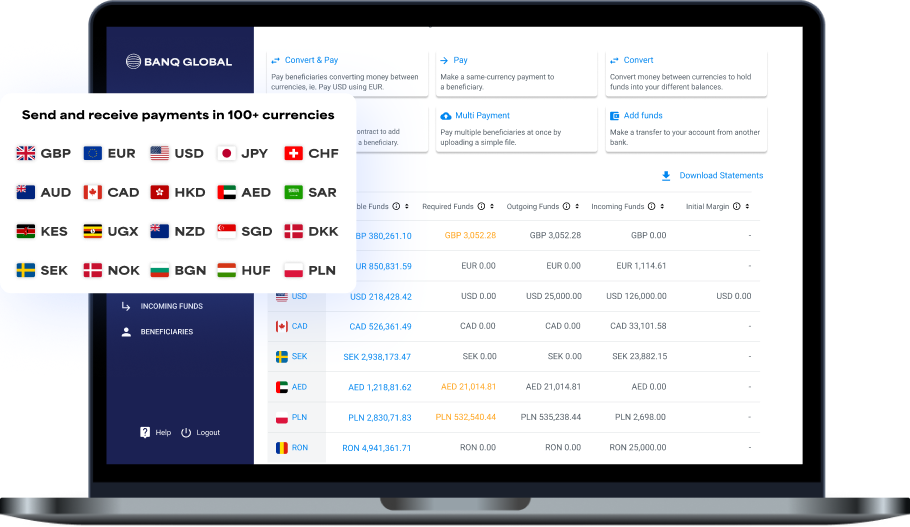
Specialist business account providers are designed for international holding structures that fall outside the risk appetite of traditional and digital banks. For example, Banq Global accepts non-resident directors and shareholders from 190+ countries, offers 100% online onboarding, and can approve eligible applications within 24 hours. It also provides Dutch IBAN, SEPA and SWIFT access, multicurrency account support (130+ currencies), and dedicated onboarding assistance for complex structures, making it particularly well-suited to Dutch holding companies, SPVs, and family office vehicles. However, unlike traditional banks, specialist providers generally do not offer lending, overdraft facilities, or cash deposit services.
The Formation Sequence
After deciding on the appropriate structure, tax position, and banking provider, the next consideration is the sequencing of setting up a Dutch holding company, which requires careful planning to avoid processing delays. Although KvK registration generally precedes a formal bank account application, banking should not be treated as a post-incorporation step.
In practice, some civil-law notaries may ask whether a Dutch IBAN has been arranged or request evidence that banking arrangements are underway before finalising the formation process. International founders should therefore begin bank screening, KYC reviews, and notary instructions in parallel rather than waiting until the holding company has been formally incorporated.
Setting Up a Dutch Holding Company: The Formation Process
Step 1: Instruct a Dutch notary and draft formation documents.
Dutch BV holding company formation strictly requires a Dutch civil-law notary (motaris). They will draft and certify the notarial deed of incorporation and the articles of association. This is a mandatory legal requirement, not a discretionary step.
Step 2: Notarisation.
The notary certifies the execution documents and formally submits the registration application to the Dutch Commercial Register.
Step 3: Chamber of Commerce (KvK) registration.
The notary completes registration with the Netherlands Chamber of Commerce (KvK), officially making the company a legal entity with a KvK number. This step must be finalised before initiating any bank account application.
Step 4: Register with the Dutch Tax Administration.
The company must be registered with the Belastingdienst for corporate income tax, and for VAT if applicable.
Step 5: UBO register submission.
All Netherlands-incorporated entities must register beneficial owners who hold a 25% or greater interest. This obligation applies at formation, must be kept current, and is integrated into the KvK registration process.
Banks cross-reference the UBO register during account due diligence. For holding chains with multiple layers, every beneficial owner through the full chain must be registered, not just those directly holding the Dutch BV. Inaccurate UBO data carries severe criminal liability rather than just administrative penalties.
Step 6: Open a business bank account.
Following KvK registration, founders must secure a business bank account (or beforehand, if required by your notary). Because Dutch banks enforce strict due diligence regarding UBOs, having all previous formation steps thoroughly documented ensures the process goes smoothly.
Timeline and Cost For Setting Up a Dutch Holding Company
- Dutch BV formation takes 3–10 business days once all UBO and formation documents are collected. Banking (due to AML/KYC checks) will add 1 to 4 weeks, depending on the provider.
- Notary costs usually range between €1,000 and €3,000, depending on the complexity of the Articles of Association and whether remote setup or share structuring is used.
- The official one-time Chamber of Commerce (KvK) registration fee is €85.15, while the tax registration via the Belastingdienst is completely free.
Ongoing Compliance After Setting Up a Dutch Holding Company
A Dutch holding company requires several key ongoing compliance measures to remain in good standing:
Annual statutory accounts
Prepare and deposit annual financial statements with the Kamer van Koophandel (KvK) within 5 months of the financial year end (extendable to 11 months by shareholder resolution).
Annual CIT return
File your annual CIT return with the Belastingdienst (default deadline is 5 months after the year-end).
UBO register
Keep the Ultimate Beneficial Owner (UBO) register updated regarding your ultimate beneficial ownership.
Substance maintenance
Boards should document where and when management decisions are made. Relevant both for treaty access and for bank reviews.
Transfer pricing
Intercompany loans, group financing arrangements, IP licences, management fees must be priced at arm's length with documentation for qualifying groups.
Periodic bank review
Provide document refreshes every 1–3 years as mandated by the Wwft.
International Reporting
Adhere to OECD CRS and FATCA reporting obligations if holding accounts on behalf of foreign tax residents, particularly within family office and investment structures.
International business structures (MNEs, private equity & venture capital funds, and corporate joint ventures) utilise licensed Dutch Corporate Service Providers (CSPs), also known as trust offices, to fulfil local corporate governance and compliance mandates.
FAQs
Can non-residents set up and bank with a Dutch holding company?
Yes. Non-residents can establish and manage a Dutch holding company (BV) as directors or shareholders. The main challenge is banking, as traditional Dutch banks apply strict KYC requirements and prefer local substance. To address this, many non-residents use specialist account providers that offer international business accounts without requiring a local address.
Can Banq open a business account for a Dutch holding company with foreign shareholders?
Yes. Banq Global provides business account solutions for Dutch holding companies with non-resident directors, foreign shareholders, and multi-jurisdiction ownership chains. It accepts clients from 190+ countries, offers fully online onboarding, and can approve eligible applications within 24 hours through its regulated financial partners.
What documents are required to open a business account for a Dutch holding company?
Standard requirements include a valid photo ID and proof of address for each director and UBO, a current KvK extract, articles of association, and deed of incorporation. Corporate shareholder structures typically require ownership-chain documentation, beneficial owner identification, source-of-funds evidence, and a description of the holding structure's purpose.
How long does it take to set up a Dutch holding company and open a business account?
Dutch BV holding formation typically takes 3–10 business days once documents are ready and the notary has been instructed. KvK registration usually takes 1–3 business days. Banking can take 2–8 weeks at traditional banks, while eligible Banq applications can be approved within 24 hours.
What does it cost to set up and bank a Dutch holding company?
Formation costs include notary fees, typically €1,000-€3,000, and a small KvK registration fee of €85.15. Tax registration is free. For ongoing banking, traditional banks charge monthly fees plus transaction costs; specialist providers charge fees that reflect the onboarding support involved.