How to Open a Business Account in the Netherlands as a Non-Resident
The Netherlands is a global hub for international corporate structuring, hosting over 12,000 special purpose vehicles (SPVs) and 26,400+ foreign multinational subsidiaries. Together, these entities manage approximately €3,500 billion ($3.8 trillion USD) in assets, commanding a formidable 6% to 7% share of global inward foreign direct investment (FDI) stock.
This concentration of international business is supported by investor-friendly features such as the Dutch Participation Exemption (deelnemingsvrijstelling) and the country's extensive treaty network. For overseas entrepreneurs, subsidiaries, and holding structures, the decision to open a Dutch business account as a foreign company is often an important practical step when establishing a presence in the Netherlands.
Why do Non-Residents need a Dutch Business account in the Netherlands?
Non-resident directors and shareholders often need a Dutch business account for legal, operational, and compliance reasons, even where Dutch law does not expressly require one.
Complete Company Formation
Most civil-law notaries require a dedicated corporate bank account before completing the incorporation deed. For non-residents, this account usually must be established and funded while the company is still in its incorporation phase (e.g., in oprichting or i.o.).
Belastingdienst Compliance
The Dutch Tax Authority (Belastingdienst) requires a Dutch IBAN for VAT payments and refunds. Foreign IBANs from other SEPA jurisdictions are not accepted for this purpose, making a local account mandatory for VAT compliance.
Domestic Payment Rails
Full access to Dutch local payment systems, such as iDEAL for e-commerce and standard SEPA credit transfers, is impossible to achieve through foreign accounts.
Payroll Processing
If your international company employs Netherlands-based staff, your payroll must legally run through a Netherlands business account for non-resident directors.
Corporate Credibility
Suppliers, corporate service providers, and business partners in the Netherlands routinely expect to transact with a Dutch IBAN, which builds immediate credibility.
Traceability and Wwft Compliance
Under the Dutch Anti-Money Laundering and Anti-Terrorist Financing Act, financial institutions and the government must be able to verify the source and flow of funds. A business account in the company's name provides the required traceability.
Holding Structures and Multi-Currency Needs
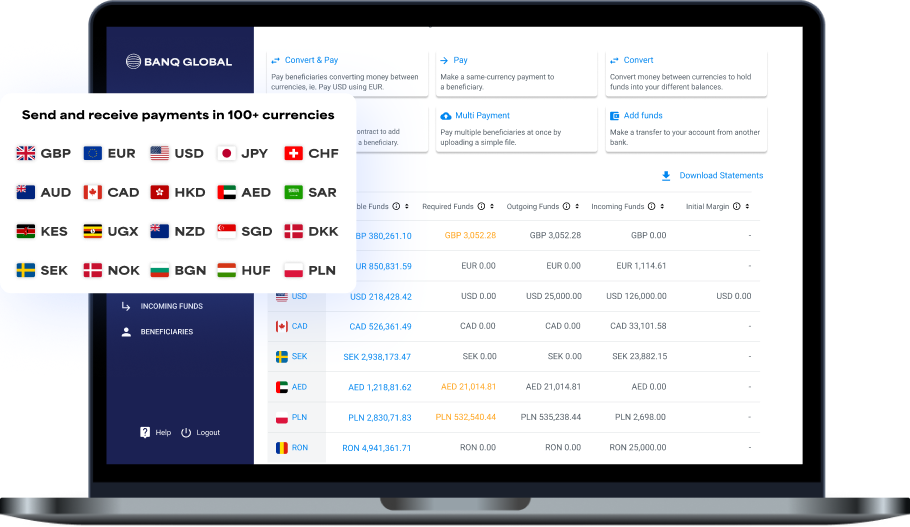
For holding structures and multi-currency international groups, having a robust Dutch account streamlines your corporate treasury. Instead of opening separate accounts per currency, a localized Dutch account that supports 130+ currencies allows you to hold, send, and receive funds globally from a single, unified platform.
Who Qualifies for a Dutch Business Account as a Non-Resident?
Dutch law places no legal restriction on non-resident directors or shareholders holding a Dutch business account. However, the practical barriers are institutional.
- Firstly, Dutch banks and account providers operate under the Wwft (Wet ter voorkoming van witwassen en financieren van terrorisme), which mandates thorough KYC and Customer Due Diligence (CDD) checks for every applicant.
- Secondly, Non-resident structures (including non-EU UBO chains, holding companies, and SPVs) are subject to more intensive review, not because they are prohibited, but because the due diligence process is more complex.
- Lastly, a rejection is not a legal verdict on the business; it reflects a provider's risk appetite and operational capacity to onboard complex international structures.
Therefore, rather than asking whether you are eligible, evaluate your business model (e-commerce vs. SaaS) and corporate structure (EU vs. non-EU UBOs), and choose a provider whose risk appetite aligns with your compliance profile.
Three Provider Options to Open a Business Account in the Netherlands as a Non-Resident
Spain offers Three options are available for non-resident to open a Dutch business account i.e., traditional banks, digital account providers, and specialist account providers.
Traditional Dutch Banks
Traditional Dutch banks such as ING, ABN AMRO, and Rabobank offer local banking infrastructure and domestic payment rails. Under the Wwft, they apply intensive KYC procedures, which can result in higher rejection rates and longer onboarding timelines for non-resident structures with foreign UBO chains or complex ownership. Identity verification is typically conducted in person and, for some structures, evidence of a physical Dutch presence may be required. These banks generally work best with companies that have a Dutch-resident director and a straightforward ownership structure.
Digital Providers
Digital providers such as bunq, Revolut Business, and Wise Business offer remote onboarding and multi-currency capability. Bunq issues a genuine Dutch IBAN, while Revolut Business and Wise typically do not, which can create issues for certain notary requirements and Belastingdienst payments. Automated KYC processes are commonly used and work best for straightforward ownership structures. Applications involving non-EU UBOs, layered ownership, holding companies, or SPVs may require additional review and can experience delays or rejection.
Specialist Business Account Providers
Specialist business account providers such as Banq Global are designed for non-resident directors, foreign-owned entities, complex ownership structures, holding companies, SPVs, and family offices. They accept non-resident directors and shareholders from more than 190 countries and provide a fully online application process with digital identity verification and dedicated onboarding support. Services include a Dutch local IBAN, full SEPA and SWIFT access, and multicurrency account (130 currencies). Account approval is typically completed within 24 hours. Lending, overdraft, and cash deposit facilities are not provided, so businesses requiring these services may need to maintain a relationship with a traditional bank alongside their account.
Core Steps to Open a Business Account in the Netherlands as a Non-Resident
Opening a Netherlands business account as a non-resident director requires a strategic, step-by-step approach.
Step 1: KvK Registration
KvK registration is the core step in the Netherlands business registration process and is required before most providers will open a Dutch business account. For most foreign subsidiaries and holding structures, this involves incorporating a Dutch BV (Besloten Vennootschap). NV is only necessary for large, publicly traded companies.
Under Dutch law, a civil-law notary must draft the official deed of incorporation and handle the registration directly with the Kamer van Koophandel (KvK)—the Netherlands Chamber of Commerce.
Once filed, the KvK issues the official company registration number and a KvK extract required by all providers. It generally takes 1 to 5 business days for the KvK to finalize the registration after the notary submits the documents.
Once KvK registration is complete, you do not need to apply separately to the Belastingdienst. The KvK forwards your details automatically, and you will receive:
- VAT Number (BTW-nummer): Usually issued by post within 1–2 weeks.
- Corporate Tax Registration: Initiated automatically.
- eHerkenning: Required to file taxes and access government portals, including Mijn Belastingdienst Zakelijk (My Tax and Customs Administration).
Step 2: Secure a Dutch Business Address
Using a registered office from a Dutch corporate services provider (often called a trust office that offers hybrid or virtual office service) is fully acceptable. However, you must ensure the provider has a proper KvK visiting address license, as mail-forwarding addresses are strictly rejected.
Step 3: Register your UBOs
Registering your Ultimate Beneficial Owners (UBOs) in the Netherlands is a strict legal requirement to open a Dutch business account as a foreign company. Under the Wet ter witwassen van geld en financieren van terrorisme (Wwft), any individual who holds 25%+ of the shares, voting rights, or exercises effective control must be recorded in the KVK UBO Register.
Foreign UBOs with non-EU holding chains require a full documented ownership chain. It is worth preparing before the account application begins to avoid delays.
Step 4: Obtain a BSN for Non-Resident Directors
Most providers require a BSN (Burger Service Number) for each director. Build this into the timeline before submitting the application, not after.
Non-residents can obtain one through the RNI (Non-Resident Records Database/Basisregistratie Niet-Ingezetenen) without establishing Dutch tax residency, using a single appointment at a designated Dutch municipality.
Some providers accept a foreign tax identification number (TIN) as an alternative for non-Dutch directors; confirm before applying.
Step 5: Choose Your Provider and Submit
Provider choice matters more for non-resident structures than for resident ones. Apply to the most appropriate provider for your structure first. Avoid parallel applications to multiple traditional banks, as repeated rejections can create a KYC track record that may complicate subsequent applications.
Step 6: Complete the AML and KYC Compliance checks
At this stage, providers conduct Know Your Customer (KYC) and Anti-Money Laundering (AML) checks, to comply with the Wwft and applicable EU AML Directive requirements. This involves
- Verifying the identity of directors, shareholders, and ultimate beneficial owners (UBOs)
- Reviewing company documents
- Assessing business activities and source of funds.
Depending on the provider, ownership structure, and responsiveness to information requests, the review process can take anywhere from a few days to several weeks.
Step 7: Activate your account and start banking
Once approved, your Dutch business account will be activated and your account details issued. You can then send and receive payments, manage payroll, and carry out business transactions in the Netherlands.
How long does it take to open a Dutch business account?
Opening a business account in the Netherlands as a non-resident director depends largely on the provider type you choose and the complexity of your company structure. In general,
- Traditional banks typically take 2-4 weeks minimum, often longer for non-resident or layered ownership applications.
- Digital providers can process simple structures in a few days to two weeks.
- Specialist providers such as Banq Global typically approve eligible applications within 24 hours, with onboarding completed entirely online.
Documents Checklist to Open a Dutch Business Account as a Foreign Company
Banks and financial providers will most definitely ask for:
Company documents
- KvK registration certificate
- Articles of Association
- Deed of incorporation
- Shareholders register
- Beneficial Owner Declaration (if requested by account provider)
- UBO register extract issued by KVK
- Proof of Dutch business address (registered office is sufficient).
Non-Resident Director/UBO Documents
- Valid passport or EU identity card for each
- Proof of address
- BSN for each director
- Business activity description covering business model, key markets, and expected transaction types.
Moreover, non-resident shareholders or directors operating through a complex ownership structure often need to provide a full chain of ownership documentation, certified and, in some cases, apostilled. Additional ownership verification is one of the most common causes of application delays.
FAQs
Do I need to be a Dutch resident to open a business account in the Netherlands?
No. Dutch law places no residency restriction on business account eligibility. Non-residents can establish a BV, provided the company has a registered business address in the Netherlands, or register a branch or foreign entity with the KvK. However, traditional banks often apply enhanced due diligence to non-resident structures, while specialist providers are generally more accommodating.
Can I open a Dutch business account remotely?
Yes. To open a Dutch business account as a non-resident online, the following is usually required: online identity verification, digital submission of company documents, identification checks via video, and electronic signatures. Most digital and specialist providers support fully remote onboarding, while traditional Dutch banks often require an in-person visit.
Can a holding company or SPV open a Dutch business account as a non-resident?
Yes, a holding company or SPV can open a business bank account in the Netherlands as a non-resident, but it is complex. You typically must register a formal presence with the Dutch Chamber of Commerce (KvK), disclose all UBOs, and pass rigorous KYC checks at traditional banks, which frequently decline or substantially delay them.
What if a traditional Dutch bank declines my application?
A rejection from a traditional Dutch bank does not close other routes. Specialist providers such as Banq Global assess applications on different criteria and regularly approve structures that traditional banks decline. Initially applying to the right provider type for your structure avoids a rejected application history and unnecessary delays.
Is Banq Global regulated, and how are client funds protected?
Banq Global works with FCA-authorised partners. Business accounts are provided by Modulr FS Limited (FRN 900573), while currency services are delivered through Currencycloud (FRN 900199). Client funds are safeguarded and held separately from Banq Global’s operational funds.