How to Open a Non-Resident Business Account in the UAE
Around 250,000 new companies were established in the UAE in 2025, taking the total number of companies to more than 1.4 million. For founders and investors establishing businesses from overseas, however, company registration does not automatically make banking straightforward.
If you hold or are forming a mainland or free zone company but do not personally have a UAE residency visa or Emirates ID, opening a non-resident account in the UAE can involve additional scrutiny. This can be particularly relevant for holding companies, SPVs and family offices with complex ownership structures, where providers may look more closely at ownership, business activity and source of funds, making provider selection and well-prepared documentation important for non-resident shareholders and directors.
Why a Non-Resident Director Needs a Dedicated UAE Company Account
While obtaining a non-resident personal account in the UAE is sometimes possible, it is not a substitute for a dedicated non-resident business account for a UAE-registered company. The distinction matters for several reasons.
Corporate Identity
A dedicated business account separates company revenue and expenses from the personal finances of directors and shareholders. This creates a clearer record of who owns and controls the funds and helps providers assess transactions against the company's stated business activity. Central Bank of the UAE guidance also identifies the use of a personal account for business purposes, or vice versa, as a transaction-monitoring red flag.
Multi-User Access and Approval Controls
Corporate accounts can allow directors, finance teams and other authorised users to access the same account under different permission levels. Businesses can also use approval workflows for payments, rather than relying on a personal account controlled by a single individual.
Trade and Commercial Banking
Companies involved in international trade may require services beyond standard transfers. Depending on the bank, account and eligibility, corporate banking can provide access to letters of credit, bank guarantees and trade finance facilities for import and export transactions.
Business-Scale Payments
A UAE company may need to pay suppliers, process payroll, receive customer revenue and make international transfers regularly. Business accounts are structured to support these commercial transaction flows, while personal non-resident accounts are designed around an individual's personal banking activity.
Can a Non-Resident Director or Shareholder Open a UAE Business Account?
Yes, but approval is not automatic. CBUAE anti-money laundering (AML) and counter-terrorism financing (CTF) guidance recognises non-resident entities within its customer risk framework and requires financial institutions to assess the risks they present.
Profile Strength
As part of customer and beneficial-owner due diligence, providers assess the company’s ownership structure, commercial rationale, expected transaction flows and the business background of its non-resident directors and shareholders. A transparent, well-documented profile can support a smoother compliance review.
Business Activity Risk
The company’s business activity also affects non-resident eligibility. Certain sectors, transaction models and cross-border activities receive greater scrutiny, while some may fall outside an account provider’s risk appetite.
Jurisdiction risk
In addition, account providers consider where the company, its directors, shareholders and UBOs are based. Links to FATF high-risk jurisdictions can lead to enhanced checks, while countries under increased monitoring are considered as part of the provider’s overall risk assessment.
Steps to Open a Non-Resident Business Account in UAE Without a Visa
The following steps explain how a registered UAE company can apply for a non-resident business account without a UAE residency visa.
Step 1: Confirm Your UAE Entity Is Already Registered
Before applying, the UAE entity should already be registered with the relevant authority. Whether it is a mainland company, free zone company or offshore company, the provider will need the incorporation and registration documents applicable to that structure.
Step 2: Match provider to profile
Non-resident businesses generally have three routes to consider when opening a UAE business account without a visa: traditional UAE banks, digital-first banks and specialist business account providers. The main differences are how they handle UAE residency, physical presence and remote onboarding, alongside the company's ownership structure and banking needs.
Traditional UAE Banks
Banks such as Emirates NBD, First Abu Dhabi Bank (FAB) and Mashreq offer comprehensive corporate banking, including international payments, trade finance and treasury services. However, non-resident applications may involve additional documentation, in-person verification or requirements relating to UAE-resident directors or authorised signatories, depending on the bank and company profile. They can be suitable for established businesses that need broader corporate banking services and can meet the bank's onboarding requirements.
Digital-First Banks
Providers such as Wio Bank, Zand and Mashreq NEO offer digital onboarding and app-based account management, which can make the application process faster and more convenient. However, digital onboarding does not necessarily mean fully remote onboarding for a non-resident business. UAE residency, visa or physical-presence requirements may still apply to directors or authorised signatories depending on the provider and account.
Specialist Business Account Providers
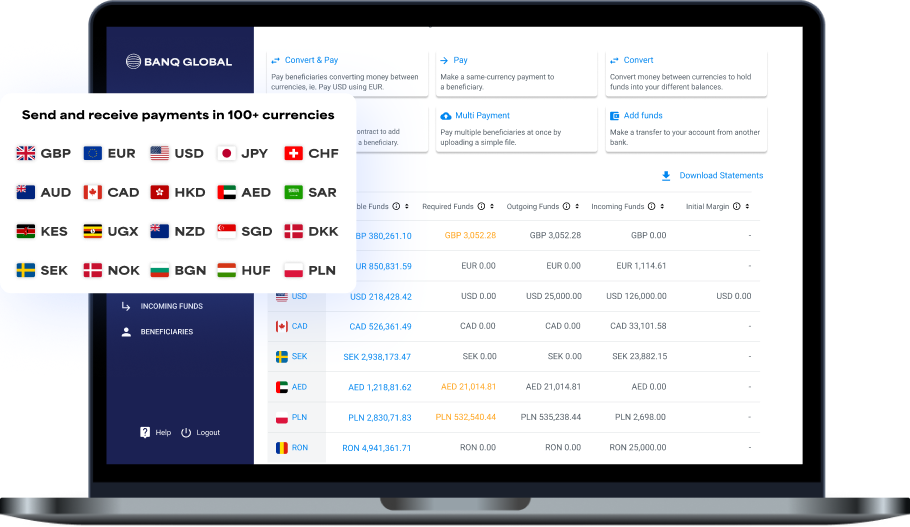
Specialist providers can be more suitable for international businesses seeking remote or non-resident-directed onboarding. Banq Global, for example, supports eligible international businesses with non-resident directors, including holding companies, SPVs, funds and family offices with more complex ownership structures. Its UAE offering focuses on multi-currency accounts, cross-border payments and FX, while taking the wider ownership structure and expected transaction flows into account during onboarding. Businesses may also have access to a dedicated account manager to support the application process.
Step 3: Prepare Your documents
The exact documents required to open a non-resident business bank account in the UAE depend on the provider you choose, your company structure and risk profile.
Standard Requirements
- UAE trade licence or Certificate of Incorporation, depending on the entity.
- Memorandum of Association (MOA) and Articles of Association (AOA), where applicable.
- Board resolution naming the authorised signatory or signatories.
- Passport copy for directors and shareholders, with Emirates ID where applicable.
- Organisation chart and Ultimate Beneficial Owner (UBO) documentation.
- Proof of the company's registered UAE address
- Six-month bank statement for an existing business.
- Source of Funds documentation
- Business plan or company profile explaining the business activity and expected transactions.
Additional Requirements for Non-Resident Applicants
- Proof of overseas address for non-resident directors, shareholders or authorised signatories.
- Tax identification number (TIN) or other evidence of tax residency for directors, shareholders or beneficial owners, where applicable or requested by the provider.
- A bank reference letter from an existing or home-country bank.
- Additional Source of Funds or Source of Wealth evidence.
- A CV or professional profile for directors or authorised signatories.
- Additional ultimate beneficial owner (UBO) chain documentation for layered or complex ownership structures.
- Contracts, invoices or other evidence supporting expected business activity and transaction flows.
Step 4: Compliance Review
Once the provider is chosen and the required documents are in place, the application moves to compliance review. The provider verifies the corporate and personal identities involved to meet its AML/CTF obligations. These requirements apply to foreign-owned companies even where 100% foreign ownership is permitted, with the level of review determined by the risks presented.
Step 5: Complete Remote Onboarding or In-Person Verification
Requirements vary by provider. Some offer remote onboarding using digital document checks and video KYC, while others may require an authorised signatory to complete in-person verification or a branch visit in the UAE.
Step 6: Account Activation
Following approval, the final stage is account activation. Depending on the provider and account, the business may receive a local IBAN and access to AED settlement, multi-currency payments and international SWIFT transfers, which may be routed through a correspondent bank where required.
Costs and Balance Requirements for Non-Resident Business Accounts in the UAE
There is no standard minimum balance for a non-resident business account in the UAE, as the amount depends largely on the provider, account type and company profile. Some basic account packages have no minimum balance, while higher-tier accounts may require larger balances to be maintained.
The minimum balance is only one part of the overall cost. Monthly maintenance fees, fall-below charges, SWIFT transfer fees and FX costs can also add up, particularly for businesses making frequent cross-border or multi-currency transactions. When comparing providers, consider the full fee structure rather than the minimum balance alone to understand the actual cost of maintaining and using the account.
Why Non-Resident Applications Get Rejected
An application for a non-resident business account in the UAE can be delayed or rejected for several reasons, including:
- Unclear or insufficient evidence of source of funds or, where required, source of wealth.
- Outdated, inconsistent or unverifiable overseas address and identity documents.
- Complex or insufficiently documented ownership structures that make it difficult to identify and verify ultimate beneficial owners (UBOs).
- Differences in names, addresses, ownership details or business activities across corporate, shareholder and supporting documents.
- Limited commercial rationale for maintaining a UAE account, particularly where the company has little apparent connection to the UAE.
- Expected transaction volumes, counterparties or payment corridors that do not align with the company's stated business activities.
- Exposure to sanctioned countries, FATF-listed jurisdictions or higher-risk business activities that can trigger enhanced due diligence or fall outside the provider's risk appetite.
- Applying to a provider whose residency, signatory or physical-presence requirements cannot be met by non-resident directors, shareholders or authorised signatories.
Many of these issues can be addressed before applying for a non-resident business account in the UAE by matching the company profile to the right provider and preparing supporting evidence in advance.
FAQs
Do I need a UAE residency visa to open a business account?
No, a UAE residency visa is not always required to open a business account. However, your options depend on the provider and company structure. Some traditional banks require a UAE-resident authorised signatory with an Emirates ID or an in-person visit, while digital and specialist providers may offer remote onboarding for eligible non-resident businesses.
Can I open a UAE business account without visiting the UAE?
Yes, it may be possible to open a UAE business account without visiting the UAE, depending on the provider and your company profile. Some providers support fully remote onboarding using digital document checks and video KYC, while others require an authorised signatory to complete in-person verification in the UAE.
How long does it take a non-resident to open a UAE business account?
The application timeline for corporate bank accounts is generally longer for non-resident applicants than for resident applicants, as the compliance review is typically more extensive. Providers specifically designed for remote non-resident onboarding tend to be considerably faster than traditional banks.
Do I need to register a UAE company before opening a business account?
Yes. A UAE-registered entity must be in place before you can apply for a business account in the company’s name. Non-residents can establish mainland or free zone companies, while DIFC and ADGM offer specialised financial free zone structures for holding companies, SPVs, funds and family offices.
Can non-resident directors and shareholders from any country open an account with Banq Global?
Banq Global supports non-resident directors and shareholders from more than 190 countries, subject to eligibility, compliance checks and restrictions relating to sanctioned jurisdictions and unsupported business activities. Check your country’s non-resident eligibility with Banq Global before starting your application.
What ongoing compliance should non-resident account holders expect?
Holding a non-resident business account in the UAE involves ongoing compliance rather than a one-time onboarding check. Providers may periodically review source of funds, transaction patterns, business activity and beneficial ownership to ensure account activity remains consistent with the customer profile. Account holders should keep corporate and KYC documentation current and promptly report material changes to ownership, authorised signatories or business activities.