How to Open a Business Account in Nigeria as a Foreign-Owned and Non-Resident Companies
Residency is often seen as a barrier when opening a business account in Nigeria, particularly for a foreign-owned company with non-resident directors. However, Nigerian residency is not a blanket requirement for foreign directors: the CBN’s Customer Due Diligence Regulations 2023 recognise directors who are both non-Nigerian and non-resident, subject to applicable identification and verification requirements.
For CFOs, legal counsel and finance teams managing Nigerian operations, the route depends on the company structure. Foreign-owned Nigerian companies generally follow CAC incorporation and corporate account onboarding, including KYC, beneficial ownership and BVN checks. Foreign companies without a Nigerian subsidiary follow a different route and may, in limited circumstances, be eligible for a CBN-recognised non-resident account or qualify for an incorporation exemption under CAMA 2020.
Why International Businesses Need a Nigerian Business Account
International businesses open a business account in Nigeria to meet commercial needs and access essential banking capabilities.
Common Commercial Needs Includes
- Accept payments from Nigerian clients securely using Central Bank of Nigeria (CBN) licensed payment channels.
- Pay Nigerian contractors, employees, and suppliers directly in Nigerian Naira (NGN).
- Convert NGN profits into major foreign currencies like USD, EUR, or GBP.
- Repatriate funds through CBN-approved FX channels to avoid trapped funds.
- Hold a local Naira account alongside a domiciliary account to manage both local and hard-currency international transfers.
- Maintain compliance by fulfilling applicable reporting requirements set by the Nigeria Revenue Service (NRS), which replaced the Federal Inland Revenue Service (FIRS) in 2026, and the CBN for commercial operations in Nigeria.
Practical Banking Capabilities Includes
- Access to domestic rails via the Nigeria Inter-Bank Settlement System (NIBSS), including NIP for real-time Naira transfers.
- CBN-compliant FX repatriation through authorised channels, reducing the regulatory and compliance risks associated with informal arrangements
- Formal account records that simplify NRS tax filings and periodic CBN regulatory reporting.
- Multi-currency functionality for specialist accounts, allowing groups to manage NGN, USD, EUR, or GBP under unified banking relationships.
- Access SWIFT and correspondent banking networks for cross-border receipts and payments, depending on the bank/provider and account type.
Steps to Open a Business Account in Nigeria as a Foreign-Owned Nigerian Company
The following are the key steps involved in opening a corporate account in Nigeria as a foreign-owned or non-resident company.
Step 1: Register with the Corporate Affairs Commission
CAC registration is required before a foreign-owned Nigerian company can apply to open a business account. Foreign investors can generally own 100% of a Nigerian company in sectors open to foreign investment, without appointing a Nigerian shareholder solely because of foreign ownership.
Registration is completed online through the Corporate Affairs Commission (CAC) Company Registration Portal (CRP). You reserve a company name, provide director, shareholder, Persons with Significant Control (PSC)/beneficial ownership and Nigerian registered office details, submit the Memorandum and Articles of Association (MEMART) and supporting documents, and pay the applicable statutory fees.
Once registration is approved, the company receives:
- An electronic Certificate of Incorporation.
- A Certified Extract of Registration Information containing the company’s registered details. (Often called a CAC status report)
- Its registered incorporation records, including the approved MEMART, through the CAC system.
Older companies and some banking document checklists may still refer to a CAC Status Report or legacy forms such as CO2 (Return of Allotment of Shares) and CO7 (Particulars of Directors). However, CO2 and CO7 should not be treated as standard documents issued with a new CAC registration today.
Note: If your company does not yet have a physical presence in Nigeria, you can use a local company secretarial firm, registered agent or virtual office provider to support the CAC registration and registered-office requirement. Before applying for the business account, confirm whether your chosen bank also requires certified true copies (CTCs) of your CAC documents.
Step 2: Documents Required to Open a Business Account in Nigeria
Once your company is incorporated with the CAC, you can prepare the corporate, tax and KYC documents required for the account application. The CBN sets the core customer due diligence requirements. However, the exact documents, certification and verification processes can vary by bank. Additional checks may also apply to foreign shareholders and non-resident directors.
Standard Requirements for an LLC
- CAC Certificate of Incorporation.
- Registered Memorandum and Articles of Association (MEMART).
- Current CAC company information, such as the Certified Extract/E-Status Report.
- Board resolution on letterhead noting the foreign address of each non-resident director.
- Valid Nigerian Tax Identification Number (Tax ID/TIN).
- Bank Verification Number (BVN) information required for the relevant directors and account signatories.
- Proof of registered company address, such as a recent utility bill or tenancy agreement.
- Completed account-opening, mandate and KYC forms required by the chosen bank.
Additional Documents for Non-Resident Directors and Foreign Shareholders
- Notarised international passports for non-resident directors, where required by the bank.
- Overseas proof of residential address, apostilled or otherwise certified where required.
- SCUML registration certificate, where the company falls within an applicable designated business category.
- Bank references or completed reference forms, where required by the chosen bank.
- Additional ownership, source-of-funds or identification documents requested as part of enhanced due diligence (EDD).
CBN rules establish the underlying CDD requirements, while the exact format, certification and supporting-document checklist varies by financial institution
Step 3: Choose the Right Account Provider
When non-residents open a business account in Nigeria, choices include traditional banks, digital fintechs, and specialist providers.
Traditional Nigerian Banks
Traditional Nigerian banks such as GTBank, Zenith Bank, Access Bank, First Bank Nigeria and UBA provide full domestic payment infrastructure for Naira transactions, making them appropriate for businesses needing local payment rails, trade finance access or credit relationships. However, onboarding can take longer for foreign-owned companies with complex ownership structures because of additional documentation, KYC and verification requirements, making traditional banks a less suitable option where remote onboarding is required.
Digital Banks and Fintech Providers
Digital and fintech options such as Kuda Business, Moniepoint and OPay Business provide faster account setup and lighter documentation than traditional banks, making them suitable for local businesses, domestic trade and everyday Naira transactions. However, they are generally less suited to complex foreign ownership structures or high-volume international operations. Providers may require a Bank Verification Number (BVN) and local identification, while account limits and foreign-currency capabilities vary by provider. Limited access to international banking services can make these business account options in Nigeria less suitable for non-resident structures.
Specialist Account Provider
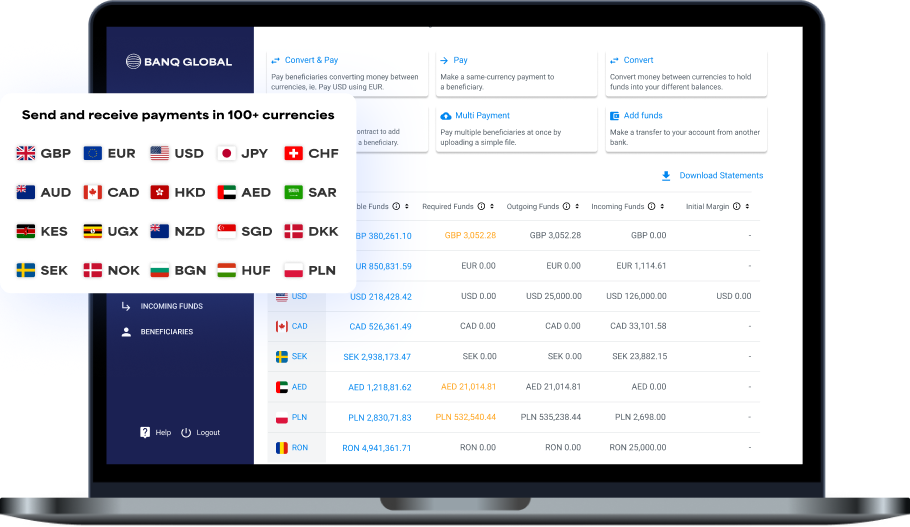
Specialist international account providers such as Banq Global bridge the gap between traditional Nigerian banks and fintechs by offering solutions for foreign-owned companies and non-resident structures with Nigerian operations. Banq Global supports fully online applications for non-resident businesses, with compliant applications typically progressing within a few days, subject to regulatory approval. Businesses can access Naira alongside major foreign currencies, including USD, EUR and GBP, while Banq Global’s wider platform provides multi-currency capabilities through its network of financial partners.
Step 4: The Application and Verification Process
After application submission, the bank completes the required checks under the Central Bank of Nigeria (CBN) AML/CFT framework:
- Reviews the submitted corporate documents and identification records for completeness and accuracy.
- Conducts a KYC check to verify directors, account signatories and other relevant parties.
- Applies Enhanced Due Diligence (EDD) to foreign-owned companies and complex structures, including additional checks on ownership, source of funds and business activities.
- Identifies and verifies all Ultimate Beneficial Owners (UBOs), particularly for companies with layered holding structures.
- Completes a verification call or branch visit, depending on the provider’s requirements.
- Activates the corporate account once the required KYC and compliance checks are completed and the application is approved.
Tip: Prepare a simplified ownership diagram showing shareholders, holding companies and UBOs when applying. This can make layered ownership easier to verify and reduce back-and-forth during the application process.
How long does it take to open a business account in Nigeria?
There is no fixed timeline for opening a business account in Nigeria, as processing times vary by provider and company structure. Foreign-owned companies may take longer with traditional banks where additional KYC, verification or Enhanced Due Diligence (EDD) applies. Specialist providers can offer faster onboarding when the required documents are complete. Inconsistent information, expired identification and certification of foreign documents can also add time to the process, so preparing the documents correctly in advance can help avoid unnecessary delays.
Additional Considerations for Foreign-Owned Companies and Non-Resident Directors
SCUML Registration for Foreign-Owned Companies
Nigeria's Special Control Unit Against Money Laundering (SCUML) requires businesses that fall within designated Designated Non-Financial Businesses and Professions (DNFBPs) categories to register. SCUML registration is not required simply because a company is foreign-owned. Where it applies, banks may require the SCUML certificate as part of the process to open a corporate account in Nigeria. Relevant categories include:
- Real estate businesses
- Law firms
- Accountants and accounting firms
- Consultants and consulting companies
- Dealers in precious metals and stones
- Trust and company service providers among others.
SCUML registration and certification are free of charge, and SCUML says they should be completed through its official website.
NIPC Registration for Foreign-Owned Companies
For a Nigerian enterprise with foreign participation, registering with the Nigerian Investment Promotion Commission (NIPC) under section 20 of the NIPC Act is an essential compliance step. This process is completely separate from Corporate Affairs Commission (CAC) incorporation and bank KYC requirements.
Registering with NIPC gives non-residents and foreign investors legal recognition, statutory investment protection, and smooth access to government approvals, making it a mandatory step to lawfully operate and repatriate funds from Nigeria.
Notarization and Apostille of Foreign Documents
Company and identification documents for foreign-owned businesses may need to be notarised and, where required, apostilled or otherwise authenticated before a Nigerian bank will accept them. Requirements vary by bank and the country where the documents were issued, so confirming the required process in advance can help non-residents avoid delays when opening a business account in Nigeria.
BVN for Foreign Nationals (NRBVN) – 2025 Update
According to NIBSS, non-Nigerian, non-resident directors of companies operating in Nigeria can obtain an NRBVN for regulatory compliance purposes, subject to pre-registration with a local Nigerian bank before onboarding. Foreign directors should therefore confirm the pre-registration and NRBVN onboarding process with their chosen Nigerian bank before applying.
FAQs
Can a non-resident company open a business account in Nigeria?
Yes, but only certain non-resident companies can open an account without establishing a Nigerian subsidiary. While Section 78 of CAMA 2020 generally requires foreign companies operating in Nigeria to incorporate locally, Section 80 allows exemptions for specific foreign companies and projects. CBN regulations also recognise non-resident accounts for eligible foreign entities, including foreign companies executing approved contracts in Nigeria.
What is the difference between a corporate account and a domiciliary account in Nigeria?
A corporate Naira account uses local account details, including a Nigerian Uniform Bank Account Number (NUBAN), to receive and make payments in NGN. A domiciliary account holds foreign currencies such as USD, EUR or GBP for foreign-currency transactions. International businesses may maintain both local and cross-border payments.
Are there fees for a Nigerian corporate business account?
Yes, though the fee structure varies by provider. Traditional banks charge account maintenance fees and transaction fees for foreign-owned companies. Some fintech providers offer zero-maintenance-fee accounts but apply per-transaction charges plus CBN stamp duty. For specialist international accounts, check current fees on the provider’s website before applying.
Can I open a Nigerian business account without visiting Nigeria?
It depends on the provider. Some traditional banks may require an in-branch visit or physical document sighting, while others support video KYC depending on the customer and account type. Fully online account opening is available through specialist providers, where identity verification is completed via video call and all documentation is submitted digitally.
Are the Nigeria business accounts offered through Banq Global regulated?
Yes. Banq's Nigeria business accounts are authorised by the CBN. The accounts are designed for international businesses with Nigerian operations, including foreign-owned companies and non-resident structures that receive significant Naira inflows and need multi-currency access alongside their NGN account.
What are the ongoing compliance requirements for a Nigerian corporate account?
Nigerian banks are required to conduct periodic KYC reviews under CBN guidelines. For foreign-owned companies, this typically means providing updated corporate documents, director identification, and confirmation of beneficial ownership regularly. Changes in directors, shareholders, or company structure must be notified to the bank promptly and may require updated CAC filings before the bank will process the change. Annual returns to the CAC and NRS (FIRS) tax filings are also required for all registered Nigerian entities.