Set Up an SPV and Open a Business Bank Account in the US
The United States is a common home for Special Purpose Vehicles (SPVs), used by US and overseas owners for investment holding, acquisitions, co-investment, financing, joint ventures and cross-border deals.
Deep capital markets, a choice of flexible company structures and a large investor base make the US a practical base for international investors, private equity firms, corporate groups and transaction sponsors. Delaware is particularly relevant for SPVs due to its flexible Limited Liability Company (LLC) structure and straightforward incorporation process.
A Delaware LLC can be formed relatively quickly, but incorporation and obtaining an Employer Identification Number (EIN) do not provide the SPV with an operational business account.
Investor capital, the purchase price and adviser fees all have to move through an account in the SPV's own name. For owners outside the US, opening that account is often slower than forming the company, because the provider has to understand every layer of ownership.
This guide explains both sides of the process:
- How to set up an SPV in the US
- The principal US SPV structures
- Delaware formation filings and registered agent requirements
- Incorporation documents, costs and timelines
- Securities regulations, tax and ongoing reporting requirements
- How to open a business bank account for a US SPV
- Foreign ownership and non-resident directors
- What account providers assess during onboarding
- Documents required to open the account
- Multi-currency and international payment requirements
US SPV at a Glance
Requirement | United States (Delaware) |
|---|---|
Common SPV structures | Limited Liability Company (LLC), series LLC, limited partnership (LP) and corporation |
Common SPV corporate structure | Delaware Limited Liability Company (LLC) |
Governing legislation | |
Formation authority | Delaware Division of Corporations |
Formation document | Certificate of Formation identifying the LLC, registered office and registered agent |
Minimum LLC capital | No fixed statutory minimum |
Minimum members | One individual or corporate member |
Management | Member-managed or manager-managed; no statutory requirement to appoint company directors |
Registered office and agent | Delaware registered office and registered agent required |
LLC formation fee | $110 |
Formation timeline | Standard processing varies; 24-hour and same-day expedited filing available |
Annual Delaware LLC tax | $400, due 1 June for the previous tax year; no annual report required |
Federal tax identification | Employer Identification Number (EIN), obtainable by eligible non-US owners without an SSN or ITIN |
Federal tax classification | Single-member LLCs are generally disregarded entities; multi-member LLCs are generally partnerships, unless another classification is elected |
Beneficial ownership reporting | US-created LLCs are exempt from FinCEN beneficial ownership reporting under the August 2026 final rule |
Foreign ownership | Permitted for non-US shareholders, members and managers |
Business bank account | Not required before LLC formation; account approval is subject to the provider's requirements |
Multi-currency accounts | Available through suitable financial institutions, subject to eligibility |
What Is an SPV in the US?
A Special Purpose Vehicle (SPV) in the United States is a company or partnership set up for a specific transaction or activity, such as holding an investment, acquiring a business, financing an asset, owning property or pooling investor capital.
An SPV is not a separate legal entity type. In the US, Delaware Limited Liability Companies (LLCs) are commonly used for these structures.
Is an SPV the Same as an LLC?
No. An SPV describes the purpose of the entity, while an LLC is the legal structure used to form it.
An LLC can operate as a traditional business with employees, customers and recurring revenue, or as an SPV set up to hold a single investment, asset or transaction.
Under Delaware law, an LLC has a separate legal identity, allowing the SPV to hold assets and liabilities independently of its owners. Members are generally not personally liable for the LLC's obligations solely because of their ownership.
Why Set Up an SPV in the United States?
The United States is a major destination for international investment, corporate acquisitions, financing and joint ventures. Delaware is particularly relevant for SPVs because its flexible company structures, mature legal framework and straightforward incorporation process make it suitable for both domestic and internationally owned investment vehicles.
Straightforward Incorporation
A Delaware LLC can be formed through the Delaware Division of Corporations for $110, with additional expedited filing options of $50 for 24-hour service or $100 for same-day service. There is no fixed minimum capital requirement, notary or pre-incorporation capital deposit.
Separate Legal Personality and Limited Liability
A Delaware LLC provides a separate legal entity for holding investments, assets and liabilities. Members are generally not personally liable for the company's obligations solely because of their ownership, helping separate the SPV's financial commitments from those of its investors and other group companies.
Flexible Ownership and Management
Delaware LLCs can have a single member, including a foreign individual or company. Their LLC agreements can set out specific management arrangements, ownership rights, capital contributions and profit distributions, making them suitable for acquisitions, investment holding and joint ventures.
Limited Public Ownership Disclosure
A Delaware Certificate of Formation does not require the names of members or managers to be disclosed. US-created LLCs are also currently exempt from federal beneficial ownership reporting to FinCEN. However, financial institutions must still obtain relevant ownership information when assessing account applications.
Strong Legal and Investment Framework
US state laws give SPVs a well-developed legal framework, and Delaware is the most common route. Delaware's Limited Liability Company Act provides flexibility over corporate governance, supported by its specialist Court of Chancery. The US also offers securities registration exemptions, including Regulation D, which qualifying SPVs can use when raising capital from investors.
Considerations for International Investors
A Delaware SPV operating or holding assets in another US state may face additional registration and tax obligations, which is why some sponsors form the SPV in the state where the asset sits or where they operate instead. Foreign-owned structures can also have substantial federal reporting requirements, while opening a business account requires separate checks on ownership, funding and expected transactions.
For international investors, the US suits acquisition vehicles, holding companies and financing SPVs best where the assets, investors or payments are in the US, provided the tax filings and banking are planned before the SPV is formed.
What Types of SPV Can Be Set Up in the US?
Several legal structures can be used to set up an SPV in the United States, depending on the intended investment, ownership arrangements and tax requirements.
Delaware Limited Liability Companies (LLCs) are commonly used for investment holding, acquisitions and financing structures.
Other options include limited partnerships (LPs), frequently used for private equity funds and co-investment arrangements, corporations, which provide a share-based ownership structure and cost from $109 to incorporate in Delaware, and Delaware Statutory Trusts (DSTs), used for certain property investments and structured-finance transactions.
Delaware LLC
A Delaware Limited Liability Company (LLC) is one of the most commonly used structures for US SPVs.
It can be managed directly by its members or through appointed managers, without requiring a traditional corporate board of directors.
A Delaware LLC can be set up to hold a single investment, acquire a business, own property or undertake a financing transaction, and one member is enough.
Its federal tax classification generally depends on the number of members and whether the LLC elects corporate tax treatment.
Series LLC (Protected and Registered Series)
Delaware also permits series LLC structures, allowing different investments, assets or transactions to be organised into separate series within a single LLC.
Two principal arrangements are available:
- Protected series: Created under the LLC agreement, with liabilities generally restricted to the assets of the relevant series where statutory requirements are satisfied, including separate asset records and the required notice in the LLC's Certificate of Formation.
- Registered series: Formed by filing a separate Certificate of Registered Series with the Delaware Division of Corporations, at $110 per series. These series also benefit from statutory liability separation where the applicable requirements are met.
A series LLC can be useful for investment sponsors managing multiple transactions or assets under one structure.
However, forming a separate LLC for each investment may be more appropriate where lenders, counterparties or account providers require clearly documented, independently registered entities.
The right structure depends on the transaction, the investors, the tax position and how the SPV will be run. Take US legal and tax advice before choosing, as the entity and its federal tax classification affect which IRS filings the SPV has to make.
How to Set Up an SPV in the US
The formation process depends on the legal structure and intended transaction, but setting up a US SPV as a Delaware Limited Liability Company (LLC) generally involves four steps.
Formation timeline: Define purpose and ownership → Choose entity and registered agent → File and register → Obtain EIN → Open business account
Step 1: Define the Purpose and Map the Ownership
Before forming the SPV, the parties should agree:
- What asset or investment the SPV will hold
- What transaction it will undertake
- Who will own and control the structure
- How much capital is required and where it will originate
- Who the investors and counterparties will be
- Which countries and currencies are involved
- Whether the SPV will issue debt or securities
- How money will enter and leave the structure
For an internationally owned SPV, the structure might be:
Non-resident Ultimate Beneficial Owner (UBO)
↓
International Holding Company
↓
Delaware SPV
↓
Underlying Investment or Asset
Each ownership layer should have a clear commercial purpose. The parties should also identify who will manage the LLC and which individual will be its responsible party for federal tax identification.
Step 2: Choose the Entity and Check the Name
The parties choose between a Delaware LLC, series LLC, limited partnership or another suitable structure based on the investment and its ownership arrangements.
A Delaware LLC name must include "Limited Liability Company", "LLC" or "L.L.C.", and generally be distinguishable from existing registered names. Use of "bank" is restricted where it could suggest an unauthorised banking business.
The Delaware Division of Corporations offers name searches. A name can be reserved for 120 days for $75, although reservation is optional.
Step 3: Appoint a Registered Agent, File the Certificate of Formation and Sign the LLC Agreement
A Delaware LLC must maintain a registered agent and registered office in Delaware. The registered office does not need to be where the SPV conducts its business.
To form the LLC, an authorised person files a Certificate of Formation with the Delaware Division of Corporations, stating the LLC's name, registered office and registered agent.
The standard filing fee is $110. Expedited filing costs an additional $50 for 24-hour service or $100 for same-day service, with faster options also available.
The members should sign an LLC agreement covering ownership, management, capital contributions, distributions and transfer restrictions. This agreement is not ordinarily filed with the state, but account providers may request it. A Certificate of Good Standing can also be obtained where required, for $50, and banks often ask for one.
Step 4: Get an EIN as a Non-US Owner and Settle the Tax Classification
The SPV will normally obtain an Employer Identification Number (EIN) from the Internal Revenue Service (IRS), using Form SS-4. The responsible party is generally the individual who ultimately owns or controls the entity.
A non-US responsible party who has no Social Security Number (SSN) or Individual Taxpayer Identification Number (ITIN), and is ineligible to obtain one, can enter "foreign" or "N/A" on Form SS-4.
Eligible international applicants can apply by telephone on +1 267-941-1099, fax or post, as the IRS online application is only available to applicants in the US. The IRS generally processes fax applications within four business days, while postal applications take approximately four weeks.
For federal tax purposes, a single-member LLC is generally disregarded and a multi-member LLC is generally taxed as a partnership, unless another classification is elected on Form 8832. The tax implications are explained later in this guide.
The business-account application can be prepared while the EIN is being obtained, although providers will usually need the EIN before the account can be opened. Providers will assess the SPV's registration, ownership, funding and intended transactions separately from its formation.
What Documents Are Usually Required to Set Up a US SPV?
The requirements depend on the legal structure, ownership and intended transaction. For a Delaware LLC used as an SPV, the following information and documents are commonly needed:
- Proposed LLC name checked against the Delaware Division of Corporations' records.
- Registered agent details and Delaware registered office address.
- Certificate of Formation stating the LLC's name, registered office and registered agent.
- LLC agreement setting out members, managers, capital contributions, distributions and transfer restrictions.
- Member and manager details, including who is authorised to act for the SPV.
- Ownership chart identifying corporate members and ultimate individual owners.
- Passports and proof of address where requested by professional advisers or financial institutions.
- Registration documents for corporate members, including overseas holding companies.
- Corporate good-standing evidence for existing owners, where requested.
- Details of proposed capital contributions or investor commitments.
- Form SS-4 information for obtaining an Employer Identification Number (EIN), including the responsible party.
- For a protected series, the required liability-limitation notice in the LLC's Certificate of Formation; for a registered series, a separate Certificate of Registered Series.
- For an investor-funded SPV, relevant subscription or investment agreements and any applicable securities filings.
The Delaware formation filing itself is relatively straightforward. It does not ordinarily require the names of members or managers to be disclosed. Much of the additional documentation is instead prepared for corporate records, professional advisers, tax registration or business-account due diligence.
Where the SPV raises capital through a Regulation D offering, Form D must generally be filed with the Securities and Exchange Commission within 15 days of the first sale, rather than as part of Delaware incorporation.
More complex international ownership and financing structures may require additional supporting documentation.
How Much Does It Cost to Set Up an SPV in the US?
The cost of setting up a US SPV depends on its legal structure, ownership arrangements and the professional services required.
For a Delaware Limited Liability Company (LLC), the principal formation fees and associated costs are:
Item | Cost (USD) | Source |
|---|---|---|
Delaware LLC formation | $110 | |
Registered series formation | $110 per series | |
Name reservation (optional, 120 days) | $75 | |
Certificate of Good Standing (short form) | $50 | |
Certified copy of formation documents | $50 plus $2 per page | |
Expedited filing | $50 (24-hour), $100 (same-day), $500 (2-hour) or $1,000 (1-hour), additional to filing fees | |
Annual Delaware LLC tax | $400, due 1 June for the previous tax year | |
Annual registered series tax | Additional $100 per registered series | |
Employer Identification Number (EIN) | Free when applying directly to the IRS | |
Registered agent services | Varies | Provider quotation |
Legal, tax and SPV administration | Varies | Professional quotation |
Business-account arrangements | Varies | Account provider |
The $400 Delaware LLC annual tax applies from the 2026 tax year, with the first payment at this rate due by 1 June 2027.
State filing fees are only a small part of the budget. Most SPVs also pay for a registered agent, US legal and tax advice, investor documents, an annual Form 5472 or Form 1065 filing, ongoing administration and banking.
An SPV with multiple investors, complex international ownership or securities-raising requirements may incur substantially higher professional fees.
The overall set-up budget should therefore reflect the underlying transaction, rather than the Delaware filing fee alone.
Securities and Regulatory Considerations for a US SPV
A US SPV raising capital from investors must consider federal securities regulations, particularly where it issues ownership interests to multiple investors, and this applies even when the investors are overseas.
The Securities and Exchange Commission (SEC) regulates securities offerings under the Securities Act of 1933, while the Investment Company Act of 1940 sets additional requirements for certain pooled investment structures.
The principal considerations include:
- Rule 506(b) of Regulation D: Allows qualifying SPVs to raise unlimited capital from accredited investors and up to 35 non-accredited investors within any 90-day period, provided those non-accredited investors meet the required financial sophistication standards. General advertising or solicitation is prohibited.
- Rule 506(c) of Regulation D: Permits general advertising and solicitation, provided all purchasers are accredited investors and the SPV takes reasonable steps to verify their status.
- SEC Form D: SPVs raising capital under Rule 506(b) or 506(c) must generally file Form D with the SEC within 15 days of the first securities sale. State securities regulators may also require separate notice filings and fees.
- Investment Company Act exemptions: Section 3(c)(1) generally excludes qualifying privately offered investment funds with no more than 100 beneficial owners from investment-company registration. Section 3(c)(7) provides a separate exclusion for qualifying funds whose investors are exclusively qualified purchasers.
- Investment adviser requirements: Sponsors managing investments through one or more SPVs may also be subject to investment adviser registration or reporting requirements, depending on their activities, assets under management and available exemptions.
For SPVs raising capital from overseas investors, Regulation S can provide a separate framework for qualifying offshore securities offerings.
These requirements depend on the SPV's activities. A company set up to acquire a single business may have different regulatory obligations from an investment SPV pooling capital from multiple investors.
US securities counsel should therefore assess the proposed investment and fundraising arrangements before capital is raised.
What Are the Tax Considerations for a US SPV?
US SPV taxation depends on the legal structure, investment activities and country of residence of its owners.
For a Delaware LLC, the main considerations include federal tax classification, foreign ownership, partnership reporting, withholding taxes and applicable tax treaties.
Federal Classification and Form 5472
A Delaware LLC with one member is generally taxed as part of its owner's income rather than as a separate company. An LLC with two or more members is generally taxed as a partnership, while LLCs can also elect corporate tax treatment.
A US SPV taxed as a corporation generally pays federal corporate income tax at 21% on taxable profits, alongside any applicable state taxes.
Foreign-owned LLCs can have additional reporting requirements:
- Form 5472: A US LLC wholly owned by a foreign person and treated as a disregarded entity must report certain transactions with related parties, including owner contributions, loans and distributions.
- Form 1120: Where Form 5472 reporting is required, the LLC must submit it with a simplified corporate tax return, even if the SPV has no taxable income.
- Penalties: Failure to file a required Form 5472 can result in a $25,000 penalty, plus a further $25,000 if the failure continues more than 90 days after the IRS gives notice.
For example, an overseas investor contributing capital to a newly formed Delaware LLC can trigger reporting obligations before the SPV generates any income.
Partnership Reporting and Withholding on Effectively Connected Income
A Delaware LLC taxed as a partnership generally files an annual Form 1065 with the Internal Revenue Service (IRS), with each partner receiving a Schedule K-1 showing their share of the partnership's financial results.
For calendar-year partnerships, the filing deadline is generally 15 March of the following year.
If the SPV earns taxable income from US business activities and has overseas investors, it may need to deduct US tax on their share of the profits, even before distributing the money.
This withholding is generally reported using Forms 8804 and 8805, with payments made through Form 8813 (see the IRS guidance on partnership withholding).
Withholding on US-Source Income and Tax Treaties
Certain US-source payments to overseas investors, including dividends, interest and royalties, can be subject to a 30% withholding tax, although exemptions or reduced treaty rates may apply.
For example, a US corporate SPV paying dividends to an overseas shareholder may need to deduct US tax before transferring the funds.
The United States has double taxation treaties with numerous countries that can reduce withholding taxes on qualifying international payments.
Foreign investors generally confirm their tax status and claim applicable treaty benefits using Form W-8BEN for individuals or Form W-8BEN-E for companies.
An SPV holding property or operating in another US state can also have additional state tax obligations.
Take tax advice in both the US and the owners' home country before forming the SPV, covering its federal classification, any Form 5472 reporting and whether treaty relief is available.
What Are the Ongoing Reporting Requirements?
A Delaware SPV has ongoing state, federal tax and potentially securities reporting obligations, depending on its legal structure, ownership and activities.
Unlike corporations, Delaware LLCs are not required to file an annual report with the Delaware Division of Corporations. However, they must pay an annual state tax and meet any applicable federal filing requirements.
For a Delaware LLC used as an SPV, the key obligations include:
Obligation | Deadline | Source |
|---|---|---|
Delaware annual tax: LLCs must pay $400 annually, even where the SPV has no income. | 1 June, covering the previous calendar year. | |
Registered series tax: An additional $100 annual tax applies to each registered series. | 1 June, covering the previous calendar year. | |
Registered agent: The SPV must maintain a Delaware registered agent and registered office. | Ongoing requirement. | |
Foreign-owned LLC reporting: A foreign-owned disregarded LLC with reportable related-party transactions must file Form 5472 with a simplified Form 1120. | Generally 15 April for calendar-year entities, subject to extensions. | |
Partnership tax returns: LLCs taxed as partnerships generally file Form 1065 and provide Schedule K-1 information to partners. | Generally 15 March for calendar-year partnerships, subject to extensions. | |
Corporate tax returns: An LLC electing corporate taxation generally files Form 1120. | Generally 15 April for calendar-year companies, subject to extensions. | |
Securities filings: SPVs raising capital under applicable Regulation D exemptions generally file Form D with the Securities and Exchange Commission (SEC). | Within 15 days of the first securities sale, with amendments where required. | |
Beneficial ownership reporting: US-created LLCs are exempt from filing federal beneficial ownership reports with FinCEN under the August 2026 final rule, although foreign companies registered to do business in the US still report. | No filing required for US-created LLCs. |
Late payment of the annual tax attracts a $200 penalty and interest of 1.5% per month.
SPVs should also maintain accurate financial records supporting their investments, capital contributions, distributions and tax filings.
Additional obligations can arise where an SPV operates or holds assets in another US state, raises investment capital or undertakes regulated activities.
The exact requirements should therefore be confirmed according to the SPV's structure, investment activities and applicable state and federal regulations.
Opening a Business Bank Account for a US SPV
Once a US SPV has been formed, the next major operational requirement is usually opening its business account.
Unlike a trading company with customers and regular revenue, a US SPV might receive capital from overseas co-investors or a foreign holding company, make one large payment at closing and then hold funds, or shares in another company, until exit. None of this rules out an account, but the provider will want to see who owns the SPV, where the money comes from and how the account will be used.
Can a US SPV Open a Business Bank Account?
Yes. A US SPV can open its own business account, which keeps deal funds separate from the sponsor's and the owners' money, subject to the provider's eligibility and compliance requirements.
For a US SPV, account providers will typically assess:
- Legal structure: Whether the SPV is a Delaware LLC, series LLC, limited partnership or corporation.
- Corporate purpose: Why the US SPV was set up and the investment, acquisition or financing behind it.
- Ownership and Ultimate Beneficial Owners (UBOs): The full ownership chain, including any overseas holding company and each individual who owns 25% or more.
- Formation and tax records: The Certificate of Formation, LLC agreement and EIN confirmation.
- Source of funds: Where the capital entering the SPV comes from, including member contributions, investor funding or loans.
- Source of wealth: How the ultimate owners or investors built the wealth behind the investment.
- Underlying assets: The business, property, securities or other assets the SPV will acquire or hold.
- Expected account activity: Anticipated balances, transaction values, payment frequency and counterparties, including expected ACH and Fedwire payments.
- Countries and currencies: The jurisdictions involved and whether funds will arrive in USD or other currencies.
- Supporting evidence: Subscription documents, purchase agreements, loan agreements or Form D filings that support the proposed transactions.
A newly formed US SPV can apply without any trading history. In its place, providers look at the formation documents, LLC agreement, EIN letter and deal documents, alongside the ownership, source of funds and expected transactions.
What Will a US Account Provider Want to Understand?
Under US customer due diligence requirements, account providers focus on four principal questions:
1. Who owns and controls the US SPV?
The provider will verify the members, Ultimate Beneficial Owners (UBOs) and complete ownership structure, including any international holding companies or trusts.
2. Why was the US SPV set up?
The commercial purpose must be clear, whether the SPV is being used to acquire a business, hold investments, raise financing or undertake a property transaction.
3. Where will the investment capital come from?
The provider will check the source of funds and source of wealth, including shareholder contributions, investor capital, financing or investment proceeds.
4. How will the US business account operate?
The provider will assess expected balances, currencies, countries, counterparties, payment frequency and flow of funds.
A well-prepared application explains these four areas clearly, supported by ownership records and relevant transaction documentation.
Can a Foreign-Owned US SPV With Non-Resident Directors Open a Business Account?
Yes. A foreign-owned US SPV with non-resident directors or managers can open a business account, subject to the provider's eligibility and compliance requirements.
Delaware LLCs can be owned by overseas individuals or companies and managed by non-US residents. Delaware law does not generally require a locally resident member or manager, although the LLC must maintain a Delaware registered agent.
For example:
Non-US Private Equity Investor
↓
International Holding Company
↓
Delaware SPV
↓
US Investment or Acquisition
The account provider will assess:
- Why the Delaware SPV was set up
- Who ultimately owns and controls the international holding company
- Where the investment capital originates
- Whether the acquisition or investment is supported by relevant agreements
- What currencies the SPV will receive and hold
- Which parties will receive payments and future distributions
Under US beneficial ownership due diligence rules, covered financial institutions generally identify individuals owning 25% or more of a legal entity customer and an individual exercising significant control, subject to applicable exemptions. Since February 2026, a bank can rely on ownership details it already holds when an existing customer opens a further account, provided the customer confirms they are still accurate.
Overseas owners are not a barrier on their own. The provider will check that the ownership chart, the EIN responsible party and the beneficial owners it identifies all match, and that the investment purpose and source of funds are documented.
Which Type of Business Account Provider Is Right for a US SPV?
US SPVs can consider traditional banks, digital business-account platforms and specialist providers.
The most suitable option depends on the SPV's ownership structure, countries involved, expected balances, transaction requirements and the provider's eligibility criteria.
Internationally owned SPVs with more complex requirements may benefit from a specialist account provider experienced in cross-border corporate structures.
What Documents Are Required to Open a US SPV Business Account?
Depending on the financial institution, legal structure and intended transactions, documents may include:
- Delaware Certificate of Formation
- LLC agreement
- Employer Identification Number (EIN) confirmation
- Certificate of Good Standing, where required
- Member, manager and authorised signatory details
- Corporate ownership chart
- Ultimate Beneficial Owner (UBO) information
- Passports and proof of residential address
- Corporate registration documents for overseas shareholders
- Source of funds and source of wealth evidence
- Investment or acquisition agreements
- Shareholder loan and financing agreements
- Underlying investment or asset documentation
- Expected account balances, currencies and transaction volumes
- Anticipated flow of funds, including countries and counterparties
For a new SPV, providers focus on the deal and the owners rather than past trading, so the purchase or subscription agreements and a clear ownership chart matter most. Structures with several overseas layers may be asked for certified copies of each holding company's documents.
Multi-Currency and International Payments
US SPVs involved in international investments, acquisitions or financing may need to receive capital from overseas investors, manage different currencies and make payments across several countries.
Can a US SPV Hold Multiple Currencies?
Yes. A US SPV can hold multiple currencies, depending on the capabilities of its business account provider.
For example, a Delaware SPV acquiring a US company may receive investment capital in EUR from European shareholders, convert it into USD to complete the acquisition and subsequently make distributions in GBP to overseas investors.
A multi-currency business account can allow an SPV to:
- Receive investment capital in different currencies
- Hold USD, EUR, GBP and other supported currencies
- Convert funds when required
- Pay international investors and counterparties
- Manage international funding and distributions
The currencies available for holding, exchange and payments will depend on the financial institution and account arrangement.
Holding EUR or GBP alongside USD in one account means the SPV can choose when to convert investor money, rather than opening separate accounts with different providers for each currency.
Can a US SPV Make International Payments?
Yes. A US SPV can make domestic and international payments, provided its account provider supports the required payment methods, currencies and destinations.
US business accounts commonly use an account number and routing number for domestic payments, rather than an IBAN.
The main payment methods include:
- ACH: Electronic USD transfers between US accounts, commonly used for routine domestic payments.
- Fedwire: Domestic wire transfers, commonly used for larger or time-sensitive USD payments.
- SWIFT: International payments between financial institutions, where supported.
A US SPV may use these payment services to receive investor contributions, fund acquisitions, repay shareholder loans, pay professional fees and distribute investment proceeds.
For example, a US real estate SPV may collect rent by ACH every month and pay quarterly distributions to investors in three countries. An acquisition SPV, by contrast, may make a single Fedwire payment to the seller at closing.
The appropriate account arrangement will depend on the currencies, payment values, countries and transaction frequency involved.
Should You Arrange the Account Before or After Forming the SPV?
For a US SPV set up as a Delaware LLC, the business account is generally opened after formation, although planning should begin earlier.
Delaware LLCs are not generally required to deposit investment capital into a bank account or obtain a capital-blocking certificate before formation, unlike a Luxembourg SPV, which needs a blocking certificate before it can be incorporated.
Once the SPV has been registered with the Delaware Division of Corporations, it receives its Certificate of Formation and can apply for an Employer Identification Number (EIN) from the Internal Revenue Service (IRS). Account providers will normally require these documents alongside information about the company's ownership and intended activities.
In practice the order is formation, then EIN, then account, but the account application can start while the EIN is pending. For a foreign-owned SPV, the EIN can take around four business days by fax or four weeks by post, so preparing the ownership documents, funding details and expected payments at the same time helps keep the closing date on track.
How Banq Global Supports US SPVs
Banq Global is a specialist provider of business account solutions for US companies and SPVs, including internationally owned and more complex corporate structures.
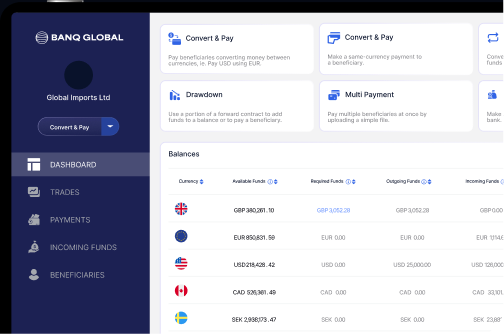
We provide a comprehensive account solution covering the banking requirements of a US SPV, from opening a dedicated USD business account with a US account number and ACH/Fedwire routing details through to multi-currency accounts, international payments and foreign exchange.
This can include:
- US business accounts in the company's name
- Dedicated USD account numbers and ACH/Fedwire routing details
- Business accounts for US SPVs
- Support for non-resident directors and international shareholders
- Support for complex international ownership structures
- USD and multi-currency accounts
- Domestic and international payments
- Foreign exchange
- International incoming and outgoing payments
- Investment funding, acquisition payments and distributions
- Additional account and payment requirements
Our Process
1. Tell Us About Your SPV
Tell us about your US SPV, its ownership and business-account requirements.
2. We Assess Your Requirements
We review the corporate structure, account requirements, currencies and expected payment activity.
3. We Provide Your Account Solution
If eligible, we provide a suitable business-account solution for your US SPV, including local USD account details, multi-currency capabilities, international payments and foreign exchange, subject to approval.
Our objective is simple: to bring together the business-account, payment and currency requirements of your US SPV through one straightforward solution, even where the ownership structure or transaction requirements are complex.
Is the US the Right Jurisdiction for Your SPV?
The United States can be a strong choice for international investors setting up acquisition vehicles, holding companies, investment structures and financing SPVs, particularly where the transaction involves US assets, US investors or USD payments.
However, these benefits should be weighed against the federal tax filings for foreign-owned SPVs, including Form 5472 and its $25,000 penalty for non-filing, US securities rules when raising capital from investors, and any extra state registration or tax where the SPV holds assets outside its state of formation.
Where the assets, investors and transactions sit mainly outside the US, another jurisdiction, such as the UK for UK assets or Luxembourg for European securitisation, may suit the structure better. The final choice should come down to the SPV's purpose, its owners and investors, the assets it will hold, the rules it must meet and how its money will move.
Frequently Asked Questions
1. What is an SPV in the US?
A US Special Purpose Vehicle (SPV) is a company or partnership set up for a specific purpose, such as acquiring a business, holding an investment, financing an asset or pooling investor capital.
An SPV is not a separate legal entity category. Many US SPVs use a Limited Liability Company (LLC), particularly in Delaware.
2. Is an SPV the Same as an LLC?
No. An SPV describes the purpose of an entity, while an LLC is a legal structure used to form it.
Many US SPVs are formed as LLCs because of their flexible ownership and management arrangements. However, corporations, limited partnerships and other legal structures can also be used.
3. How Do I Set Up an SPV in the US, and How Long Does It Take?
For a typical Delaware LLC SPV:
- Define the investment purpose and ownership structure.
- Appoint a Delaware registered agent.
- File the Certificate of Formation.
- Prepare an LLC agreement.
- Obtain an Employer Identification Number (EIN).
Formation processing times vary. Expedited filing is available, while obtaining an EIN can take additional time, particularly for overseas applicants: about four business days by fax or four weeks by post.
4. How Much Does It Cost to Set Up an SPV in the US?
The Delaware state fee for forming an LLC is $110, with an additional $400 annual state tax due by 1 June for the previous tax year.
These are statutory charges rather than the full cost of setting up an SPV. Registered agent services, legal structuring, investment documentation, tax advice and account arrangements can increase the overall budget.
5. Can a Non-US Resident or Foreign-Owned Company Set Up a US SPV?
Yes. Non-US residents and overseas companies can form and own Delaware LLCs without appointing a US-resident owner.
A Delaware registered agent is required, and the SPV will generally need an EIN for tax and business-account purposes.
Foreign ownership can also introduce additional IRS reporting obligations, depending on the company's tax classification and transactions.
6. How Many Investors Can a US SPV Have?
The number depends on the SPV's structure and applicable securities regulations.
Under Rule 506(b), qualifying offerings can include unlimited accredited investors and up to 35 non-accredited investors within a 90-day period, subject to additional requirements.
Private investment funds relying on Section 3(c)(1) generally have a limit of 100 beneficial owners.
7. Can a US SPV Open a Business Bank Account, and Is an EIN Enough?
Yes. A newly formed US SPV can apply for a business account without a trading history.
However, an EIN alone is generally insufficient. Account providers also assess the company's ownership, commercial purpose, source of funds, supporting investment documents and expected payment activity.
Approval remains subject to the financial institution's eligibility and compliance requirements.
8. What Documents Are Needed to Open a US SPV Business Account?
Account providers may request:
- Certificate of Formation and LLC agreement.
- EIN confirmation and ownership structure.
- Identification and address evidence for relevant individuals.
- Source-of-funds and source-of-wealth evidence.
- Investment, acquisition or financing agreements.
- Expected account balances, currencies and payment activity.
Additional documents may be required for complex international ownership structures.
9. How Does Banq Global Help Companies Open Business Accounts for US SPVs?
Banq Global provides specialist business-account solutions for US SPVs, including internationally owned companies and complex corporate structures.
Subject to eligibility and approval, services include dedicated USD account details, domestic and international payments, multi-currency accounts and foreign exchange.
Banq Global assesses the SPV's ownership, funding and transaction requirements to provide a suitable business-account solution.
10. Can a US SPV Hold Multiple Currencies?
Yes. A US SPV can hold multiple currencies through a suitable multi-currency business account, depending on the provider.
This can be useful when receiving investment capital from overseas shareholders, funding acquisitions or distributing investment proceeds internationally.
Banq Global supports multi-currency accounts, foreign exchange and international payments, subject to account eligibility and supported currencies.
11. Does a US SPV Need to Register With the SEC?
Not every US SPV needs to register with the Securities and Exchange Commission (SEC).
However, SPVs raising investment capital may need to comply with securities regulations.
For example, qualifying private offerings under Regulation D generally require Form D to be filed within 15 days of the first securities sale. Additional investment fund rules may also apply.
12. Should I Arrange the Business Account Before Forming the US SPV?
For a Delaware LLC, the business account is generally opened after formation and obtaining an EIN.
However, banking requirements should be considered beforehand, particularly for SPVs receiving international investment capital or completing acquisitions.
Preparing ownership documents, funding information and expected transaction details early can help avoid delays between forming the SPV and completing its intended transaction.
13. What Ongoing Compliance Does a US SPV Have?
A Delaware LLC must maintain a registered agent and pay its $400 annual state tax by 1 June.
Federal tax filings depend on its classification and activities. Foreign-owned LLCs may need Form 5472, while partnerships generally file Form 1065.
US-created companies are currently exempt from federal beneficial ownership reporting to FinCEN.