Paying Dividends from a BVI Holding Company
British Virgin Islands (BVI) companies hold an estimated US$1.5 trillion in global assets and form part of the group or holding structures of over 140 major businesses listed on the London Stock Exchange (LSE), New York Stock Exchange (NYSE) or Hong Kong Stock Exchange (HKEX). As central vehicles in these global ownership arrangements, BVI holding companies frequently hold downstream investments, collect dividends from operating subsidiaries, and distribute returns to ultimate shareholders.
However, for international business groups, multinational enterprises and private family offices, paying dividends from a BVI holding company involves navigating three key areas of compliance: BVI company law requirements, particularly the statutory solvency test; applicable tax rules in the BVI and shareholders' home jurisdictions; and economic substance and corporate record-keeping obligations.
What BVI Law Requires Before a Dividend is Paid
The BVI Business Companies Act 2004 sets out three key rules for paying dividends:
Dividends Are Legally Treated as Distributions
Section 56 defines a distribution as the direct or indirect transfer of assets (other than the company's own shares), or the incurring of debt, for the benefit of a shareholder in relation to their shares. Dividend payments are therefore treated as distributions under BVI law.
Directors Generally Authorise Dividends
Under Section 57(1) of the act, directors may approve dividends by resolution and decide how much to pay and when. However, the company's Memorandum and Articles of Association (M&As) may impose additional restrictions or require shareholder approval.
When approving dividends, directors must follow their statutory and fiduciary duties, act in the company's best interests and exercise their powers for a proper purpose. Interested director disclosure requirements may also apply where a director has a conflict of interest.
Dividends Do Not Necessarily Need to Come from Accumulated Profits
Unlike jurisdictions that restrict dividends to accumulated profits, BVI law does not impose general distributable reserves or capital maintenance requirements. Companies may distribute funds from profits, share premium or capital accounts, provided they satisfy the statutory solvency test and any applicable constitutional requirements.
BVI Solvency Test and the Resolution of Directors
Under Section 56(a) of the Act, BVI holding companies must satisfy two financial tests when paying dividends to shareholders.
- Balance Sheet Test: The company's assets must be worth more than its liabilities immediately after paying the dividend.
- Cash Flow Test: The company must still be able to pay its debts when they become due.
Both tests must be satisfied, as passing only one is insufficient. Moreover, under Section 57(2), directors must formally approve the dividend through a resolution stating that, in their opinion, the company will satisfy both solvency tests immediately after payment. This can generally be done through a written resolution without holding a physical meeting, subject to the company's constitutional documents.
What Happens if the Company's Financial Position Changes Before Dividend Payment?
If a BVI holding company's financial position changes after a dividend has been approved but before payment, directors must reassess whether the statutory solvency test will still be met. If a director no longer has reasonable grounds to believe the company will satisfy the test, any subsequent distribution is deemed unauthorised (Section 57(3) of the Act).
What Happens if a Dividend is Paid when the BVI Holding Company is Insolvent?
If a BVI holding company pays a dividend without satisfying the statutory solvency test, the company may recover the amount from shareholders. However, the shareholder may be protected if they:
- Received it honestly without knowing about the solvency failure.
- Relied on the payment and changed their financial position.
- Can establish that requiring repayment would be unfair.
Under Section 58(1) of the BVI Business Companies Act, a shareholder may be protected from repaying a dividend if all three conditions are satisfied. Simply receiving or spending the dividend does not automatically provide protection.
Can Directors Be Personally Liable for Unauthorised Dividend Payments?
Yes. A director who fails to take reasonable steps to prevent such a payment may be personally liable for amounts the company cannot recover from shareholders, subject to statutory conditions and exceptions (Section 58(2) of the BVI Business Companies Act).
Tax Considerations When Paying Dividends From a BVI Holding Company
The second key area of compliance when paying dividends from a BVI holding company is taxation, covering the BVI's domestic tax rules and the tax obligations of shareholders in their home jurisdictions.
Tax Treatment in the BVI
From a tax perspective, the BVI offers a generally tax-neutral framework for cross-border structures. Section 242(1) of the BVI Business Companies Act (January 2026 consolidation) exempts BVI business companies, dividends they pay and certain capital gains from the BVI Income Tax Ordinance. As a result, the BVI generally imposes 0% withholding tax on dividends, including payments to non-resident shareholders.
Other provisions of Section 242 provide exemptions from estate-related taxes on company securities and stamp duty, subject to exceptions involving BVI land and land-owning companies.
Tax Treatment in Foreign Jurisdictions
Although the BVI generally imposes no withholding tax on dividends, shareholders may still face taxation in their home jurisdictions. Local tax authorities determine whether dividend income is subject to ordinary or preferential tax rates, while some jurisdictions offer participation exemptions for qualifying corporate dividends, subject to ownership thresholds, holding periods and other eligibility requirements. Controlled Foreign Company (CFC) rules may also bring the BVI holding company's undistributed earnings within the scope of foreign taxation.
Tax considerations also arise when the BVI holding company receives dividends from foreign operating subsidiaries, as withholding taxes imposed in those jurisdictions may reduce the amount available for onward distribution to shareholders.
How Do Double Taxation Treaties and Pillar Two Rules Affect BVI Holding Companies?
The BVI has a limited double taxation treaty network, which may restrict access to withholding tax reductions on dividends received from foreign subsidiaries. Separately, OECD Pillar Two rules may affect multinational groups with consolidated annual revenue of at least €750 million in two of the four preceding fiscal years, potentially triggering top-up taxes in other jurisdictions despite the BVI's local tax exemptions.
Note: As of November 2026, the BVI has not introduced its own Pillar Two rules or a Qualified Domestic Minimum Top-up Tax (QDMTT), although the government has considered introducing such measures.
Economic Substance Requirements for a Holding Company
Under the BVI Economic Substance (Companies and Limited Partnerships) Act, economic substance requirements apply to companies carrying out one or more of nine relevant activities, including holding business. Simply declaring or paying dividends from BVI companies to shareholders does not, by itself, trigger economic substance requirements.
A BVI company that only holds equity participations and earns dividends and capital gains is classified as a pure equity holding entity and qualifies for a reduced substance test. For passive holdings, a registered agent and registered office may suffice, while active management may require additional personnel and premises in the BVI. Unlike other relevant activities, pure equity holding entities are not required to perform core income-generating activities (CIGA).
Does Earning Interest From Intragroup Loans Affect a BVI Holding Company's Economic Substance Requirements?
If a holding company earns other income, such as interest from intragroup lending, it falls outside the pure equity holding category and may face stricter economic substance requirements for finance and leasing business, headquarters business or other relevant activities, with non-compliance potentially resulting in penalties or strike-off.
Does Paying Dividends From a BVI Holding Company Affect Annual Economic Substance Reporting?
Paying dividends does not itself trigger economic substance reporting. However, BVI holding companies must report their economic substance status annually to the International Tax Authority (ITA), generally within six months after their financial period ends. Pure equity holding entities must report their holding business activity, while companies conducting no relevant activities must still submit a declaration, sometimes called a nil return.
Declaring and Paying the Dividend From a BVI Holding Company
Once the legal requirements have been reviewed, a BVI holding company can follow these steps to approve, pay and document a dividend:
- Review the company's Memorandum and Articles of Association for dividend restrictions and approval requirements.
- Identify eligible shareholders and calculate their dividend entitlements.
- Assess the company's financial position against both parts of the statutory solvency test.
- Approve the dividend through a directors' resolution containing the required solvency statement.
- Confirm the payment date, shareholder bank details and any applicable cross-border tax obligations.
- Reassess solvency before payment if the company's financial position has materially changed.
Paying Dividends to International Shareholders Through a Business Account
Once a dividend has been approved, a BVI holding company needs a business account that supports payments to shareholders across different jurisdictions. Companies with non-resident directors and international ownership structures may face additional banking checks, including verification of beneficial owners, source of funds, purpose of transaction and business activities.
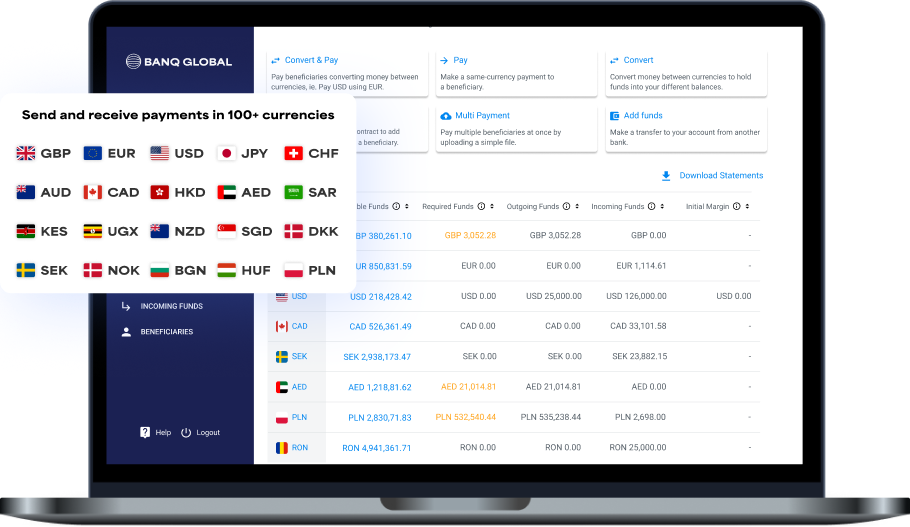
Specialist provider Banq Global supports BVI-registered holding companies, offering accounts in the company's registered legal name with local account details in selected jurisdictions, including the UK and Europe, rather than the BVI. Its services include remote onboarding, support for non-resident directors, multiple authorised users, local and international transfers via SWIFT, and access to 130+ currencies.
Record Keeping Obligations When Paying Dividends From a BVI Holding Company
When a dividend is declared and paid, a BVI holding company should maintain the following corporate records:
- Formal written resolution of directors approving the dividend and confirming compliance with the solvency test.
- Financial statements, accounts, or cash-flow forecasts used by directors to justify the solvency tests.
- Transaction receipts, bank confirmations, or wire vouchers documenting dividend payments.
- Updated register of members and register of directors, reflecting any changes to shareholder or director details, with the required updates filed with the Registrar of Corporate Affairs.
Retention Rules & Annual Filings
Failure to maintain records or file returns can result in statutory penalties or the striking off of the company.
- Under Section 98 of the BVI Business Companies Act, all relevant records, underlying documentation, and financial proofs must be securely kept for a minimum of five years.
- Under Section 98A, non-exempt BVI companies must submit an annual financial return to their registered agent within nine months of their financial year-end.
FAQs
What does paying dividends from a BVI holding company mean?
It means distributing money or other assets from the BVI company to its shareholders, typically as a return on their investment. For example, an African operating subsidiary may pay dividends to its BVI parent company. The BVI holding company can then distribute funds to its own shareholders, subject to applicable legal requirements.
Does a BVI holding company need profits to pay dividends?
No. Unlike traditional capital maintenance regimes, BVI law does not generally require distributable reserves or accounting surplus. Dividends may be paid from profits, share premium or capital, subject to the statutory solvency test. A return of capital, share redemption or share repurchase may also involve distributions but is subject to applicable statutory requirements.
Can a BVI company pay dividends to non-resident shareholders?
Yes. The BVI Business Companies Act places no residence restrictions on shareholders receiving dividends and generally imposes 0% withholding tax. Directors may authorise dividends provided the company satisfies both statutory solvency tests and complies with its Memorandum and Articles of Association. However, non-resident shareholders may still face taxation in their home jurisdictions.
How long does it take to pay a dividend and to open an account for the company?
BVI companies have no fixed statutory waiting period for paying dividends. Directors can approve dividends by resolution, subject to solvency requirements. Once approved, payment timing depends on bank processing. Banq Global can typically open an account for a BVI-registered company within five working days after receiving the correct documentation.
What does it cost to pay a dividend from a BVI holding company?
BVI law does not generally impose a separate government fee or withholding tax on ordinary dividend payments. However, companies may incur bank transfer charges, currency conversion costs and professional fees for preparing resolutions or reviewing compliance. Shareholders may also face taxes in their home jurisdictions.
What ongoing compliance applies to a BVI holding company?
A BVI holding company must pay annual government licence fees, maintain a registered agent and office, keep accurate corporate registers, file beneficial ownership information and submit annual economic substance declarations. Unless exempt, it must also file an annual financial return with its registered agent within nine months of its financial year-end.