Opening a Business Account in Spain: The Essential Guide
The Spanish banking market is highly distinctive for international businesses due to its massive global footprint, high operational efficiency, and deep connectivity with Latin America and the UK. With over 55% of total banking assets held abroad, Spanish institutions offer unparalleled cross-border expertise and liquidity for multinational expansion.
However, opening a business account in Spain is not simply a matter of selecting a provider. The most suitable solution depends on factors such as ownership structure, director residency, compliance profile, and operational requirements. A business account that works well for a Spanish-incorporated company with resident directors may be unsuitable for a foreign-owned company, holding structure, SPV, or multinational group.
What Makes the Business Banking Spain Market Distinctive for International Companies?
International businesses opening a business account in Spain face a different set of business banking considerations than locally owned companies. The following factors largely determine which account options are available and practical for your structure.
Mandatory Corporate Accounts
Spanish law requires all registered entities (SA, SL) to hold a local business account; it is strictly not optional.
- If your entity is incorporated in Spain (SA or SL), a local business account is effectively required to deposit share capital at incorporation and to handle AEAT (Agencia Tributaria) tax settlements.
- If a foreign company establishes a physical Spanish branch, it is treated as a permanent establishment and must use a local bank account for regulatory compliance and local transactions.
The only scenario where a foreign euro account may suffice is a foreign company with minimal Spanish operations that does not have a locally registered entity and makes only occasional SEPA credit transfer into Spain.
Post-2020 AML Tightening
Spanish banking regulation tightened significantly in the years following the 2017 and 2020 EU AML directives, which required banks to apply enhanced due diligence to non-resident and complex applications, including detailed reviews of beneficial ownership, source of funds, and corporate control. The Banco de España oversees the banking sector and regulatory framework, while institutions must also comply with PSD2 and Common Reporting Standard (CRS).
What was once a slow account-opening process has, in many cases, become an outright rejection without the right preparation.
The "Local IBAN" Dilemma
Many financial providers market accounts to Spanish businesses but issue non-ES SEPA IBANs (e.g., Lithuanian, Irish, or Maltese). While these work for basic transfers, they often create severe friction when dealing with the AEAT, local payroll, and domestic counterparties who expect a local ES IBAN.
Ownership Structure Matters
Opening a business account in Spain is straightforward if your company is locally incorporated and has a resident director. However, if your business has foreign owners, complex corporate structures (like holding companies), or handles frequent, large international transfers, banks will subject you to intense scrutiny and compliance checks.
Spain Business Account Options
There are three main banking options available to businesses in Spain: traditional banks, digital banks, and specialist account providers.
Traditional Spanish Banks
Traditional Spanish banks such as Santander Empresas, BBVA Empresas, CaixaBank Business and Sabadell Empresas provide full local banking infrastructure, a genuine Spanish IBAN, established AEAT and payroll integration, potential access to credit facilities, and broader banking relationships over time. However, they typically require a physical presence or business nexus in Spain such as a registered address, with branch visits commonly expected for non-resident applications, alongside extensive documentation, in-person identity verification, or notarised equivalents.
Opening a business account in Spain takes 4–8 weeks for non-resident or complex applications, often longer. Moreover, complex ownership structures frequently face enhanced due diligence requirements that many branches are not equipped to handle efficiently, increasing the likelihood of application rejection.
When assessing the best business account Spain options, traditional banks are generally most suitable for Spanish-incorporated entities with resident directors and straightforward local banking requirements.
Digital Providers And International Challenger Banks
Digital account providers and electronic money institutions (EMIs) such as Revolut Business, N26 Business, Wise Business and Qonto offer remote account opening, fast setup, lower costs, and access to SEPA & SWIFT payment rails.
However, many digital providers issue non-ES IBANs. For general SEPA direct credit this works fine. For AEAT tax settlement, some Spanish payroll systems, and counterparties who insist on a Spanish account number, it creates friction.
Moreover, transaction limits, restricted industry policies, limited customer support and ownership structure requirements can make digital providers unsuitable for more complex businesses.
In a business account Spain comparison, digital providers are generally best suited to straightforward foreign-owned entities with standard payment needs or as an interim account while a more suitable provider is set up.
Specialist Business Accounts
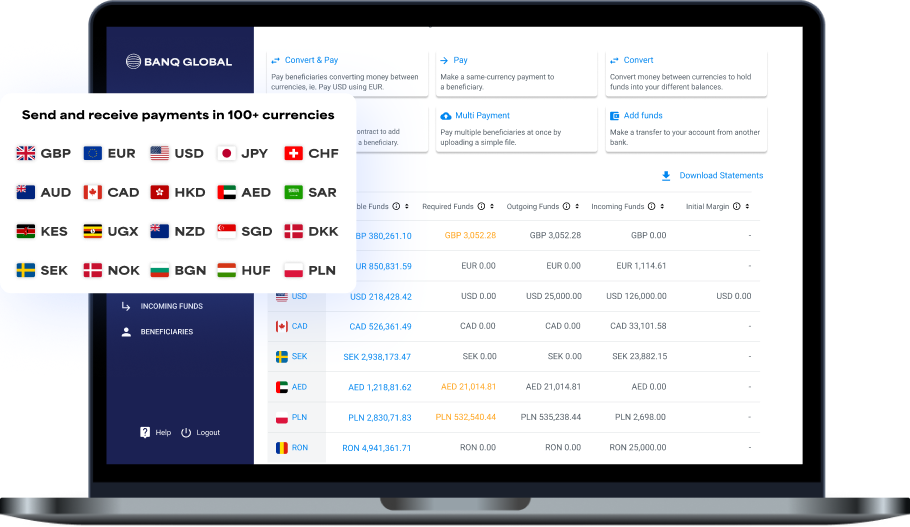
Specialist providers such as Banq Global occupy the gap between traditional banks and digital providers providing multicurrency accounts designed specifically for international businesses, non-resident directors, foreign-owned companies, holding companies, SPVs and complex ownership structures that often struggle to satisfy conventional onboarding requirements. Compared with digital providers, they offer a genuine ES IBAN and are better equipped to support businesses with multi-layer ownership structures and significant cross-border payment activity.
Banq Global provides 100% online onboarding with approvals in as little as 24 hours, access to 130+ currencies through a multi-currency account, support for non-resident directors and shareholders from 190+ countries, and a dedicated account manager throughout the onboarding process.
However, specialist providers typically charge higher monthly fees than digital providers and do not offer the broader banking services available from traditional banks, such as overdrafts, cash deposit facilities, or credit products.
Can I Open More Than One Business Account in Spain?
Yes, Business banking Spain regulations allow companies to open more than one business account in Spain. There are no regulatory restrictions on holding multiple corporate accounts for a single entity. Many international companies and local Sociedad Limitada (SL) businesses optimize their operations using the following combinations:
- Primary Domestic Account Held with a traditional Spanish bank to handle SEPA transfers, tax payments to the Agencia Tributaria (AEAT), local payroll, and supplier direct debits.
- Operating/FX Account maintained with a digital neobank or EMI to efficiently process international cross-border payments, currency conversion, multi-currency flows, and daily card expenses.
Some specialist providers offer multi-currency accounts that consolidate both functions. Whether a second account adds value depends on your payment volume and currency mix.
Can I Operate in Spain Without a Spanish Business Account?
If your entity is incorporated in Spain (SA or SL), a local business account is effectively required to deposit share capital at incorporation and to handle AEAT tax settlements. Foreign companies operating through a Spanish branch office or permanent establishment also typically need a local account for regulatory and counterparty reasons.
If a foreign company establishes a physical Spanish branch, it is treated as a permanent establishment and must also use a local bank account for regulatory compliance and local transactions
The only scenario where a foreign euro account may suffice is a foreign company with minimal Spanish operations that does not have a locally registered entity and makes only occasional SEPA payments into Spain.
What Should I Consider if my Current Spanish Bank Account is not Meeting My Needs?
The most common issues international businesses report are transaction delays on international payments, difficulty updating KYC documentation remotely, and limited multi-currency capability.
If these are recurring problems rather than isolated incidents, switching to a specialist provider is worth evaluating.
Before switching, confirm that your new provider issues a genuine Spanish IBAN if your operations require one, review any FX mark-ups and supported transaction currencies, and ensure the new provider can handle your ownership structure without friction.
Choosing the Right Account for Your Structure
The best business account in Spain depends less on the provider itself and more on your company's ownership structure, management arrangement, and payment requirements. As a general guide:
Spanish SL or SA with non-resident directors and no local employee base
Traditional banks are unlikely to be practical; start with a specialist provider and assess whether a traditional banking relationship makes sense once local operations are established.
Foreign companies operating directly in Spain (branch or representative office)
Specialist or digital; verify per provider whether a branch structure is accepted without a Spanish-incorporated subsidiary.
Holding company or SPV with non-resident UBOs
Specialist providers. Traditional banks require extensive enhanced due diligence for multi-layer structures and frequently decline without a local nexus. Digital providers impose transaction and structure limitations that make them unsuitable.
Spanish entity with a resident director and straightforward payment needs
Traditional banking is viable and may be appropriate, particularly where a local ES IBAN, branch access, and potential credit facilities are priorities.
International group needing SEPA access, multi-currency payments, and 130+ currencies
Specialist account built for this purpose. Once you know which account type best matches your structure, the next step is understanding the application process. Our guide to opening a business account in Spain as a non-resident covers documents, NIE/NIF requirements, and how to apply.
FAQs
Why have traditional Spanish banks become harder to access for non-resident businesses?
EU AML tightening and the mandate to report accounts to tax authorities have caused traditional Spanish banks to impose strict Enhanced Due Diligence (EDD). Consequently, non-resident directors and complex holding structures face intensive scrutiny, often leading to account application rejections or processing delays of up to 4 to 8 weeks.
Can I use Revolut Business, N26, or Qonto as the primary account for a Spanish holding company or SPV?
You cannot reliably use Revolut Business, N26, or Qonto as the primary bank account for a Spanish Holding Company (Sociedad Holding) or Special Purpose Vehicle (SPV). These digital providers typically struggle to support holding structures, lack the localized compliance required for Spanish SPVs, and face common onboarding rejections
Is Banq the right choice for every international business operating in Spain?
No, and it is worth saying so clearly. Banq is designed for foreign-owned complex beneficial owner structures where traditional and digital banking is impractical. If you are a Spanish-incorporated entity with resident directors and straightforward domestic payment needs, a traditional Spanish bank is likely a better fit and will offer broader services including credit facilities and branch access.
Is Banq Global a bank? How is it regulated?
No. Banq Global is a specialist business account provider, not a bank. The product is a business account, not a bank account. Business account and currency services are provided by FCA-regulated partners, including Modulr FS Limited (FRN 900573) and Currencycloud (FRN 900199), with client funds safeguarded at regulated banks.
What are the ongoing compliance requirements for a Spanish business account?
Spanish business accounts remain subject to ongoing AML and KYC requirements under SEPBLAC oversight. It includes,
- Periodic KYC refresh requests are standard.
- Providers may request updated UBO declarations and financial statements.
- Report material changes to directors, shareholders, or business activities promptly.
- Multinational groups should keep ownership structure charts up to date.
Does my business account in Spain need to issue a Spanish (ES) IBAN?
Not always, but it depends on your operational requirements. Any SEPA IBAN allows you to send and receive euro payments across the eurozone. However, certain Spanish payroll systems, AEAT tax settlement processes, and some local counterparties expect or require an account number in ES format.
If your operations in Spain are significant, a local ES IBAN reduces friction with Spanish payees, suppliers, and regulators.
If you are primarily using the account for cross-border payments rather than domestic Spanish transactions, a non-ES SEPA IBAN may be sufficient.