Opening a Business Account in France: Everything You Need to Know
According to the 2025 Annual Report on the Control of Foreign Investments, France continues to attract strong international investment, with non-EU/EEA investors accounting for 65% of filings. To avoid compliance risks associated with this increase in foreign participation, French banks have tightened onboarding and verification requirements, most importantly for international founders, foreign companies, and entrepreneurs. That is why opening a business account in France can take longer, as banks often require additional verification steps. To ensure a smooth process, international businesses should identify the appropriate account type, choose a provider that accepts non-resident structures, and prepare all required documentation in advance.
Why Do You Need a French Business Bank Account?
Opening a professional bank account is an essential step when starting a business in France in line with legal requirements and French regulations.
- For depositing capital share during company registration.
- For operating a company in France.
- For managing day-to-day business finances.
- For separating company finance from a personal bank account.
- For paying taxes to French tax authorities, including VAT and other obligations.
- For payroll payments to employees and handling social security contributions.
- For meeting operational requirements by using a local IBAN.
- For supporting cross-border transfers to international clients and suppliers.
- For building local trust and credibility through a local bank account.
Eligibility and Onboarding Requirements
Before opening a French business bank account, it is important to confirm that the company and its directors meet all regulatory requirements.
Director and Shareholder Residency Requirements
Banks verify the residency of directors and shareholders. Directors physically present in France undergo standard checks. Whereas non-EU/EEA resident directors or shareholders must appoint a legal representative based in France to meet regulatory requirements. Non-residents are also required to provide additional residential documentation and a clear justification for opening a French account.
Business Address Proof Requirements
A registered business address in France is mandatory to comply with regulations. Banks require proof, such as rental agreements, utility bills, or other official documents. For companies without physical premises, the address can be arranged through a contrat de domiciliation (virtual office) or registered-address service, and the address must match company registration records.
Corporate Structure Requirements
The company’s legal form directly affects onboarding. Banks examine whether it is a commercial company, a limited liability company, a société par actions simplifiée, or another recognised legal form. Companies must also provide a clear business plan to demonstrate their operations.
Ownership Transparency Requirements
Banks require full transparency of the company’s ownership.
- Legal entities in France must identify all natural persons who ultimately own or control the company, including complex, multi-layered, or international structures.
- Beneficial owners (UBOs) holding 25% or more of capital or voting rights must be disclosed. If no one hits 25%, banks must identify the person(s) who exercise control over management (e.g., the CEO or manager).
It is indispensable to review all the above eligibility criteria carefully, as rules regarding American citizens (FATCA), complex ownership, or non-EEA residents can lead to immediate rejection.
What can a business do if it faces repeated rejection from commercial banks when trying to open an account in France?
If a business receives refusal letters from several commercial banks, it can appeal to the Banque de France. The Banque de France will legally designate a bank to open a basic professional account within a few days. Alternatively, businesses can choose a provider that carefully assesses applications and offers tailored solutions, reducing the likelihood of rejection.
Business Bank Account Options in France
There are three main banking options available for the international businesses depending on the company’s legal structure, ownership profile, and the complexity of its business activities.
Traditional Banks
Traditional French and international banks, including HSBC France, offer full-service business accounts. They provide access to domestic payment infrastructure, lending solutions and credit facilities, making them ideal for established corporations and companies with a strong local presence. Even so, onboarding is time-consuming and overpriced. Because traditional banks typically require official documents, a clear business address in France and verified business premises. Moreover, many traditional banks strictly require at least one director to be a French tax resident, or at least a European Economic Area (EEA) resident. In-person meetings are also common part of the onboarding process.
Fintechs
Fintech providers offer a flexible way to open a business account in France, particularly for self-employed workers, small businesses, micro-enterprise, micro-entrepreneur, and international companies. The process is fully digital, with multicurrency support and faster cross-border transfers. Often, accounts can be opened within two weeks. Some providers also accept non-resident directors and offer local account options. However, onboarding is more detailed, with stricter KYC checks and additional documentation required.
They are well suited for day-to-day transactions but may not offer credit, lending, or advanced treasury services, especially for more complex or regulated business needs.
Specialist Account Providers
Specialist providers support international businesses that may not fit standard onboarding criteria, including those with complex ownership structures, non-resident directors, or cross-border operations. This may also include family offices, multinational groups, and companies with multiple legal entities. They not only save time by expertly handling compliance, eligibility, and onboarding requirements; they also provide bespoke digital services that traditional banks and fintechs may not offer. This leads to smoother approvals and fully compliant French business bank accounts tailored for non-residents' needs. By partnering with international banks and fintech providers, they also ensure smooth cross-border payments.
Documentation Checklist Before Opening a Business r in FranceOpening a Business Bank Account in France
The document requirements may vary depending on the bank account provider; however, most banks typically enquire:
- Identification documents for directors and shareholders (passport or identity card). They must be coloured and have high resolution.
- Contact details of directors and shareholders (including email and phone number)
- Proof of address for individuals (e.g, utility bill ideally less than 3 months old)
- Company formation documents (kbis extracts and company’s articles)
- Certificate of deposit of funds (attestation de dépôt des fonds)
- Proof of registered business address (lease agreements or evidence of business premises)
- A clear business plan or financial forecasts (outlining expected business activities, revenue model or transaction flows)
- Ownership structure details
- Supporting documents for international structures (such as background on operations in the home country)
It's worth noting that banks may request additional documentation depending on the complexity of the structure and the provider’s regulatory requirements. Therefore, please prepare all the documents in advance to save time and facilitate the onboarding process.
Capital Deposit and Blocked Accounts Requirements During Company Formation
All commercial businesses must need to deposit initial share capital into a temporary blocked account for company formation. The funds remain locked until the company is officially registered. The businesses can choose any of the following legal entities to register a company in France, depending on their needs.
- Private Limited Company (SARL – Société à Responsabilité Limitée)
- Single-Member Private Limited Company (EURL – Entreprise Unipersonnelle à Responsabilité Limitée)
- Simplified Joint-Stock Company (SAS – Société par Actions Simplifiée)
- Single-Member Simplified Joint-Stock Company (SASU – Société par Actions Simplifiée Unipersonnelle)
- Public Limited Company (SA – Société Anonyme)
What is the minimum share capital required to open a business account in France?
Minimum share capital can be as low as €1, depending on the business structure chosen. In practice, however, most traditional French banks ask for a higher “working capital” deposit of around €4,000 before issuing the Attestation de dépôt des fonds (capital deposit certificate), which acts as proof that the company’s share capital has been deposited.
Step-by-Step Process To Open A Business Bank Account In France
The steps below outline the entire process, from company setup to activating your operational bank account.
Step 1: Confirm the Company Structure and Banking Route
The process of opening a French business account starts with deciding the company’s legal structure and choosing a bank that can actually support it. Not all providers accept international businesses with complex ownership structures or non-resident directors.
Step 2: Prepare Corporate and KYC Documentation
Gather all essential documentation for onboarding, including corporate, residency, and business-related documents mentioned earlier.
Step 3: Translate and Certify Documents
If any documents are issued outside France or not in French, they may need to be translated. In many cases, foreign documents must also be legalised or apostilled. Both the original and translated versions may also need certification or notarisation, depending on the bank and the structure's complexity.
Step 4: Deposit Share Capital into a Blocked Account
Translated and certified documents are then submitted to the chosen bank as part of the onboarding process to open a temporarily blocked account for share capital deposit.
Step 5: Deposit Share Capital and Obtain the Certificate
The share capital (typically €1 for SARL and SAS structures, while an SA requires at least €37,000) is paid into the blocked account. Thereafter, the bank issues the attestation de dépôt de fonds, which you’ll need for registration.
Step 6: Submit the Incorporation File to the CFE
The capital deposit certificate is then submitted to the business registration center, known as the Centre de Formalités des Entreprises (CFE) (or via the online registration portal), along with the other incorporation documents mentioned above.
Step 7: Register the Company and Receive the K-bis
The CFE forwarded the registration file to the commercial court (Tribunal de commerce) for approval. Once approved, the company is registered, and the Kbis extract is issued along with the SIRET number.
Step 8: Activate the Operational Business Account
The legal representative of the company forwards the Kbis extract (birth certificate of the company) to the bank. Upon receiving the Kbis, the bank will convert the Compte bloqué (temporary account) into a fully operational professional account (Compte professionnel or Compte courant). It also changed the status of deposited share capital, making it available for operational expenses.
How to Open a Business Account as a Non-Resident?
Opening a French business account as a non-resident is possible. However, it can be more complicated due to stricter compliance checks. Many French banks require the company director to attend an in-person meeting. This means non-residents may need to travel to France to open an account.
Fintech providers offer remote onboarding through video calls and digital verification. This makes the process more accessible for non-residents, but requirements still apply. It’s an intelligent move to prepare a business address early to improve your chances of approval.
Fees, Limits and Features of Business Accounts
Bank fees in France have consistently increased by around 1–3% over the past few years, often exceeding general consumer price inflation, which has remained lower in the previous year. Account maintenance fees (up to 8.95%) and card fees are key drivers. Despite the overall increase in cost, customers can mitigate it by choosing an institution best suited to their needs.
Monthly Account Maintenance Fees
Traditional banks typically charge higher monthly maintenance and account management fees, generally ranging from €10 to €50 per month for premium packages.
In contrast, digital and fintech providers often offer free “standard” accounts, with premium subscription plans ranging from €0 to €17 per month. They operate significantly cheaper than traditional banks due to lower infrastructure costs and offer free or low-cost daily transactions.
Transaction Limits and International Transfer Fees
Traditional banks may impose stricter transaction limits and require additional approvals for cross-border payments, especially outside the Single Euro Payments Area (SEPA). This often results in lower daily transfer caps and longer processing times for international transfers.
Fintech and digital providers generally offer higher or more flexible transfer limits with faster processing. They typically charge fixed fees for SWIFT transfers (€15–€50) and apply exchange rate markups of 0.4% to 5%, depending on the provider, with more transparent pricing structures.
Multicurrency Capabilities and FX Tools
Traditional banks can handle international payments but usually apply marked-up exchange rates and additional currency conversion fees. While their platforms have improved, they often lack the ability to hold and manage multiple currencies efficiently.
Fintech and digital providers allow businesses to hold, receive, and spend in multiple currencies simultaneously. They offer real-time FX tools, including access to interbank rates, transparent pricing, and in-app conversion previews. Some also provide tools to manage currency exposure and support international operations with local account details.
Ongoing Compliance, KYC and AML Requirements After Opening a Business Account in France
French regulations require all banks to comply with Know Your Customer (KYC) and Anti-Money Laundering (AML) obligations after opening a business account. These mandatory checks include Customer Due Diligence (CDD) and Enhanced Due Diligence (EDD), which are overseen by authorities such as TRACFIN (France’s financial intelligence unit) and the ACPR (Autorité de Contrôle Prudentiel et de Résolution).
Banks must also understand the company’s business model, the origin of funds, and expected transaction activity. As part of these regulatory requirements, institutions screen clients against EU, UN, and OFAC sanctions lists and review adverse media to identify any links to fraud, financial crime, or reputational risk.
Businesses need to complete tax registration with the French tax authorities, including VAT registration, and many choose to work with a tax advisor to handle filings and stay compliant with local rules.
How does Banq Global support international businesses opening a French business account?
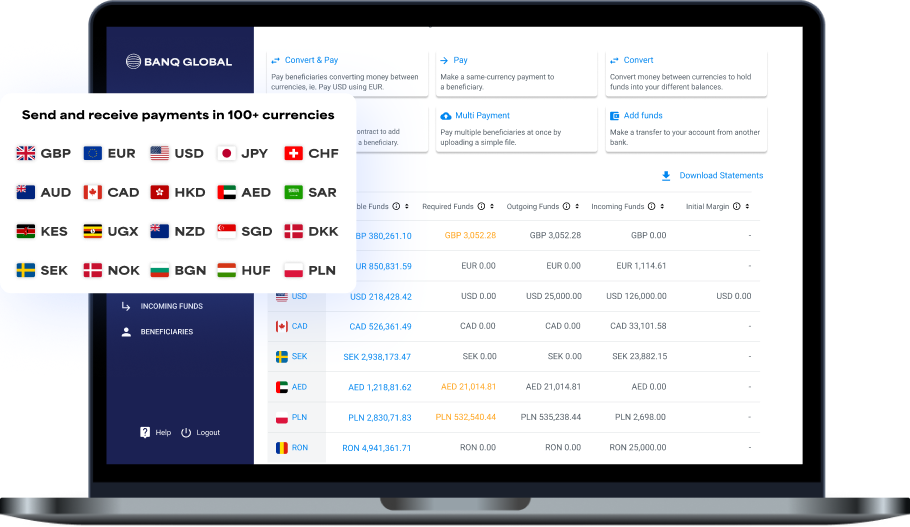
Banq Global supports international businesses that face challenges opening a French business account, particularly those with non-resident directors, complex ownership, or cross-border operations, while helping them meet French compliance requirements. It helps businesses check if they qualify, get the necessary paperwork ready, and complete the onboarding process according to local rules. It also supports SEPA and SWIFT transactions, along with multicurrency accounts and FX solutions, allowing businesses to manage international payments more efficiently while keeping the account opening process in France straightforward and compliant.
FAQs
Can I open a French bank account without a French address?
It is possible to open a French bank account without a French address, but it is not always straightforward. Many traditional banks require a local address, while some fintech providers may offer virtual address solutions or accept non-residents if the documentation is complete and clearly justified.
How long does it take to open a business bank account in France?
Opening a business bank account in France typically takes 24 to 48 hours for digital banks, while traditional brick-and-mortar banks can take one to several weeks due to in-person appointments and compliance checks.
Can the account opening process be delayed?
Yes, it can. Delays often happen when documents are incomplete, not properly translated or certified. Delays are more common where the ownership structure is more complex. This is especially the case with non-resident directors or shareholders. Even a mismatch in the business address can slow the process of opening a business bank account in France.
What is a contrat de domiciliation?
A contrat de domiciliation is a simple agreement that lets a company use a service provider’s address as its official business address in France. It’s often used when the business doesn’t have its own office or physical premises.
What is the “Right to an Account” (Droit au Compte)?
It is a legal guarantee that every person or company has a legal right to open a bank account in France. If a bank refuses to open an account, Banque de France (central bank) will designate a specific bank for you. That bank will provide you with basic banking services for free.
Do foreign companies need a tax advisor or fiscal representative to open a business account in France?
Both are required for foreign companies but serve different roles. A tax advisor guides on VAT and overall compliance, while a fiscal representative is legally required to submit filings and liaise with French authorities, enabling smooth account opening.