How to open a business account in Spain as a non-resident
Spain remains a significant jurisdiction for international expansion, supported by a domestic market of more than 48 million people and direct access to the European Union Single Market of approximately 450 million consumers. The country's financial sector is supervised by the Banco de España and operates within the broader European banking framework, providing businesses with access to an established banking and payments infrastructure.
However, businesses seeking to open a business account in Spain as a non-resident face a fundamentally different banking process from domestic companies. Ownership structure, director residency, source of funds, and anticipated transaction activity all influence provider eligibility, onboarding requirements, and approval timelines.
Businesses that understand these requirements before applying are generally better positioned to secure an appropriate banking solution and minimise delays during the onboarding process.
Can a Non-Resident Open a Business Account in Spain?
Yes, non-residents can open a business account in Spain. In a Spanish banking context, a non-resident is either a foreign individual without Spanish residency or a company incorporated outside Spain with foreign ownership. This includes non-resident directors and shareholders of Spanish companies, as well as foreign companies seeking banking access for their Spanish operations.
Approval is generally not determined by residency status alone, but by the ownership profile,company's structure, business activity, and ability to satisfy KYC and AML compliance requirements. Businesses with Spanish clients, employees, a registered office, or a well-documented cross-border trading model generally achieve stronger approval outcomes than fully offshore structures with limited operational substance.
For non-resident applicants, the key consideration is not whether an account can be opened, but which provider type is best suited to the structure.
Business Banking Options in Spain For a Foreign Company
Spain offers three options for non-residents seeking a Spanish business account: traditional banks, digital account providers, and specialist account providers.
Traditional Banks
Traditional banks such as Santander, BBVA, and CaixaBank provide full local banking infrastructure, Spanish IBANs, and established AEAT and payroll integration, making them best suited to Spanish SLs and SAs with local operations, businesses with resident directors, and companies requiring extensive domestic banking services. However, for non-resident applications, traditional banks are often structurally challenging. Because they typically require in-person branch visits, notarized documentation, and an established domestic business nexus, the onboarding timeline routinely stretches to 4–10 weeks. They are generally worth considering once a local operational presence is established, rather than as the first route for non-resident structures.
Digital Providers
Digital providers and electronic money institutions (EMIs) such as Revolut, N26, and Qonto provide remote onboarding, fast setup, and a lower-cost operating model. However, most issue non-ES SEPA IBANs (typically Lithuanian or Irish), which work for general euro payments but can create friction with AEAT tax settlements, Spanish payroll, and some local counterparties. While EMIs provide basic SEPA transfers, moving large-value international payments, managing complex cross-border trade, or handling exotic currencies can result in higher foreign exchange (FX) mark-ups and more frequent transfer reviews than traditional banking channels. They are best suited to simple operating companies, startups, and businesses with standard payment needs, making them less suitable for holding companies, SPVs, or businesses with significant international payment flows.
Specialist Business Accounts
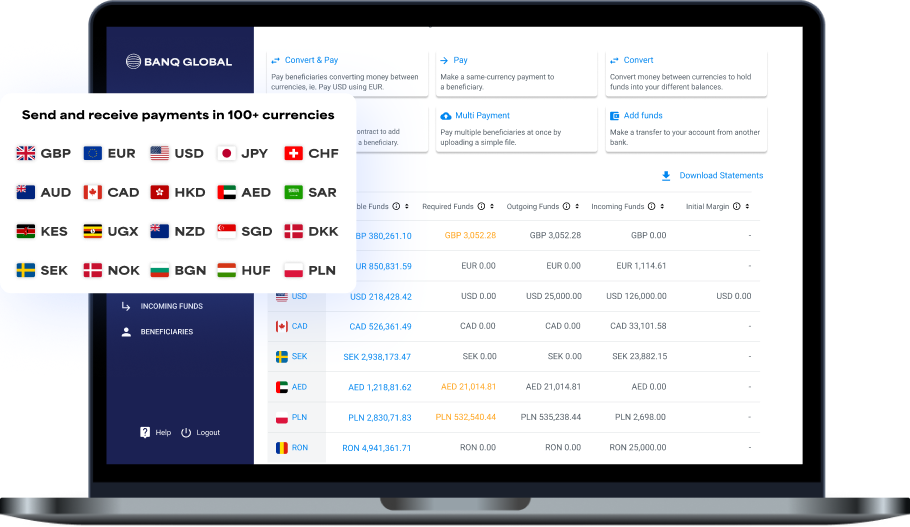
Specialist business account providers are built specifically for non-resident and internationally structured businesses. They typically provide genuine ES IBANs, 100% remote onboarding, multi-currency capabilities, and support for complex ownership structures. Banq Global offers 24-hour account approval, fully online onboarding, support for non-resident directors and shareholders from 190+ countries, a local Spanish IBAN, access to 130+ currencies, and a dedicated account manager. This makes specialist providers the most practical route for foreign companies applying directly, Spanish SLs or SAs with non-resident shareholders or directors (including foreign-owned Spanish subsidiaries), Spanish branches of foreign companies, holding companies, and SPVs.
Documents Required to Open a Business Account in Spain as a Non-Resident
For non-resident applicants seeking business banking Spain foreign company solutions, the speed of approval is determined less by the complexity of the business and more by the completeness and consistency of the documents submitted. A well-organised application allows providers to complete KYC and AML reviews more efficiently and reduces the likelihood of additional information requests during opening a business account in Spain as a non-resident.
Company Documentation
- Certificate of incorporation
- Articles of association (escritura de constitución) or deed of incorporation.
- Trade register extract dated within the last three months.
- Proof of registered business address.
- Corporate structure chart showing beneficial ownership and all Ultimate Beneficial Owners (UBOs).
- UBO declaration where required by the provider's compliance framework.
- For holding companies, SPVs, or family offices: shareholder registers, trust documentation, governance documents, or other compliance documentation demonstrating ownership and control.
Director and Shareholder Documentation
- Valid passport for all directors, shareholders, authorised signatories, and Ultimate Beneficial Owners holding more than 25% of the company. Some providers may also request a certificado de no residente (non-resident certificate) to verify the applicant's non-resident status.
- Proof of residential address, such as a recent utility bill or bank statement.
- Source-of-funds documentation, particularly for high-value initial deposits or complex capital structures.
- Additional compliance documentation where required to verify beneficial ownership, business activity, or the company's business risk profile.
Step-by-Step Process To Open a Business Account in Spain as Non Resident
Opening a Spanish business account as a non-resident requires a strategic, step-by-step approach.
Step 1: Confirm Your Legal Entity and Corporate Structure
Confirming your legal entity is the foundational first step. Setting up a Spanish S.L. (Sociedad Limitada) is the most popular route for foreign businesses, while branches or holding companies (ETVE) offer advantages for established international corporations. Your operating structure affects the documents required, KYC and AML checks, and the most practical provider route, but it does not affect your eligibility to open a business account in Spain.
Step 2: Obtain Mandatory Tax Identification (NIE and NIF)
Once your operating structure has been confirmed, the next step is to obtain the tax identification numbers required for banking in Spain. The company must obtain or confirm its NIF, while foreign directors generally require an NIE. Many non-resident businesses authorize a legal representative (gestor) to handle the NIE and NIF application process on their behalf.
Do I Need an NIE or NIF to Open a Business Account in Spain?
Yes, in most cases both are required. The NIE (Número de Identificación de Extranjero) is the personal identification number for foreign individuals, while the NIF (Número de Identificación Fiscal) is the company's tax identification number. Foreign directors typically require an NIE, and the company must obtain a NIF before opening a business account in Spain. Foreign individuals can obtain an NIE through a Spanish Consulate or a Spanish National Police office using Form EX-15, while the company NIF is obtained directly from the Agencia Estatal de Administración Tributaria (AEAT).
Step 3: Gather and Legalize Corporate Documentation
Once the required tax identification numbers have been obtained, prepare your documentation package for submission. Ensure all required documents are ready before applying, as missing or incomplete documentation can significantly delay the review process.
Where documents originate outside the EU, they will generally require either a Hague Apostille or consular legalization to verify the authenticity of signatures and official stamps.
Traditional banks typically require foreign-language documents to be translated into Spanish by a certified or sworn translator. Specialist providers, by contrast, often operate entirely in English and may accept documentation without Spanish translations, helping to streamline the application process.
Step 4: Choose the Right Account Type for Your Structure
A foreign company with no Spanish subsidiary and significant multi-currency payment needs will often find a specialist business account the most practical option. By contrast, a Spanish company with resident directors and established local operations may have broader banking options. Matching your entity type and banking needs to the right provider before applying can improve both approval rates and onboarding timelines.
Step 5: Submit your application and complete KYC
Submitting your application and completing KYC checks is the definitive crossroad where your choice of provider dictates your timeline.
Traditional banks typically impose stricter Spanish business account non-resident requirements, including in-person identity verification and additional notarisation requirements.
Specialist providers that support businesses seeking to open a business account in Spain as a non-resident online generally complete these checks remotely through secure document submission and video KYC procedures.
Applicants can usually sign the account terms electronically through SMS verification or an e-signature platform.
How long does it take to open a business account in Spain?
It depends on provider type and documentation completeness. Traditional banks typically take 4-8 weeks for non-resident applications while specialist providers can approve accounts within 24 hours for complete applications submitted online. Digital providers fall between the two.
Step 6: Receive your IBAN and Activate the Spanish Business Account
Once your application has been approved, the provider will issue your IBAN and activate the account. A Spanish ES IBAN is particularly valuable for businesses with local operations, as it facilitates SEPA payments, payroll processing, and tax settlements with the Agencia Estatal de Administración Tributaria (AEAT).
After activation, businesses can access online and mobile banking, connect accounting software and payment gateways, and take advantage of PSD2-enabled open banking integrations for payment initiation and account information services.
How much does a business account in Spain cost?
Account setup fees in Spain typically range from €0 to €500 depending on the provider and entity complexity. Monthly maintenance, subscription fees, and non-euro FX mark-ups vary greatly across different financial providers operating in the region.
- Traditional banks feature lower monthly maintenance fees, but often impose per-transaction charges, higher SWIFT fees on international payments, and account opening costs depending on entity complexity. They typically apply standard FX mark-ups of around 2%–3% on cross-border non-euro transactions, but can reach 5% in some cases.
- Digital providers feature tiered subscription plans, lower operating costs, and variable FX pricing (around 0.5%) on non-standard currencies. Monthly fees generally depend on the service tier selected, while foreign exchange costs vary according to the currency pair, transaction volume, and provider pricing model.
- Specialist business accounts are designed for internationally structured and multi-currency businesses. These accounts typically carry higher monthly fees than digital providers but often offer lower FX mark-ups (0.2%), alongside dedicated account management and stronger support for cross-border payments, foreign-owned companies, holding companies, and SPVs.
What Makes a Strong Application When Opening a Business Account in Spain as a Non-Resident?
A strong application is not necessarily the simplest one, but the most complete and well-documented. Build a robust submission that moves smoothly through onboarding by preparing the following core elements:
- Provide a visual map tracing your corporate hierarchy all the way to the Ultimate Beneficial Owners (UBOs).
- Prepare complete registration and operating documents for the parent company, subsidiaries, directors, and shareholders
- Clearly outline your core business activities and cross-border operational footprints to satisfy compliance rules.
- Ensure initial deposits align with the documented financial scale of your business and ownership entities.
- Consider working with specialist providers that offer strategy-led onboarding. They can help you structure complex data, prepare required documentation, and present your application to compliance officers effectively.
FAQs
Can a non-resident open a business bank account in Spain?
Yes, non-residents can open a business account in Spain, and the process is straightforward when you approach it with the right provider and the right documentation. Traditional banks often require in-person verification and additional checks, while specialist providers are designed for non-residents and typically handle the application, KYC, and onboarding process entirely online.
Can a foreign company open a Spanish business account without incorporating locally?
Yes, with specialist providers and some digital platforms. Many accept applications from foreign companies operating in Spain without a locally incorporated subsidiary. Traditional Spanish banks typically require either a locally incorporated entity or a formally registered Spanish branch before they will open a corporate account.
Do I need a Spanish business address?
Not always. Specialist providers generally accept a foreign registered address. Traditional banks typically expect evidence of Spanish business activity or nexus. Some providers accept a registered agent address for correspondence purposes. If your business does not have a Spanish address, confirm the provider's requirements before applying rather than discovering it mid-process.
Can holding companies and SPVs open accounts in Spain?
Yes. Specialist providers are well-suited to holding companies and SPVs — they are designed for complex ownership structures and handle multi-layer UBO documentation as part of their standard onboarding. Additional documents such as ownership structure charts, shareholder registers, and trust or governance documentation will be required. Traditional Spanish banks can accommodate these structures but apply more intensive enhanced due diligence and typically require face-to-face meetings.
Is Banq Global regulated? How does it differ from a traditional Spanish bank?
Banq Global is a specialist business account provider, not a bank. The product is a business account, not a bank account. Client funds are safeguarded through FCA-regulated e-money partners. Unlike traditional Spanish banks, it is designed for international and non-resident businesses, offering fully online onboarding, multi-currency capabilities, and dedicated account support.
What are the ongoing compliance requirements once my account is open?
Your provider will conduct periodic KYC reviews and may request updated beneficial ownership declarations, current financial statements, or confirmation of any changes to your corporate structure. Changes to directors, shareholders above the UBO threshold, or your business activity should be reported promptly. For multinational groups, keeping your group structure chart current with your provider avoids delays when reviews are triggered. Staying responsive to KYC refresh requests is the main ongoing obligation — providers treat unresponsive accounts as a compliance risk.