How to Open a Business Account in South Africa as a Non-Resident
According to the CIPC annual reports, 488,355 company registrations were processed during the 2024/25 financial year, increasing from 402,517 in 2023/24. South Africa continues to see substantial CIPC registration activity, but registration is only the starting point for businesses establishing local operations.
For international companies, multinational groups and non-resident directors looking to open a business account in South Africa, the process involves more than choosing a bank and submitting company documents. While the basic process resembles that for South African businesses, non-residents face specific friction at every step, including proof of address, document certification or apostille requirements, SARB exchange control and enhanced KYC scrutiny.
Why Do Non-Resident Businesses Need a South African Account?
For a multinational group or foreign-owned subsidiary operating in South Africa, a local business account makes it easier to manage money on the ground. The reasons are practical:
- Receiving payments from South African clients directly in South African Rand (ZAR) prevents double-conversion losses and unfavorable exchange rate margins.
- Paying local suppliers, contractors, and employees becomes faster and cheaper via local payment rails (like EFT) rather than international wire transfers.
- Meeting tax obligations with the South African Revenue Service (SARS) and corporate filings with the Companies and Intellectual Property Commission (CIPC) is easier when managing local financial transactions.
- Trading with local counterparties and major South African banks builds trust, as local entities prefer transacting with a domestic account structure.
- Holding ZAR reserves locally allows multinational groups to fund day-to-day operational expenses without triggering repeated cross-border transfer approvals.
Who Counts as a Non-Resident for Banking Purposes
According to the South African Reserve Bank (SARB) exchange-control definition, a non-resident is an individual or legal entity whose normal place of residence, domicile or registration is outside the Common Monetary Area (CMA), comprising South Africa, Lesotho, Namibia and Eswatini.
For international businesses with complex ownership structures, this definition can apply at different levels of the business:
Non-Resident Director
A director of a South African company who normally lives outside the CMA.
Foreign-Owned Subsidiary
A South African private company, usually a (Pty) Ltd, that is separately incorporated but owned by an overseas parent company.
South African Branch of a Foreign Company
A foreign owned company operating directly in South Africa via a locally registered branch, rather than a separate legal subsidiary.
Your business structure determines who and what the bank needs to verify when opening a business account in South Africa, while non-resident ownership can also affect how cross-border funds are treated.
Do I need to Register a Company in South Africa Before Opening a Business Account as a Non-Resident?
Whether operating through a subsidiary or branch, a foreign business needs the appropriate Companies and Intellectual Property Commission (CIPC) registration before opening a South African business account as a non-resident. This may involve registering a (Pty) Ltd subsidiary or completing branch registration as an external company, which can be completed electronically through CIPC e-Services.
However, having a CIPC certificate does not guarantee account approval. Banks separately verify the company, its directors, shareholders and beneficial owners under FICA/KYC requirements and may apply enhanced due diligence (EDD) depending on the risk profile and account provider you choose. Incomplete or incorrectly prepared banking documents can therefore delay account opening even when the business is fully registered with
Non-Resident Business Account in South Africa and Documents Requirements
To open a business bank account in South Africa as a non-resident director, you generally need company registration papers, official identification for all directors, and proof of physical addresses.
Common FICA and KYC Documents for South African Companies
- CIPC registration certificate showing your enterprise type and registration number.
- Memorandum of Incorporation (MOI) and a company resolution or mandate authorizing specific individuals to operate the account.
- SARS (South African Revenue Service) tax reference number or other tax information requested by the bank.
- Share register or other ownership documentation used to verify the company's ownership structure.
- Beneficial ownership register
- Valid identification for all directors, members, partners, and authorized signatories. Foreign nationals will generally provide valid passports.
- Proof of Business Address such as recent utility bill, lease agreement, or official municipal document (usually not older than 3 months) showing the company's operating location (vary by bank/provider).
- Proof of Residential Address such as recent utility bills or bank statements (not older than 3 months) for every individual director or shareholder (vary by bank/provider).
Additional Requirements Specific to Non-Residents
- Proof of address from abroad such as foreign bank statements or utility bills, typically certified by a notary or local authority.
- Apostilled or notarised foreign corporate documents.
- Certified translations for documents not in English.
- Exchange control notifications for non-resident shareholders, where foreign capital is introduced into South Africa.
- Source of funds documentation (international businesses face more scrutiny than local companies).
It's important to note here that some traditional banks may require original documents or in-person verification, while others accept certified copies. These differences can cause delays for non-resident applicants.
What if my Company Documents are Not in English?
South African banks require documents in English. Corporate documents in other languages must be accompanied by certified translations prepared by a qualified translator. Some banks also require the translations to be notarised. Factor this into your timeline when you open a business account in South Africa as a foreign company, particularly for documents issued in countries where English is not an official language.
Provider Options to Open a Business Account in South Africa as a Non-Resident Director
Foreign-owned companies with non-resident directors or shareholders can generally choose from three main provider types in South Africa, each handling non-resident compliance and onboarding differently
Traditional Banks
Traditional South African banks such as Standard Bank non-resident account, FNB non-resident banking, Absa non-resident and Nedbank non- resident offer dedicated non-resident business banking options with domestic payment infrastructure and SWIFT access. However, strict regulatory compliance aligned with SARB requirements means extensive KYC and FICA verification. Applications remain largely branch-based, while enhanced KYC and overseas proof-of-address checks can add weeks to onboarding. Common friction points include address-format mismatches, missing apostilles, inability to attend in person and increased source-of-funds scrutiny. Traditional banks are therefore generally better suited to non-residents with a local representative or established in-country presence.
Digital Providers
Digital providers can offer faster, lower-friction onboarding, but eligibility is more restrictive for fully offshore applicants. Lula, for example, requires relevant South African documentation and a local address, limiting its suitability for non-residents without an in-country presence. Wise Business supports multi-currency international payments but does not replace a local South African business bank account for domestic operational banking. Digital providers also offer less dedicated onboarding support for complex international ownership structures and South African exchange-control requirements, making them better suited to simpler business structures or straightforward cross-border payments.
Specialist Providers
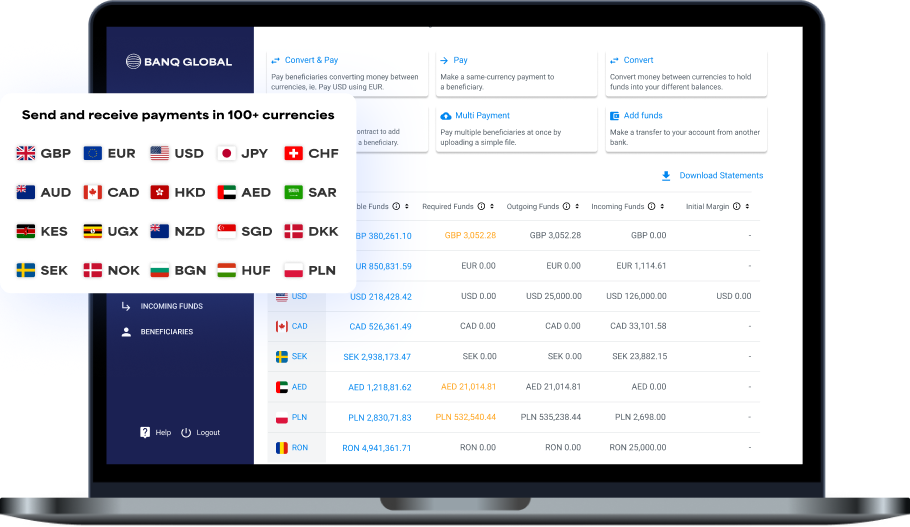
Specialist providers such as Banq Global bridge the gap between traditional and digital options by offering multi-currency accounts for established international companies with non-resident directors and shareholders. The South African offering is designed for businesses managing high-volume local rand (ZAR) inflows, typically US$500,000+ equivalent per month, that need to convert ZAR and repatriate funds internationally while navigating exchange-control requirements. Unlike branch-dependent onboarding, applications are 100% online and support complex international ownership structures without requiring a local resident director.
Steps to Open a Business Account in South Africa as a Non-Resident Director
For a foreign-owned company or non-resident director, the process generally involves:
Confirm Your Business Structure
Determine whether you will operate through a South African (Pty) Ltd subsidiary or a registered external company.
Complete CIPC Registration
Register the appropriate structure with the CIPC and maintain a South African registered office if required by your account provider.
Prepare FICA/KYC Documents
Gather company documents, ownership records, passports, proof of address and beneficial ownership information, including additional certified or legalised documents required for non-residents.
Choose an Account Provider
Compare traditional banks, digital providers and specialist providers based on non-resident eligibility, in-person requirements, currencies and cross-border capabilities.
Complete Verification
Submit the application and complete the provider's KYC process. Complex foreign ownership structures may be subject to enhanced due diligence (EDD).
Fund and Operate the Account
Once approved, use the account for ZAR receipts and local payments while complying with applicable SARB exchange control requirements for cross-border transactions and fund repatriation.
SARB Exchange Control and Repatriation of Funds
The SARB, through its Financial Surveillance Department (FinSurv), oversees the country's exchange-control framework, with Authorised Dealers such as banks handling foreign-exchange transactions within that framework.
For companies with non-resident shareholders, exchange-control requirements continue beyond account opening. When profits, dividends or capital are transferred out of South Africa, supporting documents may be required. Banks acting as Authorised Dealers can handle many of these transfers directly, while certain transactions must be referred to FinSurv for approval.
International transfers are generally routed through SWIFT, as South Africa is outside the SEPA area. For a detailed explanation of approvals, documentation and repatriation requirements, see our [SARB exchange control and repatriation guide].
FAQs
Can a non-resident director open a business account in South Africa?
Yes, but the process is more involved than for resident directors. Banks apply FICA compliance requirements to all applicants, and non-resident directors face additional scrutiny. Traditional banks often require in-branch steps that are impractical for non-residents. Specialist providers with fully online onboarding are typically better suited to non-resident directors with complex ownership structures.
Can I open a South African business account online without visiting in person?
It depends on the provider. Traditional banks often still require in-branch or in-person steps for non-resident business accounts, which is a practical barrier for directors based abroad. Specialist providers typically offer fully online onboarding, making them the more practical route for non-resident directors who cannot attend a South African branch in person. Make sure to keep records of your documents in a digital format.
How long does it take for a non-resident to open a business account in South Africa?
Traditional banks may require additional time for FICA checks, foreign document verification, beneficial ownership reviews and exchange-control requirements. Some specialist providers may open accounts within 24 hours once the correct documentation has been submitted and the application approved.
What are the fees for a non-resident business account in South Africa?
Fees vary by provider and account type. Traditional banks may charge monthly account fees, transaction and SWIFT fees, as well as FX conversion charges when converting ZAR. Specialist providers may use different pricing models, including transaction-based fees and separate charges for currency conversion and international transfers.
Does Banq Global accept non-resident directors for South African business accounts?
Yes. Banq Global accepts non-resident directors without requiring a South African resident director. Its South African business account supports local ZAR receipts, competitive currency conversion and compliant repatriation of funds offshore for established international companies.
What are the ongoing compliance requirements for non-resident shareholders in a South African company?
To maintain FICA compliance, business account providers may periodically update KYC information, monitor transactions against the company’s expected activity, and request further information where its circumstances or risk profile changes. Companies must also keep relevant CIPC corporate records and SARS tax obligations current while complying with applicable SARB exchange-control requirements when moving funds across borders.