How to Open a Business Account in South Africa
South Africa has attracted more than R1.5 trillion in investment commitments through five South African Investment Conferences, highlighting the scale of businesses investing in the country. As international companies establish and expand their South African operations, they need local financial infrastructure to manage payments and operating expenses.
Opening a business account in South Africa is a key part of that process, which starts with establishing the appropriate business structure and completing Companies and Intellectual Property Commission (CIPC) registration before meeting the account provider’s documentation and verification requirements.
Foreign-owned companies, multinational groups and non-resident directors may also face additional KYC requirements and South African exchange control regulations for certain cross-border payments.
Steps to Open a Business Account in South Africa
Step 1: Choose a Business structure
Before opening a business account in South Africa, determine how your international business will operate in the country, such as through a Private Company ((Pty) Ltd) or a foreign company registered with CIPC as an external company. Your chosen structure affects the South Africa business account requirements, including CIPC registration and the documents required for onboarding.
(Pty) Ltd (Private Company)
- A separate South African legal entity and a common structure for foreign-owned subsidiaries.
- Shareholders generally benefit from limited liability.
- Must file CIPC annual returns and comply with applicable South African Revenue Service (SARS) tax requirements.
- Audit or independent review requirements depend on factors including the company's Public Interest Score and circumstances.
- Account providers typically require CIPC incorporation documents, the MOI and identification and verification information for directors and beneficial owners.
Foreign Company / External Company (Branch)
- A foreign company operating in South Africa can be required to register with CIPC as an external company rather than incorporating a separate South African subsidiary.
- The external company remains part of the foreign parent rather than becoming a separate incorporated South African entity.
- External companies must file CIPC annual returns and meet applicable South African tax and regulatory obligations.
- Account providers may require the foreign company's incorporation or constitutional documents, proof of foreign registration and documents identifying authorised representatives, directors and beneficial owners.
Can a foreign company open a representative office in South Africa?
Yes, a foreign company can maintain a limited presence in South Africa for activities such as market research or liaison. However, a representative office is not a separate CIPC entity type. Depending on its activities, the foreign company may need to register as an external company.
Step 2: Register the Business with CIPC
Once the structure is determined, complete the required registration with CIPC before you open a business account in South Africa. A (Pty) Ltd is incorporated as a South African company, while a foreign company that conducts or intends to conduct business in South Africa must register with CIPC as an external company.
External companies must register within 20 business days of starting activities in South Africa, and CIPC currently processes these registrations through its e-Services platform using Form CoR 20.1.
After registration, CIPC issues the relevant company registration certificate: CoR 14.3 for a (Pty) Ltd or CoR 20.2 for an external company, confirming the entity’s registration in South Africa.
Step 3: Prepare the Required Documents
Once the business is registered with CIPC, the next step is to gather the documents required to open a business account in South Africa. The exact requirements vary by provider, company structure and the residency of directors and shareholders.
Documents Required to Open a Business Account
Company documents
- CIPC registration certificate.
- Memorandum of Incorporation (MOI), where applicable.
- Beneficial ownership register or other beneficial ownership information required to establish the company’s ultimate beneficial owners.
- Relevant SARS tax registration details.
Director and signatory documents
- Valid identification or passports.
- Proof of address for each director.
- Documents confirming the authority of representatives or account signatories, such as a board resolution where required.
Additional documents for foreign-owned entities
- Foreign incorporation and constitutional documents, certified or authenticated/apostilled where required
- Ownership or group structure information where required for beneficial ownership verification
- Additional information or documentation relating to applicable South African Reserve Bank (SARB) exchange control notifications or clearance where applicable
Step 4: Choose an Account Provider
After registering the company and gathering the required documents, the next step to open a business account in South Africa is choosing an account provider that fits your company structure and banking needs.
Business banking Options in South Africa
Foreign companies have three main options in South Africa: traditional banks, digital providers and specialist account providers. Which one works best will depend on your company structure, where your directors are based, and whether you need multi-currency or international payment capabilities.
Traditional Banks
Traditional banks such as Standard Bank, FNB, Absa and Nedbank provide established South African banking infrastructure, including local payments, business banking services, foreign exchange and international transfers. Some also offer foreign-currency accounts for businesses with cross-border payment needs.
For international companies, the main consideration is onboarding. Requirements vary by bank and company structure, and foreign ownership or non-resident directors can result in additional FICA, beneficial ownership and foreign-document verification. Traditional banks can therefore work well for companies that need conventional local banking infrastructure, but more complex international structures may face a more involved onboarding process.
Digital Providers
Digital providers offer a more online-focused alternative, particularly for smaller businesses and straightforward ownership structures. Lula, for example, combines digital business banking with services aimed primarily at South African SMEs, while Wise Business focuses more heavily on international payments, currency conversion and receiving money across currencies.
For foreign companies, however, digital does not automatically mean easier eligibility. The provider may have requirements around where the business is registered, where directors are resident and the complexity of its ownership structure. International groups should therefore check whether the provider can support their legal entity, non-resident directors and required currencies and payment routes before applying.
Specialist Account Providers
Specialist providers focus more directly on businesses whose international structure or cross-border requirements do not fit straightforward domestic business banking. They can offer dedicated onboarding support for non-resident directors and complex ownership structures, alongside multi-currency and international payment capabilities.
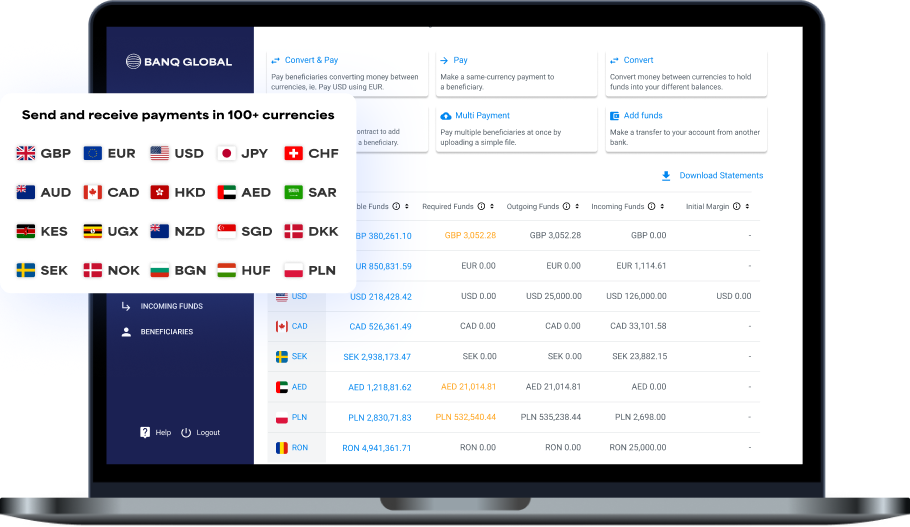
Banq Global, for example, offers a South Africa-focused solution for established international companies with customers or suppliers in the country. Its offering supports non-resident directors and is designed for businesses managing significant ZAR inflows that need to convert rand and move funds internationally. This makes the specialist model particularly relevant where cross-border cash flow and repatriation are central to the company's South African operations, rather than simply day-to-day domestic banking.
Step 5: Submit the Application
Once you have chosen an account provider, submit the application together with the required company, ownership and identification documents. Depending on the provider and company structure, applications may be completed online or may involve additional onboarding steps for foreign-owned businesses.
Step 6: Complete FICA Verification
After receiving the application, the provider carries out the required checks under the Financial Intelligence Centre Act 38 of 2001(FICA) in South Africa. This includes KYC and anti-money laundering checks to verify the business and identify and verify its beneficial owners and relevant representatives or authorised signatories.
For international businesses, the provider may request additional information based on the company’s risk profile. This may include details about its foreign ownership structure and source of funds. Companies with complex ownership structures or non-resident shareholders may also need to provide additional documents before account approval.
Step 6: Activate the Account
After an account provider finishes your FICA checks and approves your application, your business account opens. You can then set up South African Rand (ZAR) payments, multi-currency accounts, and global SWIFT transfers based on your provider's available services.
Additional Compliance Requirements for International Businesses
Opening a business account does not end a company’s South African compliance obligations. International businesses should also consider the following requirements:
SARS and VAT registration
Companies incorporated through CIPC are generally automatically registered with SARS for Corporate Income Tax. VAT registration is separate and becomes compulsory where the applicable registration requirements are met, while voluntary registration may be available to qualifying businesses.
SARB Exchange Control
Foreign-owned companies may be subject to South African exchange control regulations (EXCON) when bringing capital into the country or making certain cross-border payments, loans, dividend payments or capital transfers. These matters are generally handled through an Authorised Dealer, with referral to the South African Reserve Bank’s Financial Surveillance Department (FinSurv) where required.
For international businesses, this means the applicable requirements depend on the type, purpose and structure of the transaction rather than every cross-border payment requiring direct SARB approval.
FAQs
Can a non-resident director open a business account in South Africa?
Yes. South African company registration rules allow foreign nationals to be appointed as directors, with CIPC providing a Foreigner Assurance process for foreign directors using passport identification. However, having a non-resident director does not guarantee that every bank will open the account. The account provider must complete its FICA and KYC checks, and eligibility and documentation requirements vary by provider.
How long does it take to open a business account in South Africa?
Traditional banks may require additional FICA checks for complex international business structures. Digital providers offer streamlined online applications for straightforward businesses, while specialist providers are better suited to foreign-owned companies and non-resident directors. The timeframe for meeting South Africa business account requirements ultimately depends on the company structure, documents and compliance checks required.
What are the fees for a business account in South Africa?
Fees vary by provider and account type. Traditional banks charge monthly and per-transaction fees, while some digital providers offer low or zero monthly fees. Specialist international account providers often structure fees differently and typically include multi-currency access. Verify current fee ranges against live provider websites, as these change frequently.
Is Banq Global authorised to offer business accounts in South Africa?
Banq Global offers a South Africa-focused business account solution for international companies and non-resident directors. The account is fully regulated and authorised by SARB. Banq Global is not itself a bank and provides business account and payment services through regulated financial partners.
Can I open a South African business account online?
Yes. Traditional banks offer online applications for certain business accounts, although additional verification may apply to foreign-owned companies. Digital providers also offer online applications for eligible businesses. Specialist providers such as Banq Global offer online onboarding designed for international companies and non-resident directors, including support for more complex ownership structures.
What payment rails are available from a South African business account?
South African business accounts can provide access to local ZAR payment rails, including electronic fund transfer (EFT) and real-time payment services (RTC), depending on the provider. High-value interbank payments are settled through South Africa’s RTGS infrastructure, while SWIFT and correspondent banking networks support international transfers. Some providers also offer multi-currency capabilities for businesses receiving, converting and moving funds across borders.