Are you a family office, multinational group, foreign-owned company, or non-resident director ready to expand into Norway? Opening a Norwegian business bank account is a strategic move toward long-term growth and international success. With GDP projected to exceed USD 517 billion in 2025 (IMF), Norway continues to attract international investors and globally active enterprises seeking stability and transparency.
Backed by strong financial institutions and clear regulatory standards, Norway offers compliance with tax reporting requirements while offering the credibility and resilience international businesses demand. Whether managing global clients, international suppliers, or complex ownership structures, a Norwegian business account positions your company for secure, efficient, and compliant international operations.
This blog post will explain everything you need to know about how to open a business account in Norway, covering different legal structures, available bank options, account types, required documents, and practical tips to make the process simple and efficient.
Why does a company need a business bank account in Norway?
Opening a Norwegian business account marks the start of your company’s financial journey and builds a foundation for credibility and growth.
Legal and Operational Requirement for Registered Companies
A Norwegian business bank account is essential for any company registered with the Brønnøysund Register Centre. It allows registered companies, larger businesses, foreign-owned enterprises, and other business enterprises to operate under their official company name, manage their business enterprises, and comply with local regulations and legal requirements. The account ensures proper financial management and provides an official account number required for all corporate transactions.
Access to Payments and Currency for Daily Operations
A business account provides seamless access to Norwegian banks, payment systems, and transactions in Norwegian krone (NOK), while supporting multiple currencies and international transactions. This allows companies to manage money efficiently, pay employees and partners, and serve foreign clients with ease.
Ensuring Tax Compliance and Regulatory Reporting
All registered companies must report corporate tax, VAT, and tax returns to the Norwegian Tax Administration. A business bank account is required for timely tax payments and ensures compliance with applicable laws for foreign-owned companies, larger businesses, and international enterprises.
Managing Employees, Partners, and Operational Expenses
An active account enables businesses to pay salaries, settle supplier invoices, distribute funds to partners, and manage day-to-day operational expenses. Payroll and reporting obligations can be handled digitally via Altinn, making the account crucial for efficient financial operations.
Access to Norwegian Banks and Financial Infrastructure
Norwegian banks provide secure financial infrastructure, online banking systems, and integration with national reporting frameworks. Access to these banks supports registered companies, larger businesses, foreign-owned enterprises, and business enterprises operating in Norway.
Opening a Business Bank Account in Norway: Step-by-Step Guide
Expanding your business into Norway requires careful planning, legal registration, and selecting the right banking solution. Here’s the step-by-step process to open a Norwegian business bank account.
Step 1: Company Registration and Choosing a Legal Structure
Before opening a business bank account, your company must be legally registered with the Brønnøysund Register Centre. Choosing the right legal structure determines your obligations, minimum capital, liability, and banking requirements::
AS (Aksjeselskap) – Private Limited Company
An Norwegian AS (Aksjeselskap) is the standard private limited liability company and the most commonly used structure for domestic and foreign-owned businesses.
- Separate legal entity; shareholders are not personally liable beyond their capital contribution
- Exact amount of share capital (NOK 30,000) must be deposited before registration
- Required to have a board of directors; larger companies may require an auditor
- Subject to Norwegian corporate tax on profits
- Company name must include “AS” or “Aksjeselskap”
- Commonly used for long-term operations, holding structures, and investment vehicles
- Generally preferred by Norwegian banks due to clear ownership, capital structure, and limited liability protection
ENK (Enkeltpersonforetak) – Sole Proprietorship
An ENK (Enkeltpersonforetak) is a sole proprietorship in Norway where one person owns and operates the business.
It has the following characteristics:
- No separate legal entity; the owner is personally responsible for all debts
- No minimum startup capital requirement
- Profits are taxed as personal income (including social security contributions)
- VAT registration required if turnover exceeds NOK 50,000 within 12 months
- Company name must include the owner’s surname
- Limited social benefits compared to employees
- Generally suitable for freelancers, consultants, and small one-person businesses.
NUF (Norskregistrert Utenlandsk Foretak)– Norwegian-Registered Foreign Company
A NUF (Norskregistrert Utenlandsk Foretak) is a Norwegian-registered branch of a foreign company that allows international businesses to operate in Norway without forming a separate legal entity.
It has the following characteristics:
- Commonly used by foreign-owned companies entering the Norwegian market for projects, expansion, or structured cross-border operations.
- Not a separate legal entity; the foreign parent company remains fully liable
- No minimum share capital requirement
- Required to maintain accounting records under Norwegian standards
- VAT registration mandatory if turnover exceeds NOK 50,000
- Subject to Norwegian tax rules where a permanent establishment exists
- May require a local representative with a Norwegian address
- Banks typically request full parent company documentation when opening a business bank account
While a NUF offers a lower capital barrier compared to a private limited company, banks apply enhanced due diligence due to foreign ownership and cross-border risk considerations.
ASA (Allmennaksjeselskap) – Public Limited Company
An ASA is a public limited company in Norway, designed for large, stock-based businesses that can be listed on stock exchanges. It protects shareholders by limiting personal liability for company debts.
It has the following characteristics:
- Minimum share capital of NOK 1 million
- Can be listed on stock exchanges; shares must be registered in a securities register
- Must have a board of directors and an auditor; board rules depend on company size (at least three members if assets exceed NOK 3 million)
- CEO or managing director cannot serve as board chair
- Suitable for large corporates and publicly traded companies
ANS / DA – General Partnerships
ANS (Ansvarlig selskap) and DA (Delt ansvar) are Norwegian general partnerships use for two or more owners. Partners’ personal assets can be used to cover business debts and a written partnership agreement is recommended to define responsibilities and decision-making.
It has the following features:
- ANS: all partners are jointly liable; DA: each partner is liable only for their share of the debt
- Profits and losses are taxed at the individual partner level (pass-through taxation)
- Partners manage the business directly according to the partnership agreement
- Formation requires at least two partners and mandatory registration
- Partners can withdraw with six months’ notice or immediately in case of serious breaches
- No minimum capital required
- Suitable for closely held, small, or family-run businesses
BA (Cooperative – Samvirkeforetak)
A selskap med begrenset ansvar (BA), literally translated as "company with limited liability and is designed to operate for the benefit of its members rather than external investors. It is common in sectors like agriculture, retail, finance, and housing.
It has the following features:
- Owned and controlled by members who use its products or services
- Limited liability for members, protecting personal assets
- Operates democratically, typically “one member, one vote”
- Profits or surpluses are reinvested or returned to members based on their usage
- Suitable for businesses where members’ interests are central rather than maximizing profit
Tip: Most foreign-owned companies in Norway use an AS or NUF for credibility and easier bank account approval.
Step 2: Gather Documents and Meet Bank Account Requirements for Foreign-Owned Companies
Opening a Norwegian business bank account, whether for a local company or a foreign-owned company in Norway, requires submitting key documents to comply with local regulations, tax reporting, and AML/KYC requirements. Make sure you prepare the following:
For Norwegian companies:
- Proof of company registration and a valid organisation number.
- Identification for directors or authorised signatories, such as a Norwegian passport or national ID.
- Confirmation of a business address in Norway.
- Supporting documents to verify the address, such as utility bills or rental agreements.
For foreign-owned companies/ non-resident directors, or international businesses, additional documents are needed:
- Norwegian organisation number and a D-number or national ID for all owners and signatories.
- Proof of identity, such as passports, usually presented in person.
- Core corporate documents from the home country, including Articles of Association, certificate of incorporation, shareholder register, and a business plan.
- Apostilled and translated copies of foreign documents in Norwegian or English.
- Documents that demonstrate business activity, like invoices, contracts, bank statements, or financial plans, especially for foreign entities opening a Norwegian account.
Step 3: Choose Your Bank and Decide on Account Types
After completing company registration and gathering documents, select the right bank and account types based on your business structure and operations.
Bank Options:
Traditional Banks
Traditional banks like DNB, Nordea, SpareBank 1, Handelsbanken, and Danske Bank are best suited for established companies with a real presence in Norway. They usually require in-person meetings, higher minimum balances, and full documentation for onboarding. Their timelines are slower, and they adopt a conservative approach to risk. These banks are ideal for domestic businesses seeking straightforward banking, but may be challenging for non-residents, foreign-owned companies, or businesses with complex ownership structures.
Digital Banks
Digital banks like Revolut, Lunar, Sbanken, and Builder bank provide faster onboarding, making them convenient for startups and small businesses that need quick access to a Norwegian business bank account. They are generally app-based and low-cost but may have limited features for multi-currency operations or complex ownership structures. Many digital banks cannot accept share capital deposits, making them more suitable for simple business models or domestic-focused operations.
Global Business Account Specialists
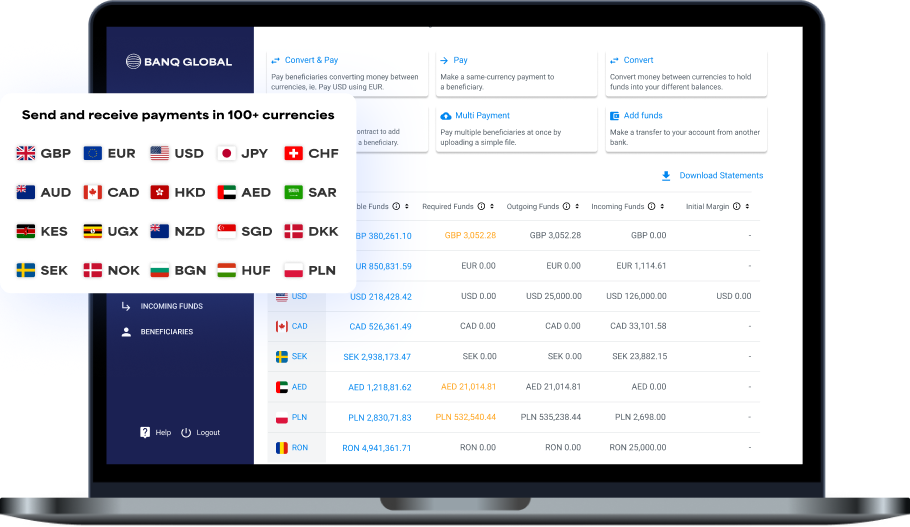
Global Business Account Specialists are designed for foreign-owned companies, international founders, and businesses with more complex ownership structures. They focus on helping companies get local bank accounts and IBANs across multiple countries, with personalised onboarding and support to make the process smoother and reduce the risk of account rejection. These providers usually offer SEPA and SWIFT payments, multi-currency accounts, and solutions for cross-border operations. A well-known example is Banq Global, which supports Norwegian business accounts for non-resident directors and regulated companies.
Business Account Types to Consider:
Current Accounts
For paying suppliers, receiving client payments, and managing operational expenses, available in NOK and often multiple currencies.
Multi-Currency Accounts
Allow holding, sending, and receiving several currencies, ideal for foreign clients and cross-border payments.
Payroll Accounts
Manage employee salaries, corporate tax, and social security, integrated with Altinn for Norwegian tax reporting.
Merchant Accounts
Process card payments, online transactions, and e-commerce sales efficiently.
Investment or Holding Accounts
For larger businesses or holding companies to manage share capital, investments, and dividends.
Specialist Accounts
Designed for non-residents, foreign-owned companies, and complex structures, offering local account numbers, SEPA/SWIFT access, multi-currency support, and compliance solutions.
Tip: For foreign companies, combining a current account with a multi-currency account is often the most effective setup.
Step 4: Apply for and Complete the Process of Opening a Business Bank Account
Submit all identification documents, business plan, and share capital to the chosen Norwegian bank. Banks verify authorized signatories, ownership for foreign-owned companies, and compliance with local regulations and corporate tax, helping your new company secure a valid business account.
Step 5: Activate Your Account and Banking Services
After approval, your business account in Norway is activated with an account number, cards, and online banking. Within 1–2 weeks, banks complete due diligence checks on authorized signatories, foreign-owned companies, and corporate documentation.
You can then set up SEPA/SWIFT payments, multi-currency access, and Altinn integration for tax payments, allowing international businesses to manage money, operate efficiently, and remain compliant with Norwegian banks and local regulations.
Step 6: After Opening: Compliance, Tax, and Ongoing Operations
After opening the business bank account in Norway, foreign-owned companies and international businesses must manage ongoing compliance, tax obligations, and daily operations efficiently:
Pay employees and partners
Use your business account to settle operational expenses and manage payroll while serving foreign clients.
Register for VAT
If your turnover exceeds NOK 50,000, register with the Norwegian Tax Administration within 30 days. Non-resident businesses may use the simplified VOEC scheme for low-value goods, but standard registration is needed for broader activities.
Set up payroll and tax reporting via Altinn
Ensure corporate tax and social security contributions are processed on time for business enterprises.
Maintain annual accounts and submit required filings
Keep accurate records, prepare tax returns, and comply with legal requirements for your Norwegian business.
Monitor compliance and due diligence
Regularly verify authorized signatories, account activities, and documentation to prevent processing delays and maintain transparency for foreign companies operating in Norway.
Tips to Get a Business Bank Account Approved Faster
Opening a business bank account in Norway can sometimes be slowed by documentation issues, verification delays, and compliance checks, especially for foreign-owned companies, non-resident directors, and international businesses. To speed up approval and avoid unnecessary obstacles:
- Prepare all documents in advance, including your company registration, Articles of Association, business plan, and proof of business address, and for foreign companies, ensure they are properly apostilled and translated.
- Appoint a local representative with a Norwegian D-number if required, so the bank can verify signatories easily.
- Choose banks experienced with international businesses or global business account specialists, who understand multi-currency accounts, international transactions, and cross-border compliance.
- Ensure share capital and minimum deposits are ready, particularly for AS (Aksjeselskap) or ASA (Allmennaksjeselskap) structures, so the bank can complete onboarding without delays.
- Be proactive in communication – respond quickly to requests for additional information and clarify any questions about your company structure or operations.
Following these steps can make your Norwegian business bank account setup smoother, faster, and fully compliant with local regulations, letting your foreign-owned company or non-resident business operate efficiently.