British Virgin Islands Business Banking: Everything You Need to Know
With 354,015 business companies on its register as of June 2026 (BVI FSC bulletin), the British Virgin Islands remains a leading jurisdiction for international holding companies and offshore corporate structures, supported by its generally tax-neutral corporate regime, English common law-based legal system and flexible company legislation. However, local British Virgin Islands business banking options remain limited, with just six general banking licences and some institutions favouring businesses with a local presence, physical economic substance and established banking relationships. For BVI companies with non-resident directors and shareholders, opening business accounts in other jurisdictions offers an alternative to local banking, with access to multi-currency services, including US dollar payments and cross-border transactions, subject to provider eligibility.
How the BVI Banking Market Is Structured
The BVI is a British Overseas Territory that regulates its financial sector via the Financial Services Commission (FSC) under the Banks and Trust Companies Act, 1990. The FSC issues the following three types of banking licences (Sections 10 and 11) to institutions, allowing them to provide different banking services within or from the BVI:
- A general banking licence allows banks to conduct banking business within and outside the BVI, including accepting deposits and providing lending services.
- A restricted Class I banking licence allows banking activities within and outside the BVI but restricts deposits from BVI residents, with certain exceptions for licensed institutions and BVI companies.
- A restricted Class II banking licence has the same restrictions as Class I but also limits the bank to receiving or soliciting funds from specifically approved customers.
Which Banks Are on the Official FSC Bank Register?
The FSC's register of licensed banking institutions includes
- VP Bank (BVI) Limited: General banking licence.
- Republic Bank (BVI) Limited (formerly called Scotiabank): General banking licence.
- Bank of Asia (BVI) Limited: Restricted Class I banking licence entry.
- CIBC Caribbean Bank (Cayman) Limited (formerly FirstCaribbean): Licensed banking institution.
- National Bank of the Virgin Islands: Licensed banking institution.
- Banco Popular de Puerto Rico: Licensed banking institution.
- FirstBank Puerto Rico: Licensed banking institution.
However, a bank being licensed in the BVI does not mean it must accept every BVI-registered company. Each BVI bank decides which customers it will accept based on its internal policies and compliance reviews.
Why Opening a BVI Company Bank Account Is Harder Than It Looks
Opening a bank account for a BVI company can involve additional scrutiny due to international anti-money laundering (AML) requirements, offshore ownership structures and regulatory risks. The main banking challenges include:
Offshore Classification Scrutiny
Banks may conduct enhanced due diligence (EDD) checks on BVI companies due to the jurisdiction’s tax-neutral structure, offshore status and evolving international compliance requirements, including its addition to the Financial Action Task Force (FATF) grey list on 13 June 2025.
Reduced Banking Options
Some international banks limit their exposure to BVI companies because of compliance costs and internal risk policies. This practice, known as de-risking, can reduce the number of institutions willing to open accounts for offshore businesses.
Banking Continuity Risk
BVI companies may face additional account reviews, transaction restrictions, or closures when banks change their policies towards offshore businesses, potentially disrupting investment flows, dividend payments, and cross-border payments.
Non-Resident Directors and Shareholders
When a BVI company's management is based outside both the BVI and the country where the bank operates, banks may require additional Know Your Customer (KYC) checks.
Prolonged Vetting Times
Banks may take several weeks or months to verify the ownership, business activities, and source of funds of BVI companies, particularly those with complex international structures, resulting in repeated documentation enquiries and high rejection rates for multi-layered cross-border operations.
Regulatory and Compliance Requirements for BVI Business Banking
Beyond these banking challenges, BVI business companies must also demonstrate compliance with applicable regulatory and reporting obligations, which include:
Economic Substance Requirements
Under the BVI Economic Substance (Companies and Limited Partnerships) Act 2018, companies conducting relevant activities must meet applicable substance requirements. Pure equity holding companies benefit from a simplified substance test, while other relevant activities may require greater local presence and expenditure.
Entities that are tax residents in a qualifying jurisdiction outside the BVI may be exempt but must provide evidence of that residency. Banks may also use economic substance to assess genuine commercial activity and the rationale behind a company's structure and transactions.
Beneficial Ownership Transparency
Banks review beneficial ownership information to identify ultimate beneficial owners (UBOs) and confirm who owns or controls a company. From 1 April 2026, eligible applicants, potentially including banks that meet the legal criteria, may request access to the BVI Register of Beneficial Ownership to verify ownership details during onboarding. BVI companies must therefore keep accurate beneficial ownership records and submit the required information through the government's VIRRGIN system, which replaced the former BOSS framework in January 2025. Newly incorporated companies generally must file within 30 days of incorporation.
Tax and Reporting Obligations
BVI business companies are generally exempt from local corporate income tax under the BVI Business Companies Act, 2004. However, to comply with international tax transparency requirements such as the OECD's Common Reporting Standard (CRS) and the US Foreign Account Tax Compliance Act (FATCA), BVI banks may request tax residency declarations, tax identification numbers, and business activity details during onboarding.
Sanctions Screening and OFAC Compliance
BVI-registered offshore companies often use international banking providers outside the territory to manage cross-border payments, investments, and intercompany transfers. Banks serving these companies also screen customers, ultimate beneficial owners (UBOs), and transactions against applicable sanctions lists, including UK sanctions extended to the BVI and, where relevant, those administered by the US Office of Foreign Assets Control (OFAC). These checks are particularly important for international payments involving correspondent banking networks, private banking clients and transactions linked to sanctioned jurisdictions.
British Virgin Islands Business Banking Options: Traditional, Digital and Specialist Providers
BVI companies have three main business banking options: traditional banks, digital providers, and specialist international account providers. The right choice depends on the company's structure, banking needs, and eligibility.
Traditional Banks
Traditional British Virgin Islands business banking includes locally licensed banks, as well as international commercial banks (such as HSBC, Standard Chartered, or DBS) that may serve eligible BVI-registered companies through offshore banking centres in Singapore, Hong Kong, or London. These banks offer established banking relationships, corporate lending, credit facilities, investment services and wealth management solutions, depending on the institution and account type. However, opening a corporate bank account may require substantial minimum deposits, evidence of commercial substance or business activities, and extensive compliance checks. Eligibility for BVI companies varies by bank and jurisdiction.
Digital Banking Providers
Digital banking providers, including electronic money institutions (EMIs) such as Wise Business and Revolut Business, offer online account management, multi-currency payments, currency conversion, and generally lower account fees than traditional banks. However, these mainstream providers typically do not accept BVI-incorporated companies for business account opening due to their eligibility and compliance policies. Their services may be available to eligible individuals, but personal account eligibility does not extend automatically to BVI-registered companies.
Specialist International Account Providers
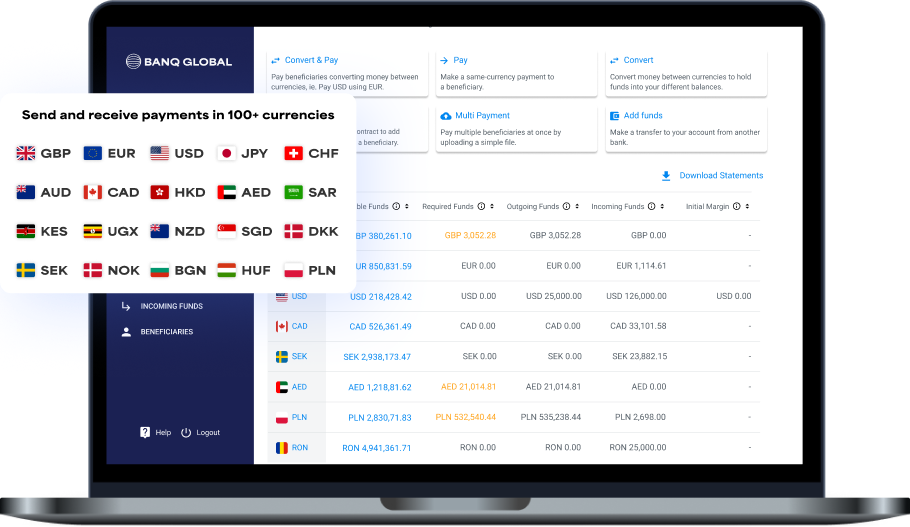
Specialist providers such as Banq Global serve BVI-registered holding companies, SPVs, family offices and international corporate groups with complex ownership structures. They offer multi-currency business accounts, SWIFT cross-border payments, international wire transfers and trade finance services through regulated financial partners, subject to availability. Their services include remote account opening, dedicated onboarding support and compliance assistance for multi-layered corporate structures. Accounts may be opened in eligible international jurisdictions, depending on the company's requirements and the provider's compliance approval.
Operational feature | Traditional Route | Digital Route | Specialist Route |
|---|---|---|---|
Onboarding timeline | Often several weeks; depends on the bank and complexity. | Faster standardised onboarding for eligible companies | Typically 5 working days after correct documents are received. |
BVI company acceptance | Selective, subject to bank policies | Limited. Revolut Business does not list BVI companies as eligible. | Explicitly supports eligible BVI-registered companies |
Multi-currency services | Vary by bank and account type. | Available to eligible customers, but not necessarily BVI companies | 130+ currencies, including USD, EUR and GBP |
Non-resident directors | May require additional verification; in-person visits are not universally mandatory. | Depends on corporate eligibility and applicant requirements. | Accepts non-resident directors explicitly with remote verification |
Complex ownership (SPVs/trusts) | Case-by-case assessment, often involving extensive documentation. | Standardised eligibility rules may restrict complex structures. | Bespoke onboarding for eligible SPVs, holding companies and family office structures. |
Human support | Relationship managers or client advisers are available at some banks | Support ranges from automated assistance to live customer service. | Dedicated onboarding team and assigned onboarding lead |
Documents Required to Open a Business Account for a BVI Company
Opening a corporate bank account for a BVI company requires a complete set of corporate, ownership, financial, and Know Your Customer (KYC) documents. Requirements vary by provider, business activities, and ownership structure.
Corporate Documents
- Certificate of Incorporation.
- Memorandum and Articles of Association.
- Register of Directors.
- Register of Members (Shareholders).
- Certificate of Incumbency (typically issued within the previous three to six months).
- Certificate of Good Standing (typically issued within the previous three to six months).
- Trust Deed or Declaration of Trust (where applicable).
Ownership and Management Identification (KYC)
- Certified copies of passports or government-issued photo identification for directors, shareholders, ultimate beneficial owners (UBOs), and authorised signatories.
- Proof of residential address, such as a utility bill or bank statement, typically dated within the previous three months.
- Professional CVs, biographies or references for key stakeholders, where requested
- Beneficial ownership declarations.
- Corporate ownership structure chart for holding companies, SPVs and multi-layered entities.
Business Activities and Financial Documents
- Business activity explanation or business plan.
- Expected transaction profile, including payment volumes, currencies, counterparties and jurisdictions.
- Source of funds declaration and supporting documents, such as contracts, invoices, bank statements, shareholder loan agreements or capital contribution records
- Source of wealth declaration and supporting financial or investment records, where required.
- Financial statements or management accounts, where available.
- BVI Annual Financial Return or supporting accounting records, where requested.
Additional Documentation for Complex Ownership Structures
For BVI holding companies, SPVs, and investment structures with multiple ownership layers, British Virgin Islands business banking providers may require additional corporate and identification documents for each intermediate entity to verify the full ownership and control structure. If your BVI company is owned by another offshore or onshore holding company, expect the bank to request a complete compliance chain for every parent company down to the individual level.
British Virgin Islands Business Banking Fees and Minimum Balance Requirements
BVI business banking costs include monthly account fees, transaction charges, foreign exchange (FX) margins and any minimum balance requirements, which vary by banking route and provider. The table below provides a concise comparison of fees and minimum balance requirements across the three banking routes.
Category | Traditional route (e.g., VP Bank (BVI)) | Digital Route (International EMIs) | Specialist route (Banq Global) |
|---|---|---|---|
Target Profile | Private banking, investment entities and wealth management | Eligible trading and service businesses | Holding companies, SPVs, family offices and complex corporate groups |
Minimum Balance | USD 250,000 initial deposit for international corporate clients | Often no minimum balance, subject to provider eligibility | Assessed on a case-by-case basis. |
Monthly Fees | USD 60–120 for international corporate accounts, depending on balance; additional charges may apply. | Free or subscription-based, depending on provider | From £200 per month for BVI companies |
FX Margins | Bank-specific exchange rates and spreads | Variable, depending on provider and currency | From 0.2% on published general pricing, subject to account terms |
Transaction Fees | International wire transfer and other service fees depend on the bank's tariff. | Domestic and international payment charges vary. | General pricing lists £10 for international payments. |
Choosing the Right Banking Provider for Your BVI Company
The most suitable business banking option depends on your BVI company's structure, activities and transaction requirements.
Holding Companies
BVI holding companies managing shares in subsidiaries or other investments may consider traditional banks or specialist international account providers. Where local Caribbean banking is not necessary, specialist providers can offer remote account opening, multi-currency accounts and international payments, subject to eligibility.
Special Purpose Vehicles (SPVs)
SPVs established for asset holding, joint ventures or specific transactions may need accounts that accommodate limited business activities and complex ownership arrangements. Traditional banks may require extensive documentation, while specialist providers can offer onboarding support for these structures and international payment services.
Family Offices
BVI family office structures holding real estate, private equity or international investments may use traditional private banks for investment management, wealth planning and established banking relationships. Specialist providers can complement these arrangements by supporting operational payments, multi-currency transactions and transfers between group entities.
Operating Groups
BVI companies conducting international trade or managing subsidiaries across multiple jurisdictions may require multi-currency accounts, international wire transfers and access to relevant payment networks. Traditional banks and specialist providers can support these needs, depending on the currencies, payment destinations and available banking arrangements.
Before applying, assess your company's ownership structure, business activities, expected transactions and supporting documents to identify providers whose eligibility requirements match your needs.
FAQs
Is the BVI a tax haven?
The BVI consistently ranks first on the Tax Justice Network’s Corporate Tax Haven Index, reflecting its zero corporate income, capital gains and dividend withholding taxes. However, the BVI government describes the territory as “tax-neutral” rather than a tax haven, citing its participation in international tax transparency frameworks, including the OECD’s CRS and the US FATCA.
Can a Non-Resident Director Access British Virgin Islands Business Banking?
Yes, BVI company law does not require directors or shareholders to live in the territory. However, incorporating a BVI company does not automatically guarantee a bank account. Local BVI banks may require a commercial connection to the territory, evidence of business activities and additional due diligence for non-resident applicants. Accounts can also be opened outside the BVI through international banks or specialist business account providers offering remote account opening and multi-currency accounts.
Why Do BVI Banks Refuse Business Accounts for BVI-Registered Companies?
BVI banks assess a company's commercial substance, business activities, source of funds and ownership transparency before approving an account. Applications may be declined due to links with sanctioned jurisdictions, undisclosed beneficial ownership, or lack of a credible commercial purpose, or involvement in restricted industries. Holding companies and SPVs may still qualify if they demonstrate legitimate investment activities, transparent ownership, and supporting financial records.
Which banks operate in the British Virgin Islands?
British Virgin Islands business banking is available through locally incorporated banks, including National Bank of the Virgin Islands, Republic Bank (BVI), VP Bank (BVI) and Bank of Asia (BVI), alongside foreign banks operating in the territory, such as CIBC Caribbean Bank (Cayman), Banco Popular de Puerto Rico and FirstBank Puerto Rico. Several banks maintain branches or offices in Road Town, the capital of the BVI, located on Tortola.
Is Banq Global a bank, and is it suitable for a BVI company?
Banq Global is a specialist international business account provider, not a bank. Through its regulated financial partners, it supports BVI-registered companies, including holding companies, SPVs and family office structures, with multi-currency accounts in over 20 jurisdictions and remote account opening, subject to eligibility and compliance checks.
How long does it take to open a business account for a BVI company?
Timelines depend on the route and the completeness of documentation. Opening a business account for a BVI company may take several weeks with local BVI banks and traditional offshore banks in jurisdictions such as Singapore, Hong Kong, and Switzerland. Specialist international account providers may offer faster onboarding. For example, Banq Global can open accounts in as little as five working days after receiving the correct documentation.
What ongoing compliance applies to British Virgin Islands business banking?
BVI companies must maintain accurate beneficial ownership records, meet applicable economic substance reporting requirements, and cooperate with periodic KYC reviews. Account providers may request updated corporate documents, contracts, and invoices to verify cross-border transactions and prevent account restrictions.