AML & KYC In Sweden: Essential Compliance Insights for Businesses
Sweden has a relatively low crime rate of 6.7 per 1,000 residents, yet its financial sector handles over SEK 30 trillion ($2.9 trillion) in assets, making it vulnerable to money laundering and terrorist financing risks. In 2024 alone, Swedish regulators imposed fines exceeding SEK 1.2 billion on banks and fintechs for AML compliance failures. Businesses interacting with Swedish financial institutions—especially foreign-owned companies or firms with non-resident directors—must follow strict AML and KYC requirements.
AML/CTF Compliance in Sweden
There are two main frameworks designed to combat money laundering and terrorist financing in Sweden: AML (Anti-Money Laundering) and CTF (Counter-Terrorist Financing). AML focuses on preventing criminals from using the financial system to move or hide illicit funds, while CTF works to stop money from being used to support terrorist activities. Together, they form the foundation of Sweden’s financial compliance system, with KYC at its core to verify customer identities, assess money laundering risk, and monitor suspicious transactions.
- These obligations are enforced through the Money Laundering and Terrorist Financing (Prevention) Act, SFS 2017:630, which applies to financial institutions and certain non-financial businesses.
- The Act is supported by Finansinspektionen Regulations FFFS 2017:11, which provide practical guidance on implementing AML, CTF, and KYC requirements.
- Sweden’s framework also aligns with EU 4th and 5th AML Directives and FATF Recommendations, reflecting its commitment as a FATF member to international AML and KYC standards.
In 2024, Swedish authorities fined Klarna SEK 460 million (approximately $46 million) for weaknesses in its AML and KYC procedures, highlighting the importance of robust customer due diligence and risk assessments.
Key AML and KYC Authorities in Sweden
Swedish Financial Supervisory Authority (Finansinspektionen / SFSA)
The SFSA (Swedish Financial Supervisory Authority) is the primary regulator overseeing banks, payment institutions, investment firms, and other financial entities. It enforces strict measures against money laundering, targeting both petty money laundering offenses and gross money laundering offenses to ensure that Sweden’s financial system remains secure and compliant with national and international standards.
Financial Intelligence Unit (FIU / Finanspolisen)
It is part of the Swedish Police Authority and analyses suspicious transaction reports from obliged entities. In addition, it collaborates with national and international law enforcement to prevent money laundering and terrorist financing.
Other Supporting Authorities
Other authorities play specific roles:
- The Riksbank, Sweden’s central bank, ensures internal AML policies align with national legislation.
- The Swedish Gambling Authority (Spelinspektionen) oversees AML compliance for gambling operators.
Together, these bodies create a comprehensive supervisory and enforcement framework that keeps Sweden’s financial system secure and aligned with international standards.
Who Must Comply with AML and KYC Rules in Sweden?
Sweden’s AML and KYC regulations apply to a wide range of obliged entities (entities required by law to follow AML and KYC rules), including:
- Banks and financial institutions – such as credit institutions, payment providers, investment firms, fund managers, and insurers.
- Certain non-financial businesses – including real estate agents, auditors, tax advisers, trust and company service providers, and gambling operators.
What does this mean for foreign-owned companies and non-resident directors?
Foreign-owned companies are not automatically “obliged entities” under Swedish AML law if they are conducting normal business activities. However, they still must complete KYC checks required by their bank or payment provider.
In practice, factors such as non-resident directors, complex ownership structures, or connections to higher-risk jurisdictions can lead banks to request additional information and documentation (CDD & EDD) during account opening and ongoing monitoring. This does not make banking in Sweden inaccessible—it simply requires the right approach.
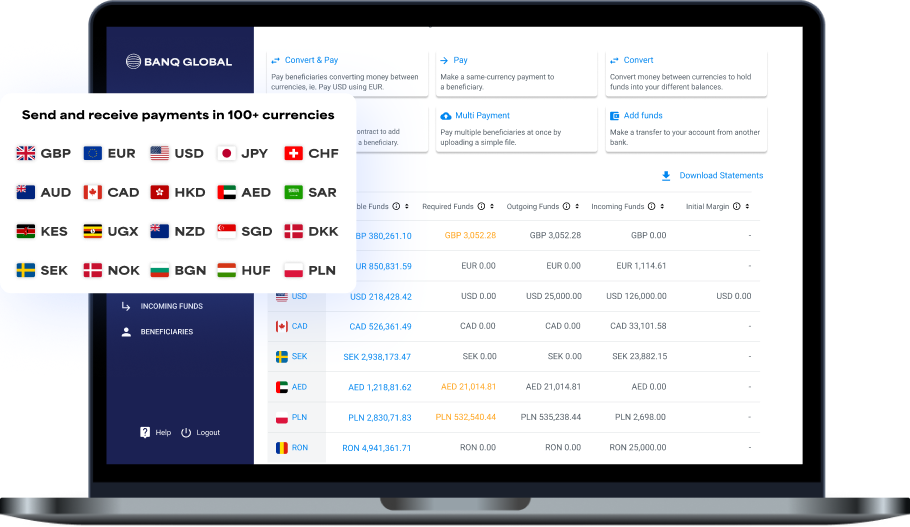
Specialist providers like Banq Global are designed for these scenarios, supporting foreign-owned companies with thorough KYC checks, customer risk profiling, and complex ownership verification in line with Sweden’s AML regulations.
Sweden Applies a Risk-Based Approach to AML and KYC
This approach ensures that companies focus more resources and attention on higher-risk customers and activities.
- Risk is assessed based on factors like customer type, industry, products/services, geography, and ownership structure.
- Customers are classified as low, medium, or high risk, and high-risk customers must undergo enhanced due diligence (EDD).
- The goal is to prevent money laundering and terrorist financing effectively while keeping businesses compliant with the AML Act and KYC rules.
This risk-based approach is supported by Sweden’s national risk assessments, which highlight sectors like gambling and certain cross-border financial services as higher-risk, leading to stricter expectations and oversight.
Core AML & KYC Compliance and Customer Due Diligence (CDD) Requirements
All obliged entities in Sweden must carry out customer due diligence (CDD) as part of AML and KYC compliance. This means they need to know their customers, verify identities, and understand the risk profile of each business relationship.
Key aspects include:
- Basic due diligence – Identify and verify customers when starting a business relationship or processing large transactions.
- Beneficial ownership – Identify ultimate beneficial owners (UBOs) and anyone with significant control, including complex ownership structures.
- Understanding the relationship – Know the purpose of the account, expected transactions, volumes, and geographies.
- Non-resident verification – For customers outside Sweden, firms may require certified passports, proof of address, and legalized corporate documents.
Implementing CDD helps companies monitor risks effectively, comply with the AML Act and KYC rules, and prevent money laundering or terrorist financing.
Enhanced Due Diligence (EDD) and High-Risk Situations
Some customers and situations carry higher money laundering or terrorist financing risks. In these cases, obliged entities must apply Enhanced Due Diligence (EDD).
When EDD is required:
- High-risk customers, such as politically exposed persons (PEPs).
- Customers from high-risk jurisdictions.
- Complex or opaque corporate structures, including multi-layered ownership.
EDD measures may include:
- Collecting additional documents like contracts, audited accounts, or ownership declarations.
- Asking detailed questions about the source of funds and wealth.
- Requiring senior management approval before onboarding.
- Tighter ongoing monitoring and more frequent reviews of transactions.
Ensuring ongoing AML & KYC compliance
AML and KYC compliance in Sweden is not just a one-time process; it needs regular checks and strong internal processes.
Ongoing Monitoring and Periodic Review
Businesses must monitor transactions, update risk profiles, and review relationships when changes occur, including ownership updates or unusual transactions over SEK 500,000 ($48,000). Continuous monitoring helps detect suspicious activity early and maintain compliance.
Internal Controls and Training
Firms must also maintain written AML policies, appoint a compliance officer or MLRO, and provide regular staff training to ensure effective KYC and reporting procedures.
Record-Keeping
CDD records, risk assessments, and transaction data must be retained for at least five years after the relationship ends. Proper record-keeping supports audits, FIU investigations, and regulatory compliance.
Digital and Cross-Border Account Providers for AML & KYC Compliance in Sweden
Proper implementation of CDD, EDD, and ongoing monitoring can be complex, especially for foreign-owned companies or businesses with multi-layered ownership. Specialist cross-border account providers simplify AML & KYC compliance in Sweden by offering clear onboarding processes, digital document collection, e-signatures, and, where available, digital identity verification—reducing onboarding time by up to 50% compared with traditional methods. Their systems feature built-in AML workflows, including risk-based scoring, PEP and sanctions checks, and adverse media monitoring, enabling real-time oversight of hundreds of transactions.
Providers like Banq Global specialize in complex ownership structures, guiding clients through verification for 2–5 layers of ownership while ensuring full compliance with Swedish AML regulations and EU directives. This approach ensures account onboarding is safe, efficient, and fully compliant.