Opening a business account in Luxembourg as a non-resident is entirely possible, but the reality is that the process is far more selective and documentation-heavy than many founders expect.
Around 60% of non-resident applications undergo enhanced due diligence due to complex ownership or international payment flows, and over 40% experience delays when corporate documents or source-of-funds evidence are incomplete.
Choosing the wrong approach can easily cost weeks of lost time and lead to repeated document requests, so careful planning from the start is essential for smooth EU business banking and seamless international transactions.
What “Non-Resident” Means in Luxembourg Business Banking?
In Luxembourg business banking, non-resident does not simply mean that a company is incorporated abroad. Instead, the term is applied at the level of the people behind the structure. An application is typically treated as non-resident where one or more of the following are based outside Luxembourg:
- Director or authorised signatory
- Shareholder or controlling parent company
- Ultimate beneficial owner (UBO)
This distinction matters because Institutions take a stricter view of cross-border risk and require detailed evidence of control, business activity, and the source of funds. Accordingly, non-resident founders should anticipate extra questions, supporting documentation, and extended timelines compared with resident-led companies.
How Luxembourg Institutions Assess Non-Resident Applications?
Given the additional scrutiny applied to non-resident founders, Luxembourg banks and account providers assess applications through a process known as risk-based onboarding. This means the institution evaluates whether your business fits its internal risk appetite based on who you are, what you do, and where the money will move.
The process is guided by regulatory expectations set by the Commission de Surveillance du Secteur Financier (CSSF) and EU anti-money-laundering (AML) frameworks. Together, these frameworks and institutions carefully evaluate companies across five key assessment areas, which are as follows:
Ownership Clarity
Institutions require a complete and verifiable picture of the main business owner, including UBO identification, ownership charts, corporate shareholders, and control rights.
Business Activity
Reviewers examine what you sell, to whom, and where operations take place. They consider sector risk, regulatory status, client types, and the justification for connecting the structure to Luxembourg.
Transaction Flows
Expected volumes, payment corridors, currencies, and counterparties are reviewed early. Institutions assess international payments patterns, foreign currency exposure, and whether flows align with the stated business model.
Source of Funds
Initial funding and ongoing funds must be traceable. Evidence may include bank statements, investment records, sale agreements, or documentation of retained earnings.
Economic Rationale
Applicants must demonstrate why Luxembourg or EU banking is genuinely required — for instance, to serve EU partners, investment structures, holding activities, or cross-border operations.
What You Need Before You Apply (Non-Resident Prep Checklist)
Based on the way Luxembourg institutions assess non-resident applications, here is a quick checklist of documents and information you should prepare before applying.
- Business description – what you do, who you serve, and where your clients or partners are located
- Products/services, pricing model, and expected turnover
- Transaction flow summary – expected inbound/outbound transactions, currencies, countries, and volume
- Client and supplier profile – types, locations, and example names if applicable
- Ownership chart – including UBOs and corporate shareholders
- Source of funds explanation with supporting evidence, such as bank statements or investment records
- Luxembourg/EU rationale – why a Luxembourg business account or EU business account is required
Preparing these corporate documents and supporting materials in advance ensures a smoother onboarding process,
Step By Step Non-Resident Business Account Setup in Luxembourg
For non-resident founders and cross-border groups, opening a business account in Luxembourg is closely linked to the company formation process, but it is not the same procedure. In most cases, it follows a two-stage reality:
- Company formation and setup
- Operational banking activation
Most banks, particularly traditional institutions, require more formal sequencing, especially where share capital deposits or a blocking certificate are needed before full account access is granted.
However, some routes, especially digital-first or specialist onboarding, support getting operational account functionality earlier, enabling smoother account setup, faster digital onboarding, and coordination of initial funding. They can also provide access to basic overdraft facilities for immediate liquidity.
So, it’s a good idea to plan banking alongside incorporation to streamline setup, avoid delays, and ensure your company is ready for international operations and payments.
Step 1: Choose the Right Bank
Non-resident founders in Luxembourg have three main options when opening a business account. Each route has advantages, limitations, and suitability depending on the company structure, ownership complexity, and international operations.
Traditional Banks
Traditional banks like banque internationale à luxembourg, are best suited for established companies with clear ownership and straightforward, low-risk business models. They also work well when there is a demonstrable Luxembourg/EU economic link, such as local clients, suppliers, offices, staff, or resident signatories. Non-resident founders should expect more selective onboarding, longer timelines (commonly weeks rather than days), possible in-person meetings, and higher ongoing requirements, such as minimum balances, higher fees, and monitoring of transaction history.
When this route makes sense:
- Your company has direct access to multiple banks
- Ownership structure is simple and low-risk
- Clear corporate documents and proof of business activity exist
- You need a full-featured EU business account with long-term banking relationships
Digital Banks
Digital banks like Revolut are a digital-first option, often enabling faster account setup for companies with predictable international transactions, lower complexity ownership, and primarily online operations needing online banking, payments, and cards. While this route is faster, it may not suit complex ownership structures, higher-risk sectors, or situations where local substance is expected by counterparties, clients, suppliers, or tax authorities.
When this route makes sense:
- Company structure is simple and transparent
- Payment flows are mostly digital and predictable
- Ownership is low complexity with few non-resident directors
- Main requirements are fast online banking access and operational flexibility
Specialist Business Account Providers
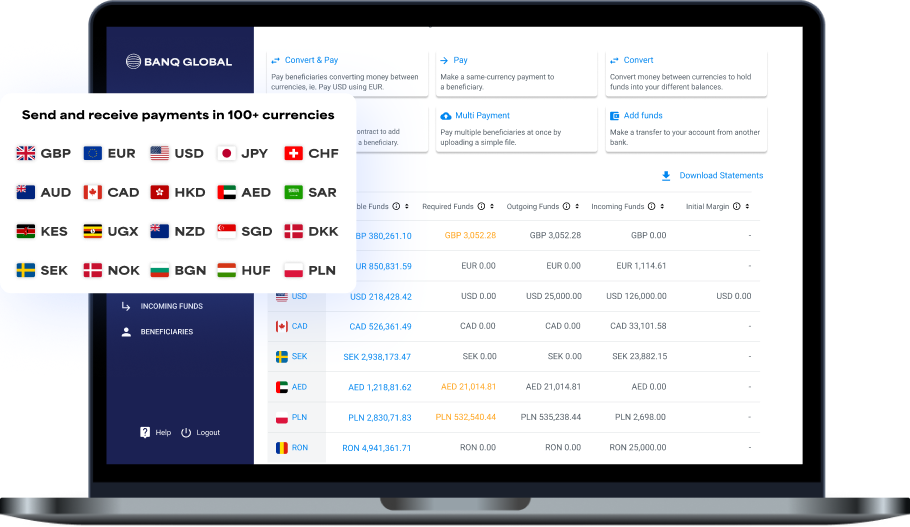
Specialist providers, like Banq Global, assist companies in obtaining local Luxembourg business accounts through partnerships with regulated banks and electronic money institutions. This route is ideal for companies with non-resident directors, complex ownership or cross-border operations, offering guided support for documentation, initial funding, and account setup. Access to a local Luxembourg IBAN can significantly reduce friction in international payments, SEPA transfers, and cross-border operations, while a guided onboarding process minimizes wasted applications.
When this route makes sense:
- Ownership structure is complex or includes non-resident directors
- You require direct access to Luxembourg account details
- The company handles significant cross-border transactions
- You want a guided onboarding process to ensure compliance and reduce delays
Step 2: Company Types, Share Capital, and the Blocking Certificate
Once a bank or account provider is selected, non-resident founders can begin preparing for company incorporation and initial funding, which may occur alongside account setup depending on the route chosen.
For common Luxembourg structures, the minimum share capital requirements are:
Sàrl: €12,000
S.A.: €30,000
Initial funding refers to the capital that must be deposited for these structures. Typically, this capital is placed in a restricted or temporary account, and the bank issues a blocking certificate confirming the deposit.
Step 3: Company Registration with the RCS
After receiving the blocking certificate (attestation de blocage), the notary finalizes the company’s articles of association and registers the company with the Registre de Commerce et des Sociétés (RCS). This formal registration confirms the company’s legal existence in Luxembourg and allows the business account to move closer to full operational status.
Step 4: Activating Your Full Business Account
Once registration is complete, the notary issues a de-blocking certificate, enabling the bank to release the frozen share capital. The blocked account is then converted into a fully operational business bank account, ready for account setup, international transactions, online banking, and multi-currency operations.
What extra documents do non-resident directors and beneficial owners need to provide?
- Identity cards of founders, directors, and authorised signatories
- Proof of registered office (e.g., a recent electricity, water, or gas bill)
- Founders’ notarised declarations confirming compliance with Luxembourg law
- Company name approval (if applicable)
- Power of attorney, if a representative acts on behalf of the founders
Step 5: Setting Up a Local LU IBAN and Payment Infrastructure
With the account fully active, non-resident founders can establish a local Luxembourg IBAN, set up direct access to payment rails, and enable swift transfers for international payments. This ensures smooth cross-border operations, seamless fund management, and integration with EU and global business partners.
How long does it take to open a business account in Luxembourg as a non-resident?
For non-resident founders, the process typically takes 3–8 weeks, depending on the completeness of corporate documents, initial funding, and regulatory checks. Planning the account setup alongside company incorporation can help streamline the timeline.
How much does it cost to open an online business account in Luxembourg?
Costs vary by institution and structure. Founders should expect account setup fees, share capital deposit handling, and monthly maintenance charges, along with any optional services such as multi-currency accounts or overdraft facilities.
Causes of Delays and Rejection While Opening a Business Bank Account in Luxembourg
Common reasons for delays or rejection include incomplete corporate documents, insufficient evidence of source of funds, unclear business activity, complex ownership structures, and inadequate justification for Luxembourg/EU banking.
Engaging a specialist provider can help non-resident founders navigate these challenges, ensure all documentation is compliance-ready, and reduce onboarding delays.